Share this :


Post on twitter:


Vinod Khosla @ AlwaysOn: Listening to a cleantech hero
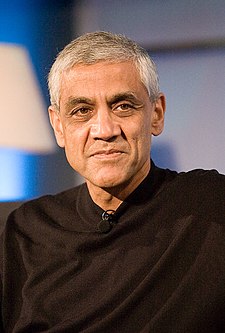
 
Vinod Khosla

Vinod Khosla

MaRS went to the AlwaysOn Summit at Stanford. From a Cleantech perspective, there was one clear star. The fireside chat with Vinod Khosla of Khosla Ventures.

Vinod Khosla gets it. Not just business. As the founder of Sun Microsystems, former partner at Kleiner Perkins, founder of Khosla Ventures and one of the richest Americans, that’s pretty clear. But Khosla also gets climate change. Its severity and scale, the policy tools we need to tackle it, even the moral arguments surrounding the upcoming talks in Copenhagen that will attempt to forge a post-Kyoto deal.

Clearly, Khosla is in Green with some green. And he loves high-tech. Khosla Ventures has big bucks aimed at cleantech companies — and not just any companies. Only those that have high technology risk; companies that can potentially change the game. Khosla knows that if we are to avert the climate crisis, something drastically different needs to emerge. Smart storage that would let solar energy fly. Biofuels grown at scale on currently infertile land. He’s even game for cold fusion if he could find a good play there. If you’ve got a cleantech play that is game-changing, early stage and high-risk, you might be right for Khosla.

But Khosla is more than just high-risk, green venture.

But more importantly (and more impressive to me): Khosla pulls no punches on three issues:

  1. He calls green wash out for what it is.
  2. He gets the scale of the problem.
  3. He acknowledges the moral arguments put forth by the developing countries, in advance of the Copenhagen negotiations. He puts these ideas forward, clearly and unequivocally, unlike any other star American executive.

What’s green wash for Khosla? A hybrid car. Why? Because, from a cost-of-carbon-reduction perspective, it’s much more effective to put that money towards painting roofs white, reducing energy used for cooling. That doesn’t mean you shouldn’t drive a hybrid (he does), his point is more subtle. If the goal is to reduce carbon, that money is better spent on painting roofs white. But the people with the money to spend on hybrid cars, rich Californians like himself (his words!), aren’t going to spend that money painting other people’s roofs white. He’s pointed out a clear failure of the free market. Money will not find the least-cost approach to reducing carbon.

He also acknowledges the scale of the problem. If we all followed every single recommendation in the Lazy Environmentalist, for example, what would it get us? Squat. Diddly-do. Nothing. The scope of our carbon problem is way past those sorts of measures and he’s candid enough to say so.

And moral arguments? “The moral argument that every person on the planet is allowed to emit the same amount of carbon is a very hard moral argument to refute,” he says (paraphrased). That’s the first time I’ve ever heard an American captain of industry acknowledge the validity of the developing worlds starting position on climate change.

Khosla is impressive. Sure he’s smart and successful and a hero to a cleantech player like me. But it’s his willingness to step outside the safe, secure optimism of American big business that sets him apart. We would do well to listen.

Related Blogs

Tags: , , , ,

  • http://www.vimeo.com/5183140 Tim

    With the auto sector almost gone, and the average American with a debt of $184,000+ USD (public debt + social security + entitlement programs + personal debt), the North American auto industry in the next 3 years are unpredictable.

    The issue is transporting goods from point A to B. That is not necessarily an energy problem. The energy sector has an energy problem; not the auto sector.

    Even if 100% of the cars on the road are electric, that just means 100% of the energy load is transferred to the grid which runs on coal, nuclear, and hydro. That is why reducing the amount of work a car needs to do, such as reducing the weight, could reduce the overall net energy load.

    There are other engineering/design questions to ask before jumping on this energy bandwagon. For instance, are there metals that become rigid when a electric current is applied? If so, could we just apply that current when the force of impact exceed a certain threshold? And if so, what is its status in term of commercialisation?

    Design could solve the problem too. The Romans designed the arch bridge to be lightweight, yet offer the required structural support with minimal material. They did it by understanding the distribution of force and placement of bricks. Its bridges still stand 2000 years later. “Old” tech could be very reliable.

    There are also simple fundamental things one could do. For instance, painting house roof white could reduce room temperature by 20-25C in the summer. A study in Texas showed 11% drop in energy consumption, 14% drop in peak hour demand, and save $7,200/year ($0.07/sq-ft). Does this create jobs? Probably not enough. Is it effective? Certainly on a cost-benefit basis. Just “KISS” it.

    Another point against electric cars is the price; it’s a disconnect with market forces until there is a price on carbon. Tata Motor in India is rolling out its $2,500 USD car this year; forget electric cars as the game changers. You may have heard the one-laptop-per-child movement. In the next 10 years, we may see an one-car-per-teen movement. You read it here first.

    Is this the only future of cars? Here’s another future from the world of redesign:

    http://www.youtube.com/watch?v=6v4YNkurhLk

  • Keri

    I heard Vinod speak as well and found him very impressive and passionate about changing the US’s (and the world’s) dependence on foreign oil. There are lots of great nuggets of wisdom, papers and presentations on his website. See:

    http://www.khoslaventures.com/resources.html

    The lasting comments from his talk that I was left with: that plugging in an electric car is like plugging in a lump of coal (where most of the electricity comes from), and that the most likely breakthroughs in green energy will come from carbon sequestration from coal and electricity energy storage (i.e. we need a breakthrough in storage/grid storage for wind and solar for renewable energy to succeed).

    He also talked about ‘Black Swan’, the idea that one breakthrough will change the rules as to what green energy even is. Let’s hope that breakthrough comes sooner rather than later…

Tom Rand @ MaRS

Tom Rand @ MaRS

Tom leads MaRS’ role in the Canadian cleantech ecosystem and works with our Advisory Services group to support our growing portfolio of cleantech ventures.


Get More From MaRS   MaRS NEWSLETTERS
Facebook Twitter Vimeo Flickr

MaRS Charitable Registration Number
876682717 RR0001

Please enter your email address to subscribe to our newsletter