
SWOT analysis: A framework to develop strategic marketing and business goals
Researching a market? Our free online course Introduction to Market Sizing offers a practical 30-minute primer on market research and calculating market size.
A SWOT analysis is a very commonly used strategic framework in business. It is simple to understand and provides a great starting point for considering strategic choices. A SWOT analysis is also versatile, as it can be applied to a product (for marketing), business unit or entire company—in relation to strategic business goals. A SWOT analysis has two key purposes:
- To help a company to determine its strategic goals
- To provide the foundation for developing a strategy
What is SWOT?
The acronym SWOT stands for Strengths, Weaknesses, Opportunities and Threats:
- Strengths are capabilities that enable your company to perform well and must be leveraged.
- Weaknesses are characteristics that prevent your company from performing well and must be addressed.
- Opportunities are trends, forces, events and ideas that your company can capitalize on to succeed.
- Threats are possible events or forces beyond your control that your company must either plan for or decide how to deal with.
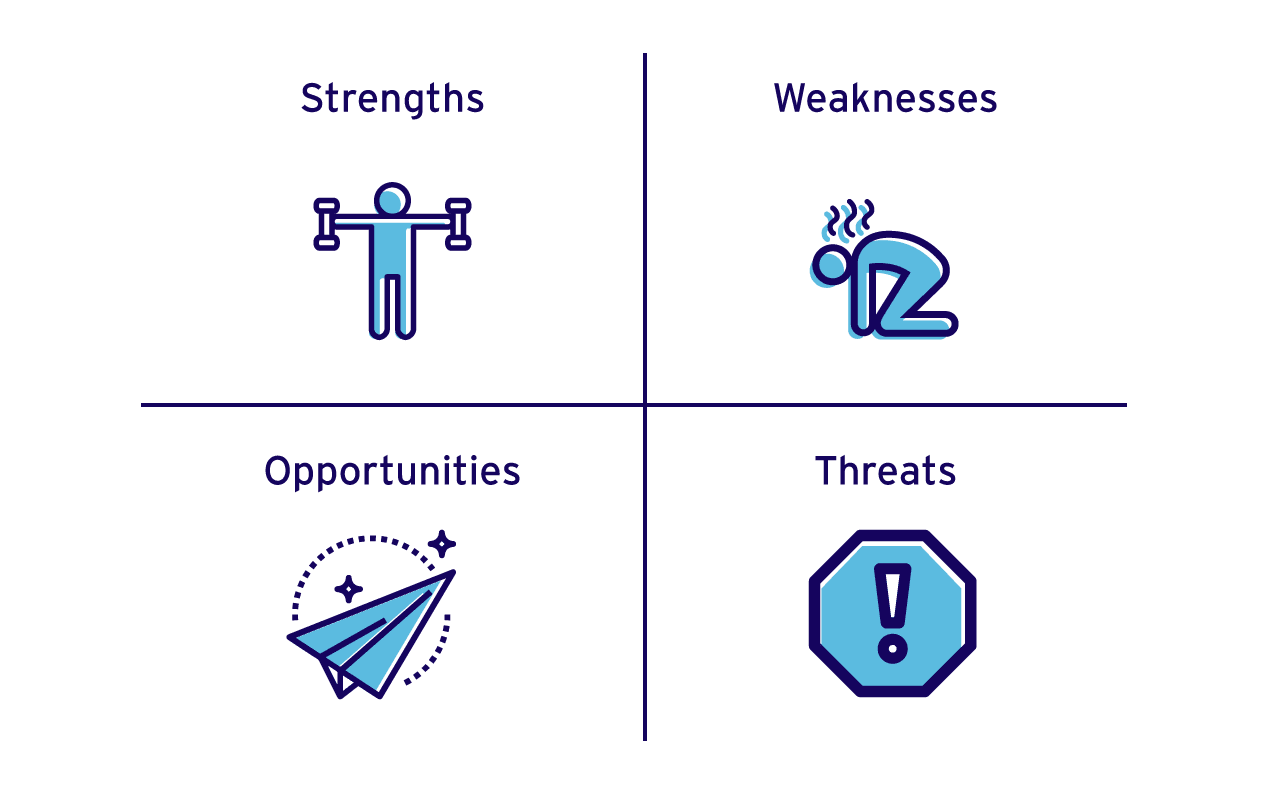
A SWOT analysis has both an external and internal component. The external analysis usually precedes the internal analysis, as opportunities and threats are often appraised first.
Externalities in SWOT analysis
The external analysis examines opportunities and threats—which focus on the company’s environment. They include the following factors:
- Customers
- Pricing constraints
- Competitors
- Distribution issues
- Technology
- Macroeconomy
- Regulation
- Workstyle trends
- Major uncertainties
- Suppliers
- Potential partners
Types of external analysis
There are two main types of external analysis:
- PEST analysis (PEST being an acronym for Political, Environmental, Social/Cultural and Technology): This type summarizes high-level trends as they relate to your target customers, markets and technology; it captures changes on a macro level (that is, the big picture).
- Industry analysis (also known as the Five Forces Framework): this type focuses on the immediate environment surrounding the company, competitors, customers, substitutes, suppliers and new entrants; it complements the PEST analysis.
Internal analysis
The internal analysis examines strengths and weaknesses—which focus on the company’s resources. They include the following factors:
- Current performance
- Brand power
- Cost structure
- Product portfolio
- R&D pipeline
- Technical mastery
- Employee skills
- Company culture
Examining strengths and weaknesses
During a SWOT analysis, consider strengths and weaknesses in three stages:
1. Consider strengths and weaknesses in relation to opportunities and threats created by big picture trends revealed in the external analysis:
- What can you leverage to capture new opportunities?
- Where would you need to add capability in order to exploit the opportunities?
- How can you best overcome potential threats?
2. Consider strengths and weaknesses in relation to the competition:
- What do you do better than the competition?
- What does the competition do better than you?
3. Identify the opportunities you are better positioned to capture than the competition.
References
Harvard Business School. (2005). Harvard Business Essentials: Strategy: Create and Implement the Best Strategy for Your Business. New York: Harvard Business Press.