Share this :


Post on twitter:


Hard lessons in social media: three corporate missteps


If the Internet was a high school, social media would be where all the cool kids hang out. Twitter and Facebook are like the bleachers or that spot under the stairwell - the place every company wants to be.

But like chest-high corduroy trousers, social media mistakes can put a company in a situation where all the cool kids are pointing and laughing. In these three examples of corporate social media blunders, popularity (or even acceptance) ends up even farther off.

Molson Canadian’s social media binge

All too often, organizations jump into social media simply because everyone else is doing it—they rush in without direction, knowledge of their key audiences or understanding of the platform’s reach.

During the unprecedented growth of Facebook in 2007, organizations saturated the social network with promotional contests to increase followers and funnel traffic to their websites.  Caught up in this hysteria, Molson Canadian ran a contest to find the best party school in Canada: university students were encouraged to upload outlandish drinking and partying pictures for a chance to win a trip to Cancun, Mexico.

Without a concrete understanding of key Facebook audiences, Molson failed to take into consideration first- and second-year university students who were under the legal drinking age.  Criticism erupted as Molson was accused of promoting underage binge drinking and obscene behaviour. 

Universities also attacked Molson for portraying them as places to drink and party. The campaign was quickly pulled and the brand suffered an embarrassing blowback. In trying to be “cool” and fit in, Molson made a critical mistake that swiftly got it kicked out of the social media circle that year.

Lesson #1: news travels fast, social media mistakes travel even faster
In order to stay in the good books of groups on the periphery of social media, organizations have to remember that their social media efforts will ripple outside the the groups they target. And they should refrain from political taboos that can offend and ignite controversy.

Kenneth Cole broadcasts its insensitivity

Last February, Egypt became the centre of the world as masses demonstrated and rioted for regime change. In an attempt to capitalize on this political spotlight, Kenneth Cole tweeted, “millions are in uproar in #Cairo. Rumor is they heard our new spring collection is now available online at http://bit.ly/KCairo -KC.” The fashion retailer was immediately bombarded with criticism for making light of a very serious situation and for using the “#Egypt” hashtag to siphon Internet traffic.  Many even called for the boycott of the company and its products. 
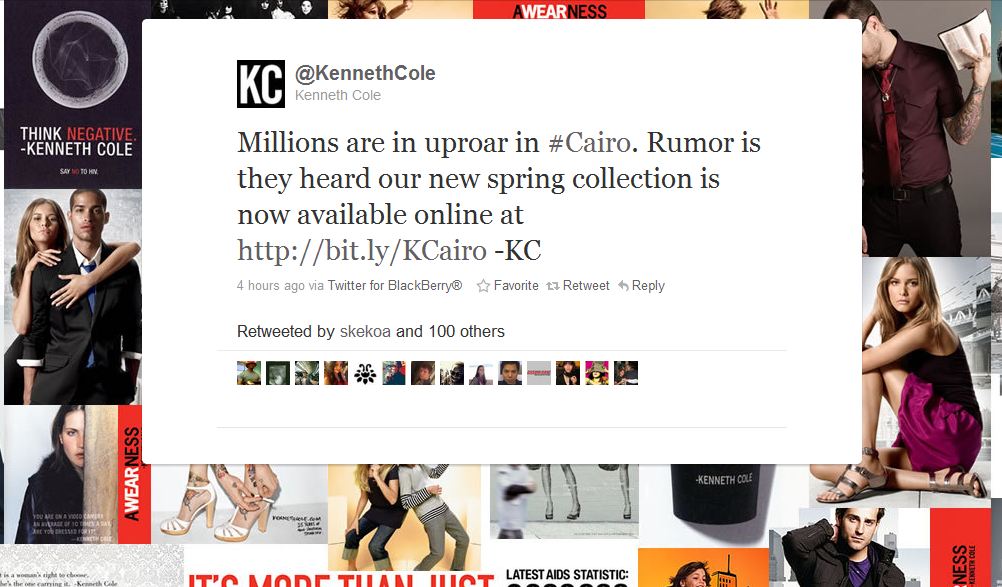
Lesson #2: Don’t make light of a serious situation for cheap promotion (or, don’t tweet something you wouldn’t say around your mother)
While it makes sense to capitalize on the popularity of trending topics and world events, it’s incredibly important to think carefully about what and when to share.

A FedEx partner delivers an Internet insult

An employee from Ketchum Inc. could’ve used some training on how to properly conduct himself online. The PR agency account executive had just landed in Memphis, Tennessee, headquarters and hometown of FedEx, a major Ketchum client.  Perhaps overwhelmed by past experiences, the executive tweeted, “True confession but I’m in one of those towns where I scratch my head and say ‘I would die if I had to live here!’”

Unfortunately for the exec, a FedEx employee read this tweet and word spread that the person who supposedly represented FedEx was attacking a major identity of the company.  Though the executive tweeted from his personal Twitter account, his name still represented Ketchum, and the relationship between the agency and its multi-million dollar FedEx account was strained (to say the least!).

Lesson #3: every employee, partner and service provider represents your brand
As the popularity of social media grows, companies and organizations need to remember that their employees are likely Tweeting and Facebooking away—and that it’s very easy to connect the online dots between an individual and an organization. Staff should be reminded that they’re representatives of a company, even on their private social media accounts.

Social media networks are complex, with official and unofficial rules of conduct and best practices. Many organizations have adapted well to the new online world, devising innovative strategies to engage social media users and provide interactive experiences. On the other hand, many organizations fail to use social media effectively, rendering their Twitter, Facebook and other accounts a waste of bandwidth.

I can’t help but be reminded of high school, divided into the cool kids who understood popular culture and the socially awkward kids who didn’t (and so retreated into the corners of the building). If your business is contemplating enrolling in the online high school of social media, remember to take it seriously, have direction and train your employees appropriately. After all, these might just be the best years of your life.

Related Blogs

Tags: , , ,

  • Ray Chen

    “Molson failed to take into consideration first- and second-year university students who were under the legal drinking age.” 
     
    Pretty sure most second-year university students are above the legal drinking age :P

  • Ericka Anne

    There’s one that exists MUCH greater than Google+ and Facebook. Who? OnlyMeWorld. Don’t let the name throw you off; it has the potential to be bigger than the above-mentioned. Why? With all the problems that exist from such sites affecting the users PRIVACY, it is only right to have a social network that won’t sell your information, recognize your FACE, make money off your site, and ask for every other piece of information you have to your name. I’m sorry but I don’t feel the need to verify my Facebook account with my PHONE NUMBER, do you? And the new Google+ share circle–NO. Even if you post something intended for just YOU and a FRIEND, you click that little circle and off it goes shared to the worldwide web. Even if it’s set to private! hough you probably know the same goes for facebook.

    OnlyMeWorld.com –I love this site. I DID NOT need to use any of my real information to create the account, not even a real email. And an extra bonus is the ability to place Google Adsense Ads on your personal site and actually YOU–yes YOU, the user, gets paid for it! GENIOUS!!

    That and the geek within me loves the Games, Blogs, Video Chat etc…all in one place. It’s a more PROFESSIONAL doman for such businesses that don’t require the user to input WHERE they work OR go to School..you can choose several different networks depending on your industry.

  • Kanta

    Very interesting lessons for companies. Well written.

  • GAGA234

    I enjoyed the article except for the last paragraph which left me with an uncomfortable feeling.  Aren’t the ‘cool’ kids typically depicted as shallow and superficial while the awkward ones are really the intelligent students, ridiculed for their smarts, but are the ones that actually go on to succeed as adults?

  • Brenda

    Good example of the complexities social media presents for corporate communications.

    As for the point about the legal drinking age, apparently there are enough underage students that the universities are becoming hyper-careful. Some won’t allow alcohol service at functions that younger student might possibly attend.  

    In the evolution of social mores to an ever more protective environment, I think we can expect more of this. 

    It may also just be another demonstration of how easy it is to for a corporate entity to provoke criticism by attempting to pushing the line a bit.  

  • Robert Medeiros

    This bit made me cringe a little:
      Staff should be reminded that they’re representatives of a company, even on their private social media accounts.

    Talk about infringing on the personal lives of employees with an odious chill of censorship! Any employee presented with a dictum like this should (politely) refuse to adhere to it, and let the chips fall where they may. Now is the time to push back against absurd expectations like this, before they become normative and we have to spend every moment of every day reflecting on how our every action or expressed opinion will reflect on our employers.

  • Robert Medeiros

    This bit made me cringe a little:
      Staff should be reminded that they’re representatives of a company, even on their private social media accounts.

    Talk about infringing on the personal lives of employees with an odious chill of censorship! Any employee presented with a dictum like this should (politely) refuse to adhere to it, and let the chips fall where they may. Now is the time to push back against absurd expectations like this, before they become normative and we have to spend every moment of every day reflecting on how our every action or expressed opinion will reflect on our employers.

  • Anonymous

    Robert, I agree with you in principle. The expectation that people ‘fall in line’ with their employer is odious, and dangerous. 

    However common sense and common courtesy need to be practiced as well. 

    For example, say I just met my future mother-in-law for the first time, and felt that her home town was Dullesville. It would be idiocy for me to put up posters (complete with my photograph and address) around her neighborhood that said 

    “I’d die if I had to live here! PS. I’m marrying so-and-so’s daughter. Love, Trevor.” 

    This would be hurtful and stupid and I couldn’t expect my in-law to be happy about it or neglect to mention it to my fiance.

    We should have the right to say what we please, employer be damned, but social media is not a license to be crude or demeaning, and there must be repercussions for public displays of poor judgement and bad taste.

  • Anonymous

    Robert, I agree with you in principle. The expectation that people ‘fall in line’ with their employer is odious, and dangerous. 

    However common sense and common courtesy need to be practiced as well. 

    For example, say I just met my future mother-in-law for the first time, and felt that her home town was Dullesville. It would be idiocy for me to put up posters (complete with my photograph and address) around her neighborhood that said 

    “I’d die if I had to live here! PS. I’m marrying so-and-so’s daughter. Love, Trevor.” 

    This would be hurtful and stupid and I couldn’t expect my in-law to be happy about it or neglect to mention it to my fiance.

    We should have the right to say what we please, employer be damned, but social media is not a license to be crude or demeaning, and there must be repercussions for public displays of poor judgement and bad taste.

  • Robert Medeiros

    Thanks for the thoughtful reply.
    I agree with you that there ought to be repercussions to comments made online. If I was concerned about possible “blowback” from the comments I make I wouldn’t be posting using a service like Disqus (or anything else connected to my personal identity). At the least I would be posting pseudonymously, possibly anonymously, depending on how inflammatory I had to be. It’s easy enough to do, and I think it’s preferable to neutering oneself.

    As it happens, I know for a fact that things I have posted on-line have had real-life repercussions for me, both good and bad. I’ve both gotten and been denied jobs, for instance, on the basis of opinions I’ve expressed. Since I generally don’t engage in trolling (at least not deliberately) and state my honestly held opinions, I am by-and-large all right with that.

    Companies should be able to deal with individual instances of employee behaviour that have *real* repercussions on the firm, but the onus should be on the company to show harm, and even where harm exists there should be a strong regard for the free speech rights of the employee. If I can feel the hot breath of the HR department on the back of my neck, even when posting on 4chan from the basement in my underwear (for example), then I have been convicted of pre-crime, and that’s more oppressive than we should permit any company to be.

    As for your point, I see what you’re saying but would draw a distinction between the expectations of courtesy due to individuals and prospective family members versus what a company (any company) has a right to expect from us.Part of the problem is with our social media tools; we need better ways to confine our online lives to distinctive “silos”. Not everything needs to be seen everywhere, all the time, by default. Sites like Google+ are starting to address this with features like their friend “circles”, but that’s just the cusp of a coming deluge of online identity management systems, I expect.

    Thanks for the conversation!

  • Robert Medeiros

    Thanks for the thoughtful reply.
    I agree with you that there ought to be repercussions to comments made online. If I was concerned about possible “blowback” from the comments I make I wouldn’t be posting using a service like Disqus (or anything else connected to my personal identity). At the least I would be posting pseudonymously, possibly anonymously, depending on how inflammatory I had to be. It’s easy enough to do, and I think it’s preferable to neutering oneself.

    As it happens, I know for a fact that things I have posted on-line have had real-life repercussions for me, both good and bad. I’ve both gotten and been denied jobs, for instance, on the basis of opinions I’ve expressed. Since I generally don’t engage in trolling (at least not deliberately) and state my honestly held opinions, I am by-and-large all right with that.

    Companies should be able to deal with individual instances of employee behaviour that have *real* repercussions on the firm, but the onus should be on the company to show harm, and even where harm exists there should be a strong regard for the free speech rights of the employee. If I can feel the hot breath of the HR department on the back of my neck, even when posting on 4chan from the basement in my underwear (for example), then I have been convicted of pre-crime, and that’s more oppressive than we should permit any company to be.

    As for your point, I see what you’re saying but would draw a distinction between the expectations of courtesy due to individuals and prospective family members versus what a company (any company) has a right to expect from us.Part of the problem is with our social media tools; we need better ways to confine our online lives to distinctive “silos”. Not everything needs to be seen everywhere, all the time, by default. Sites like Google+ are starting to address this with features like their friend “circles”, but that’s just the cusp of a coming deluge of online identity management systems, I expect.

    Thanks for the conversation!

  • Anonymous

    Hi, thanks for your comment! To clarify, my analogy was
    simply to show the relationship between companies that get social media, and
    those that don’t. It was more of an illustrative tool than a critical comment -
    it wasn’t to insinuate the actual merits of the students or the organizations. A
    social awkward student may very well be more intelligent, just as a company with
    poor social media practices may excel in other business aspects – but that is
    outside the scope of my blog.

  • Anonymous

    Sure, most second year students are above the legal drinking age, but
    some are indeed under – particularly those with late birthdays :P   Though the percentage may seem insignificant, the consequences are enough to merit careful consideration. 

  • Anonymous

    Hi Robert, thanks for your insightful comments. Like you, I wouldn’t want to be thinking of my HR department before every move I make online.  Reality is – there will be consequences for unacceptable online actions. This is where a clearly defined online policy (based primarily on common sense) may actually be more liberating then confining. At least now, we can go on our merry way knowing exactly what will get us fired!

  • Robert Medeiros

    My hope is that any group of employees subject to such a policy won’t meekly accept it, and will rise in collective defence of any colleagues that are unjustly persecuted. Since policies like this are ripe for abuse, I’d like it even better if folks would object in strenuous terms when these ideas are still in their formative stages, but hoping for that sort of social cohesion amongst employees, especially those that work gold collar jobs, seems a bit futile unfortunately. Tell your average programmer he should consider joining a union and then put on your asbestos suit; flames will be coming your way. :)

    Thanks for the thought-provoking article, Shenthuran!

  • Vineca Gray

    You raise important points.

    In the eyes of the CEO, social media is a rich marketing channel. In this context, you have captured the greatest imperative of all – corporations have a sterling opportunity to deliver their vision statement to a global audience, and they are failing – unparalleled messaging gravitas gone awry. 

    I take a more courageous position and challenge the disturbing reality that many and indeed most corporations function within a bubble that neatly excludes meaningful social responsibility as part of their vision – full stop.

    Factoring farming, exploitive labour practices including child labour, environmental degradation, including agricultural desertification and large scale ground water toxicity – these are all real outcomes as we wax eloquently about the rich opportunities in this world of ‘globalization and free-trade’.

    Your cautionary tale is not new, nor exclusive to the ‘social’ media culture.  For an unapologetic look at Public Relations real-time, I suggest you peruse the online and especially hardcopy pages of Adbusters.  http://www.adbusters.org

  • Choosedemocracy

    I think that when employees identify their employer in their private Facebook profiles or Twitter accounts, they invite the intrusion.  Certainly an employee who is not readily identifiable to the public or customers of the employer should not have their rights diminished.  In a world where everyone really can be famous for 15 minutes, fame has obligations that not everyone can comprehend or begin to fathom.  Sports and entertainment personaliies can’t say anything they want without the the threat of financial reprecusssions.  John Q Public is learning that lesson the hard way in the social media space. 

  • Robert Medeiros

    This is an interesting take on the issue. I like your equation of online presence with celebrity since there is so much overlap in the two conditions, as you point out.

    I don’t think I cotton to the idea that we should accept this equivalence and just learn to deal with the negative aspects of our new-found and never-ending celebrity. If we go that route, some will just learn how to game on-line reputation systems or project a false persona on the net (the sine qua non of marketing and PR firms), or do other shady things even more than they already do.

    It would be nice if we could all just take a deep breath and stop taking celebrity itself quite so seriously. So often, what we attack in a celebrity is the appearance of hypocrisy; their public persona is so glossy that when they’re revealed to be merely human we see them as hypocrites and at the same time indulge in a bit of schadenfreude. Instead, we should realize that the carefully manicured public image is just a facade. There are real people under the plastic masks, with all the faults that entails, and we need to stop paying so much attention to the “celebrity” distinction. That way, we maybe have a moral claim on others to extend us the same courtesy when we have an occasional lapse of judgement on the tubes. There are bounds that can be crossed, of course, but one should really need to work to do so.

    My $0.02. Thanks for the reply.

  • Emma Ng

    Your statement “first-and second-year university students” imply that all of the students were under the legal drinking age. No where did you mention students in second year with late birthdays. Just saying…

    Also, I don’t think full blame should be placed on Molson for their contest. What have American Pie 1-3 (and other numerous college movies) taught us? What has MTV taught us? Yes Molson encouraged to post outlandish pictures of their parties, but who’s to say that they weren’t even going to have these parties in the first place? We can’t blame Molson for the actions of UNIVERSITY students. Are we suppose to baby them throughout their whole life? 

    Staff should be reminded that they’re representatives of a company, even on their private social media accounts.—oo man what were you thinking??? Robert pretty much summed up what I was thinking. This is our life! So I guess in your way of thinking, we should confirm with the boss if I’m about to purchase a funny but offensive t-shirt? Work and one’s personal life should be separate. 
    I really was upset when I read this following statement, “I can’t help but be reminded of high school, divided into the cool kids who understood popular culture and the socially awkward kids who didn’t (and so retreated into the corners of the building).” Popular culture to who??? News flash, everyone has different interests!!! Maybe you should receive some training in better conveying certain analogies before you accidentally hurt other people./rant

  • Anonymous

    Hi Emma, thanks for your comments.


    With that said, yes of course students
    are going to drink and party. But is it really a smart idea for a company to
    connect themselves with such behavior? Yes Molson facilitates fun an enjoyment,
    but they also pride themselves on responsibility (society forces them to).
    Their social media campaign blurred the boundaries of fun and responsibility
    and therefore generated criticism – rightly so.


    As for company social media policy – if
    you want to purchase an offensive t-shirt, go right ahead that’s your personal life – but common sense
    dictates that is probably not a good idea to post pictures of yourself wearing
    this shirt on Facebook WHEN you know you have Facebook friends that are
    clients, bosses, teachers, etc. No one is stopping you from doing this, but
    rest assured that there would be consequences for such actions (personal life gets blurred online).  It’s more about common sense then anything
    else – but some people still tend to ignore basic principles of behavior. That
    is where a clearly defined social media policy can help.  


    Popular culture is defined as the
    ideas, perspectives, and attitudes deemed preferred by informal consensus of a
    particular society. It is heavily influenced by mass media.  Sure everyone has different interests, but
    popular culture is defined by the interest shared by the MAJORITY.  If you are a high school student today,
    strolling through the hallways with a Sony Walkman cassette player listening to
    80’s music, while everyone else is listening to Katty Perry on their Ipods,
    then you will be deemed just a tad weird – (its unfair, but that’s
    the society we live in). 

    The purpose of
    my blog was to facilitate thought and discussion. I did not intend to offend or
    hurt anyone, and I apologize if you perceived my analogy in such way.

  • Wing 0g

    I agree with the fact we should be able to post whatever and be who ever on facebook/twitter/other social media sites, but also agreeing with shenthuran you should do this with consideration on who is able to see this information and images, my suggestion, get that limited profile list organized and working :P

    High school was not the greatest of times for everyone but this analogy was comparing what companies would look like if they were given high school life personalities, this was not a direct reference stating what they will grow up to be or how the nerd will take revenge on the jock :P I mean I would love a world where you could be who you wanted to be and not be criticized for your thoughts and opinions but in reality that is never the case, even after high school through university and work, people are divided with social labels it just how human society works….sucks I know…it would be nice not being the socially awkward guy for once :P

  • Wing 0g

    I agree with the fact we should be able to post whatever and be who ever on facebook/twitter/other social media sites, but also agreeing with shenthuran you should do this with consideration on who is able to see this information and images, my suggestion, get that limited profile list organized and working :P

    High school was not the greatest of times for everyone but this analogy was comparing what companies would look like if they were given high school life personalities, this was not a direct reference stating what they will grow up to be or how the nerd will take revenge on the jock :P I mean I would love a world where you could be who you wanted to be and not be criticized for your thoughts and opinions but in reality that is never the case, even after high school through university and work, people are divided with social labels it just how human society works….sucks I know…it would be nice not being the socially awkward guy for once :P

  • Sharmila Pathmanathan

    Congratulations Shenthuran -  Great article and even more insightful thoughts from you in response to the comments below. Social media is such an exciting and innovative tool but it all depends on how we use it! Looking forward to hearing more from you on this topic!
    Sharmila Pathmanathan

Shenthuran Vijayananthan @ MaRS

Shenthuran Vijayananthan @ MaRS

Shenthuran is a Communications Associate at MaRS. As a recent graduate, Shenthuran brings a fresh new perspective and is actively involved in various PR projects, blogging and web content.
Twitter: @Shenthuran_V


Get More From MaRS   MaRS NEWSLETTERS
Facebook Twitter Vimeo Flickr

MaRS Charitable Registration Number
876682717 RR0001

Please enter your email address to subscribe to our newsletter