A moonshot idea: The story behind Canada’s largest innovation hub
Dr. Calvin Stiller, one of the cornerstones of the Canadian biotech sector, talks about the evolution — and potential future — of MaRS Discovery District.
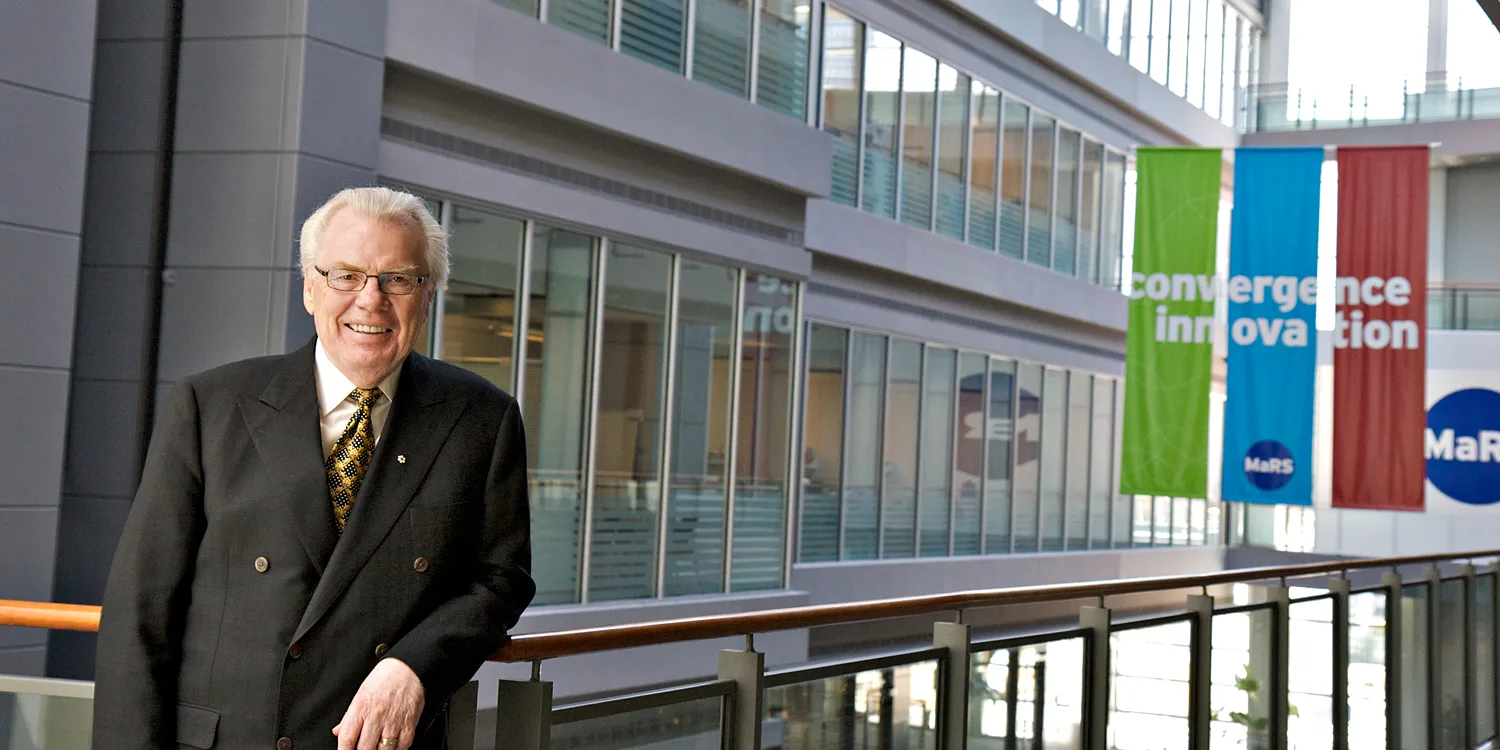
When it comes to improving the well-being of Canadians, few people have done more than Dr. Calvin Stiller. A visionary in the field of organ transplantation, he established the multi-organ transplant service at UHN and helped develop a key protocol to mitigate rejection in kidney recipients; he also discovered the benefits of using immunosuppressants to treat type 1 diabetes. He co-founded the Robarts Research Institute, developed several funds to spur public and private sector partnerships in supporting groundbreaking medical discoveries and was the catalyst for Ontario’s first telemedicine service.
As all that breakthrough work suggests, Stiller, who was named an officer of the Order of Canada in 2011, is a lifelong champion of medical innovation. That ethos is what led him to connect with Dr. John Evans — initially to provide funding for Allelix, Canada’s first public biotech firm, where Evans served as CEO and executive chairman and, ultimately, as one of the essential sparks that led to the founding of MaRS in 2001.
Here, Stiller looks back at a quarter century of innovation and shares his memories of how all that critical infrastructure came to be.
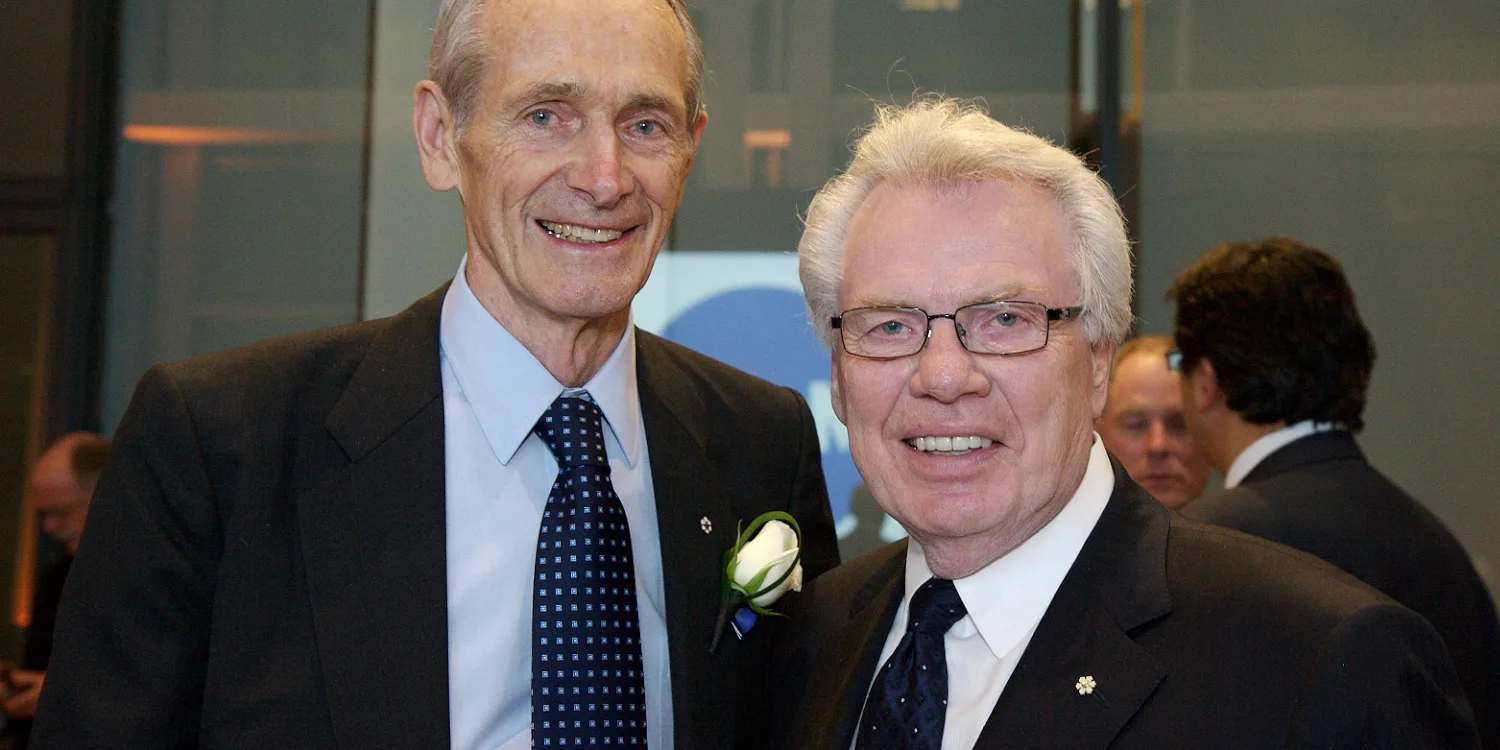
We often talk about the establishment of MaRS as though it was a sudden epiphany. But there was quite a bit of runway — or perhaps “scaffolding” is more apt in this context — that helped Dr. John Evans get his big idea off the ground… and much of that involved you. Can you tell us a bit about that journey?
I don’t think I’ve ever told the story about how John Evans and I came together. It was a converging of interests and boards that we sat on — and passion. I was a professor at Western, and was committed to the whole idea of translating ideas from the laboratory to the bedside to the community, and then paying back into the system. Henry Friesen, who was the president of the Medical Research Council (the predecessor of the Canadian Institutes of Health Research) came to me in 1994 and said, “Look, we don’t have money that’s being invested from the private sector in the area of medical research. Will you take a leave of absence from the university for a few years and raise money in the venture capital area?” I formed the Canadian Medical Discoveries Fund, and everyone thought it was going to be a failure. Henry Friesen went on the road with me, and we raised $540 million. It was unheard of — we had 100,000 individuals who paid $5,000 apiece. So we started investing this in small companies and scientists across the country.
[After Premier Mike Harris was elected in 1995], Michael Gurley became the deputy minister of finance. Well, Mike had been on the board of Robarts Research Institute, which I helped found. About two years in, I said, “Mike, you’ve dismantled so much in Ontario, it’s time for you to do something grand and glorious, something noble, something that inspires people — like Kennedy putting a man on the moon.”
A few months later, a car came up my driveway and in it was Mike Gurley. He sat down in my kitchen and said, “Cal, I want to put forward to the premier to do something significant in the area of research and the translation of research.” He’d bought into my idea that we should not be calling these grants, but investments, and we should be expecting ROI — that we should find ways to translate them into commercial and social impact. He said he was starting a fund and asked how big it should be. I said it should be $100 for every man, woman and child in Ontario. He wanted me to chair the fund, and I couldn’t say no. And that’s how I met Ken Knox. We became like brothers.
And that fund presaged MaRS, correct?
That was the Ontario Research and Development Challenge Fund, and it was the first foundational stone for MaRS, because it was the first time that a provincial government had supported and invested in research — the template was that you had a private sector partner. From the private side, I’d raised $500 million for the Canadian Medical Discoveries Fund. Those two things came together. The biggest investment that the Canadian Medical Discoveries made was in Allelix, the first public biotechnology company in Canada, which was formed by John Evans.
Was that the first time you’d connected with Dr. Evans?
I’d known about John, but I didn’t know him. Again, we became like family. We were together or on the phone with each other virtually every day. We wanted to find a site for Allelix in Toronto, and we thought the place to do that was right in the heart of the city, down on University Avenue. That was the spring of 2000. In June of that year, Ken Knox and I went to a big biotech meeting in Boston and we visited Kendall Square, which is an area in juxtaposition to MIT and Harvard, in the old Navy Yard, where big biotech companies were located and young companies were forming. As we walked down the street, Ken and I turned to each other and said “We’ve got to do this in Toronto.”
When we got back, Ken and I arranged to have a meeting at the Ontario Hydro Building in the president’s office on the 11th floor, which now faces the MaRS Centre. John Evans and I happened to be on the board of Paul Reichmann’s big real estate company [Olympia & York], so I called Paul and said, “This is big stuff; we need a real Moses figure to be involved,” and invited him. I remember Paul going over to the window, looking down over the old Toronto General Hospital site and imagining developing it from Elizabeth Street and beyond. At the end of the meeting, we began to get excited that this was doable. They were going to start working on this file, but they said we needed to give it a name. Now, remember the earlier story I told about the moon launch? They were calling this the lunar file. Well, Mike Gurley was in the corner of the room and he says, “You’ve already got an idea — call it Mars.”
So the name predated the acronym?
Yeah. About a week later, John and I were travelling and got caught in a snowstorm in Chicago. We had to spend the night there. John and I tried to sleep on this wooden bench, and in the middle of the night, he sat up, pulled out a pad of paper and said, “Well, Cal, we’re not getting any sleep. Let’s start working.” If we could get 11 people to put up a million dollars apiece, that would be enough to go to the government and ask them to match it — and that would be enough for a down payment on the land. We decided that Mars needed to get a real name. Joe Rotman knew the guru of branding, Bruce Mau, and arranged for him to come in pro bono. When I explained what we were trying to do, Bruce asked, “What do you call it now?” I said, “We have a file name. It’s Mars.” Bruce looks away and says “I can see it now: Mars, the greatest address on Earth. Now, figure out what Mars stands for.” We were trying to find a place for medical and related sciences — and so that’s what MaRS is.
Do you have any insights into how all those pieces fell into place so smoothly?
The reason we succeeded was that we had a parallel operating group. We were kind of the private sector’s political side, right? We were haranguing politicians, hectoring them, bribing them with words. But we had a really smart group on the inside — Mike Gurley, who was the deputy minister of finance, Mike Harris’s chief of staff David Lindsay, who became deputy minister of energy and infrastructure, Michele Noble, who was the secretary of the management board of cabinet, and Ken Knox, who was the deputy minister of energy, science and technology, at the head. That committee of four kept everything moving along the track of the civil service. But Ken Knox is the unsung hero of this whole thing, because he worked like crazy.
Even today, it’s not always easy to capture the essence of MaRS in an elevator pitch. How did you articulate that at the time?
It was like pulling teeth. Now, one thing that was a bit of a problem was that in 2000, there was a dot-com bust and the market crashed. Early startups had drummed up a lot of money, and then … nothing happened. Early-stage financing was not in vogue. We eventually overcame that. And although medical and related sciences was our base, there was not much in the area of medical developments in MaRS for, frankly, the first 10 years. But of course, with the figures you have now, nobody should have any remaining doubts.
This whole thing was catalyzed, in part, by your moon-launch idea — the notion of creating the conditions to, say, find a cure for cancer. Looking forward, where should MaRS be focusing to meet the moment in a similarly ambitious way?
One of the things I used to say was that the two greatest discoveries in medicine were DNA and the computer chip, because without the computer chip, our understanding of DNA would never have been able to be developed. That convergence of those different disciplines was critical. Today, AI is completely changing the discovery and application of new drugs and processes in medicine. We need to pick an area, and I think that is medicine, and a technology, which is the large language model of AI, and put those two in an intense partnership.
As the landscape has evolved in tandem with this technology, we’ve seen a huge increase in people accessing misinformation and disinformation, especially when it comes to health and medicine. As a physician, what’s your take on this issue?
Vetting is everything. You’re not just going to buy a good-looking Rolex watch right on Yonge Street, because you’re not getting it from the right source. Open that thing up and it’ll fall apart. We’ve got to develop a source of truth. Ultimately, a tool should be developed that is a purifier of ideas and information, a base that will be able to sort out that which is popular or widespread from that which is true. But who’s working on that? I don’t know. Limiting the spread of information is not in the interest, frankly, of a lot of the users of the software side of things.
Well, the most progress in that area is arguably happening in academia, because there’s a vested interest in facts and objectivity. If you go back to the idea of MaRS being at the crux of enterprise and academia and government and working to ensure that these tools reach the market…
So, you just described one of the most important new initiatives that should come out of MaRS. There should be, there should be a virtual institute of authenticity, of truth, of reality-based information, where you bring the smartest people from academia together with your AI people and develop a vetting mechanism.
Now that’s something that I could go out and fundraise for.
Canada’s largest urban innovation hub is celebrating 25 years of discoveries and breakthroughs. Read more here.
Photo credit: MaRS Discovery District
-
 Sarah Liss