Canadian first-of-a-kind cleantech is getting a boost

A new program for a crucial sector
It’s a cleantech chicken-and-egg conundrum: you need a ton of capital to commercialize a novel solution, but to secure that capital, you must first prove the solution is scalable. MaRS’s inaugural FOAK Lab, which launched last week, is trying to square that circle. Below, Dominique Ritter explains how the lab works — and the possibilities it could open up.
Also, in this week’s newsletter:
Stories from the ecosystem, upcoming events and the hottest jobs this week
First things first
How do you solve a problem like getting to first-of-a-kind?
It’s a question vexing innovators, investors and the future of climate-mitigating technologies. At the crux of the dilemma: a massive void of risk. That’s because paradigm-shifting startups can be too big to get out of the gate, even if the never-been-done-before solutions they promise and the returns they could generate are just as giant.
To achieve first-of-a-kind (FOAK) status, a cleantech venture needs to have commercial-scale implementation, but reaching that stage requires substantial — $50 to $200 million — institutional and investor backing for a business that’s yet to be proven. In Canada’s innovation ecosystem, there are a few notable examples, such as General Fusion and ARC Canada, but finding backing has been a special kind of challenge and FOAKs remain a notoriously rare breed of startup.
Launched last week, the MaRS FOAK Lab will support five ventures navigating the leap from pilot to commercial deployment. (And, yes, the lab is itself a MaRS first-of-a-kind.) It was created in partnership with the Global Climate Finance Accelerator and PwC Canada.
“We saw a groundswell of cleantech solutions that were approaching full-scale commercialization and, in parallel to that, a lack of financial instruments serving this specific stage,” says Alex Zakreski, a senior manager of cleantech ecosystems at MaRS, who refers to this nebulous phase as the “missing middle.” “We set up this program to deal with critical gaps in the ecosystem.”
Over the coming months, the five ventures in FOAK’s inaugural cohort will work on pivoting from technology developers to project developers with the help of financial advisors and climate tech partners and dealmakers. These startups were selected from sectors that are critical to Canada’s economic development, such as sustainable critical mineral production, ocean alkalinity enhancement and green building materials.
“They all have significant economic and greenhouse-gas reduction potential in Canada as well as the potential to scale globally,” says Zakreski. “Part of the goal of this pilot is to create a playbook for companies on this journey.”
That said, each member of the cohort is unique, with different technologies and challenges, so workshopping is tailored to their individual needs. Using a framework established by PwC, the companies are fine-tuning criteria like risk management and financing to better meet investors’ needs. That means Exterra Technologies, whose planned facility will transform asbestos tailings into critical minerals for use in EV batteries, is collaborating with the Lab team to find the equity, debt and government support to put together the capital it needs. And Green Graphite Technologies, which aims to produce low-carbon battery-grade graphite, is working on an investor-friendly financial model that demonstrates the path to ROI.
Beyond delivering results for investors, these startups are also poised to manifest potent climate solutions that can reduce carbon, boost energy sovereignty and scale globally. Take Planetary Technologies. The Nova Scotia startup has devised a way to counter the acidification of oceans by adding alkaline minerals, which would mean low-cost carbon removal and the restoration of oceanic ecosystems. It already has an agreement to sell carbon credits to a consortium that includes Shopify, Google and Meta.
In November, these FOAK folk will present their projects and progress to an audience that will include ecosystem partners, financiers and purchasers. Until then, the learning continues for the cohort and MaRS.
“It’s really highlighted how few sources of early development capital there are in Canada,” says Zakreski. “We’re hoping this program will create some good advisory for government on where they can play a role and what kind of holes they can fill to get ventures to the position that they need to be.” — Dominique Ritter
Stories from the ecosystem
ROBOTICS: Who’s the chef with AI making fresh pizza pie? That’s a robot! And now London, Ont.’s Appetronix is hoping to expand its autonomous pizzaiolos’ reach with a next-gen robotic arm acquisition.
CLIMATE TECH: Skyward Technologies gets $1 million from Innovate B.C. to test its anti-wildfire cloud-seeding tech.
HEALTH: Recorded live at last month’s Impact Health, TVO’s (Mis)Treated explores how hormonal changes impact women’s brain health.
FINTECH: Tax season may be over, but adulting never ends. These digital tools can take the tedium out of your to-do list.
HEALTH: Possibility Neurotechnologies CEO Dion Kelly talks BCIs on The Current.
MaRS Monthly: May
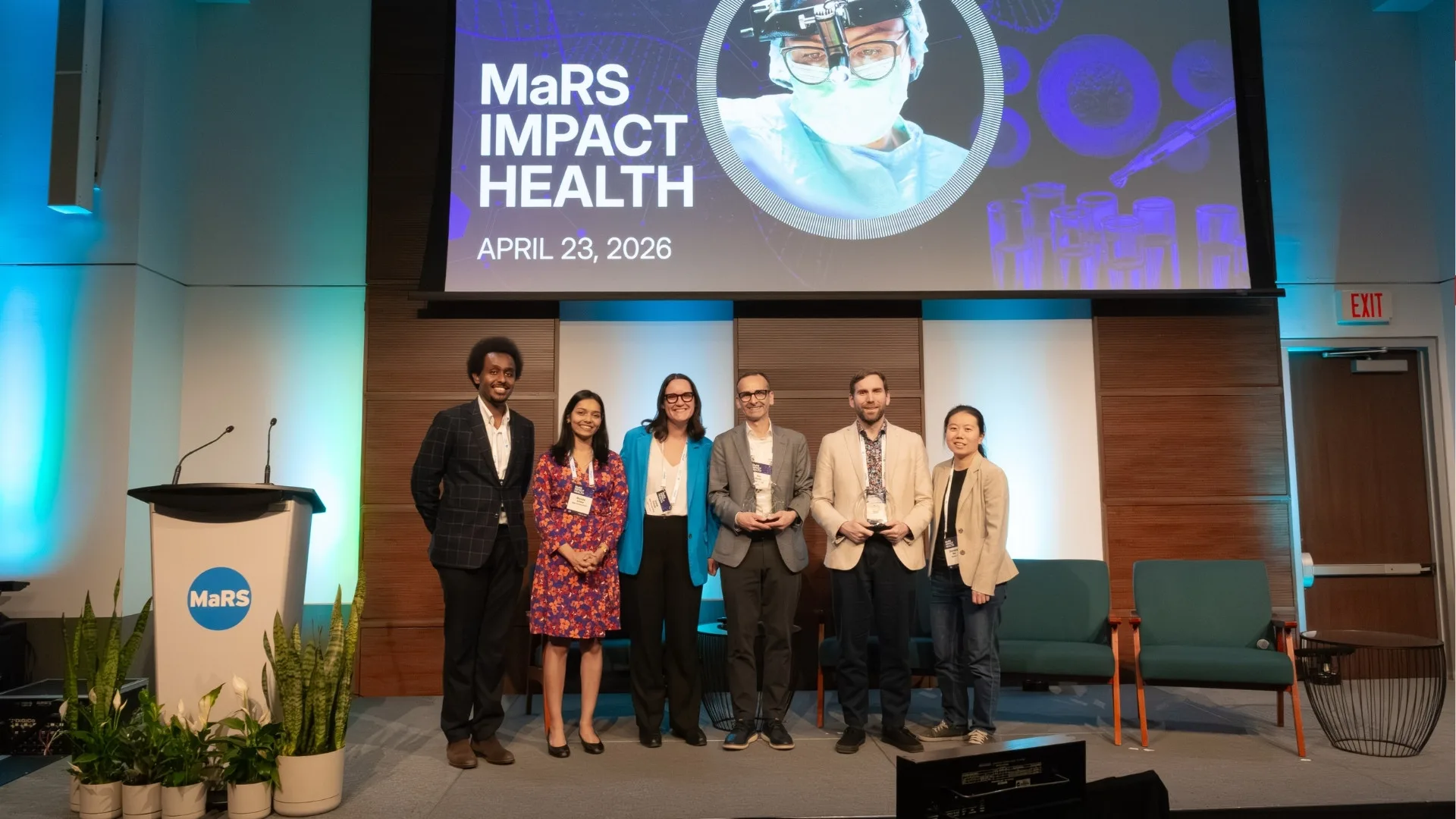
Get caught up on the latest tech news in this 103-second video: MaRS Impact Health draws big numbers, Growcer picks up a Governor General’s Innovation Award, a pizza-making robot and much more.
Upcoming events
- “Cutting through the AI noise: What’s actually driving impact” features leaders from AI-Innovate, Durham College, Fleming College and the Ontario Centre for Innovation, in conversation about how AI is being implemented across industries today. Online. May 14.
- Toronto Tech Week brings together hundreds of founders, investors and builders to showcase the energy, creativity and ambition driving Canada’s innovation economy. May 25–29.
- MaRS is co-hosting several events during TTW, including special MaRS Mornings and other networking opportunities:
- “New world order: Scaling globally in an era of ‘middle power’ ties,” May 25, 9 a.m.
- “Toronto takes on the world: winning strategies for global growth,” May 25, 12 p.m.
- “Pitch session: AI, quantum and emerging tech ventures,” May 26, 9 a.m.
- “Hype versus reality: Valuation in the age of AI,” May 27, 9 a.m.
- “Compute costs: Accounting for AI’s hidden energy bill,” May 28, 9 a.m.
- During Toronto Climate Week, MaRS co-hosts two events: “Celebrating five years of Mission from MaRS: Wins, challenges and perspectives,” June 1; and “The climate tech journey: From ideation to industrialization,” June 4.
For more, visit our events page
In the queue: What we’re reading, watching and listening to at MaRS
Olivier Dufresne is the co-founder and CEO of Exterra Technologies, one of the five companies making up the inaugural FOAK cohort. Here’s what he’s been consuming lately.
 An indispensable guide to completing major projects: “How Big Things Get Done by Bent Flyvbjerg and Dan Gardner is essential reading for anyone who builds. Taking a company from a technology concept to a funded commercial plant has taught me firsthand that the gap between ambition and delivery is almost always a planning problem, not a vision problem, and Flyvbjerg and Gardner’s data-driven framework for managing megaproject risk is one of the most useful things I have read.”
- A masters-of-the-universe podcast: “Acquired is a masterclass in how founders with genuinely differentiated technology turn a defensible process into a category-defining business. Every episode I listen to, I’m essentially studying how the greats built their moats one institutional partnership at a time. If you’re building something, it’s both strategic fuel and personal validation in audio form.”
- A thought-provoking take on a little-known sector: “Douglas Silver’s Rise of the Mining Royalty Companies is one of the most informative books I’ve read about an industry most people outside of resources have never heard of. Silver traces how the royalty model was born out of necessity, how a handful of contrarian thinkers turned a financing instrument into a global asset class and how the companies behind the biggest names in the sector built businesses that outlasted the mines themselves. It fundamentally reframes how you think about where lasting value actually sits in the value chain.”
Careers: The hottest jobs in tech this week
- Vention, whose AI-powered platform enables factory floor automation, is hiring a senior business advisor, a senior master planner, a product manager of physical AI and other positions. (Montreal)
- PulseMedica, a medical device startup, is looking for multiple interns: software developer, optics design, mechanical design and more. (Edmonton)
- MaRS is hiring a senior associate, member experience, a director of platform (IAF), and a senior associate, advisory services. (Toronto)
- Perpetua, which provides growth optimization and reporting tech for e-commerce businesses, is looking for a planning director, an account supervisor, a contracts specialist and other positions. (Multiple cities)
For more, visit our jobs page
Did you know that MaRS is a charity?
Your support helps us advance Canadian innovation and science, bring our community together and transform the world for the better. Discover our programs and ways to give.
Photo courtesy of Planetary Technologies
-
 MaRS Staff