How greater automation could give farmers a helping hand
Thanks to labour shortages, climate change and trade turbulence, farming is more difficult than ever before. Is it time to call in the robots?
Harvesting fruit and vegetables is notoriously tedious and backbreaking work, whether you’re picking peppers or foraging for fiddleheads. Mushroom farming, however, is in an agricultural league of its own. Fungi are extremely fast-growing — they can double in size every 24 hours and must be picked at a rate of 60 mushrooms per minute — and also very fragile. They are also grown entirely indoors, on cramped, tiered shelves, in windowless, humid and pungent warehouses — in other words, the sort of environment that appeals to spores, not people.
Recruiting mushroom pickers, therefore, is difficult. Canadian agriculture has been plagued for years by labour shortages — the sector’s lost 55,200 workers since 2020, according to StatCan’s most recent Labour Force Survey. Mushroom farming has been particularly hard hit, because of the challenging conditions but also because the crop grows year-round, requiring perpetual harvesting.
But what if this work could be handed over to machines? Mushroom farmers have been dreaming of an automated future for at least 40 years, but the industry has only come close to realizing those dreams in the last couple of years, thanks largely to advances in AI. Indeed, with the entire agricultural sector contending with converging crises — the lack of labour, but also climate change, supply chain disruptions and trade turbulence — advanced technologies that promise to make farming more efficient, productive and competitive have become increasingly appealing.
“Farmers are always thinking, ‘OK, what do we need to do to allow us to be here for another generation?’” says Katherine Festeryga, a manager of climate programs at MaRS and founder of the agtech startup Edie Farming. A 2025 report from the Canadian Agri-food Policy Institute argues that digital agricultural tools available today could unlock up to $1.5 billion in annual net revenue over the next decade.
Old MacDonald may have had a farm, but New MacDonald is managing that acreage with driverless tractors, robot weeders and precision field analytics — all of which promise to reduce labour costs, lower emissions and optimize yields. But like so many other technological advancements, these tools come with their own complications. A 2024 Conference Board of Canada report estimated that automation will reduce the agricultural workforce by a third in the next decade. Agtech has high upfront costs, and the AI that powers so much of it requires data centres whose construction increasingly imperils fertile farmland.
But with so many farmers managing razor-thin margins, the pros may well outweigh the cons.
Building the perfect mushroom picker
In 2013, Stefan Glibetic, an ambitious mechatronics student at Western University, was presented with a challenge by a local mushroom farmer named Murray Good. Given the idiosyncrasies of fungi, and the persistent labour problem, was it possible to help automate production by designing a mushroom-picking robot?
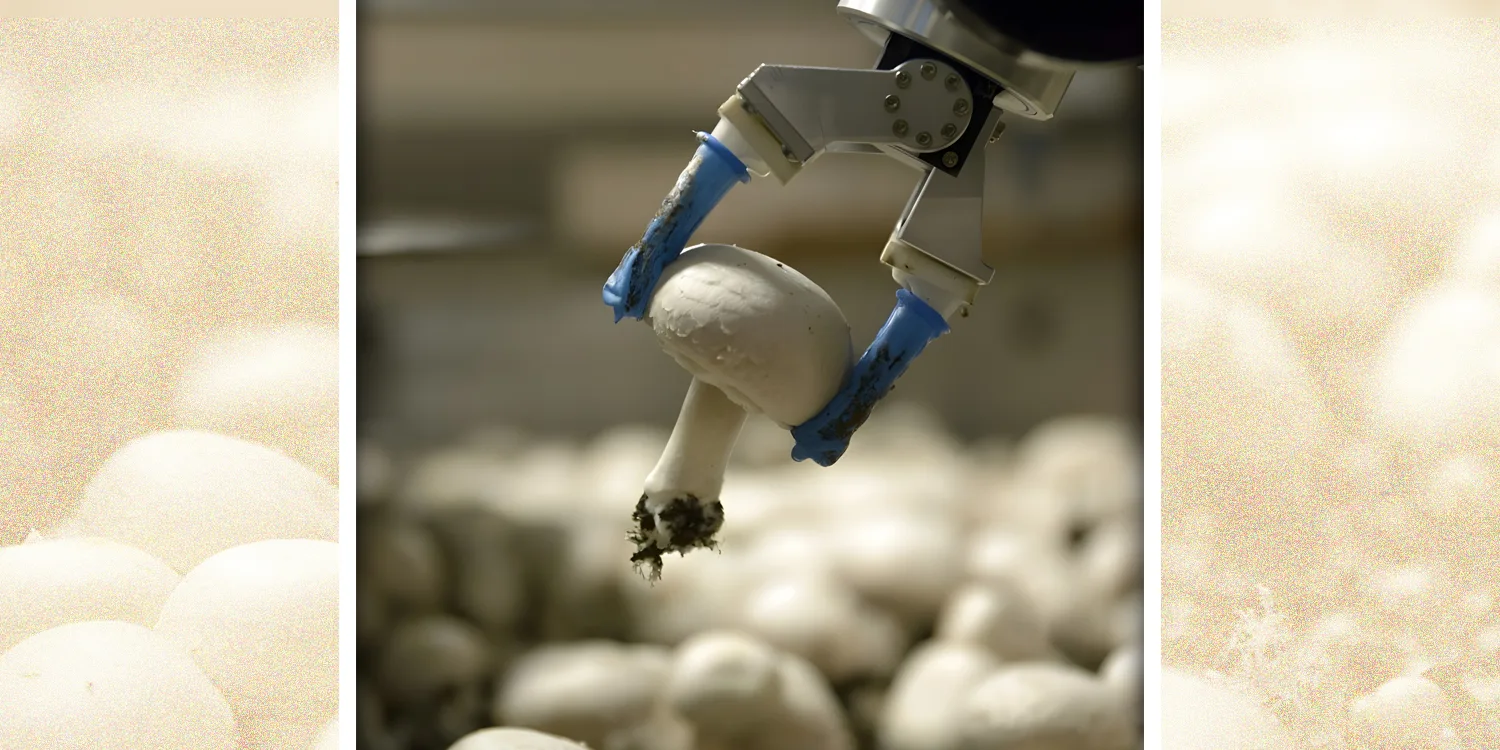
It was a tall order, largely because of one seemingly intractable problem: replicating human dexterity. “The human hand is a technical marvel,” Glibetic says. It can move in 25 different ways — in robotics, these are known as “degrees of freedom” — whereas even the most cutting-edge robotic hands can move 10, max. A human hand, in conjunction with a human arm and human brain, can also perceive texture and weight and accordingly adjust its pressure and force. In the case of mushrooms, Glibetic gradually realized that their quirks could be a boon — they lack deep roots, can be plucked without too much force — and that the hand’s entire dynamic range wasn’t required. A robot picker only had to twist, push, pull and pivot a mushroom in any direction. The suction cups that previous roboticists had tried tended to damage the delicate skin of the cap so Glibetic designed what he calls “grippers,” which act more like an index finger and thumb, with both the cushion of a finger pad and the firmness of bone. He equipped these grippers with feedback, so the force and pressure they applied could be adjusted, and a vision system that would give the robot a bird’s eye perspective on the entire crop.
By 2022, Glibetic and Good had built their first commercial fleet of robots and a company they called Mycionics. The device is currently being used at three farms across Canada and Europe and a more advanced iteration is being piloted on a B.C. farm. Glibetic also has plans to expand: With different grippers and recalibrated computer vision, Mycionics’s robots could potentially pick other delicate crops, like strawberries or peppers. “After 40 years of disappointment, I think people are finally getting hope that robots are coming soon,” he says. “That disappointment has shifted into optimism.”
A killer weed killer
In 2020, when COVID lockdowns were in place, David Tao, a Toronto-based robotics engineer, went to visit a friend’s carrot farm outside of Windsor. It was a tough time. The herbicide that the friend had been spraying for the past 20 years had become ineffective, as most weeds had developed resistance to the stuff — and, with the border then closed, he couldn’t hire any foreign workers to manually weed his fields. Faced with the prospect of losing his crop, he asked if Tao’s engineering expertise could help solve these problems.
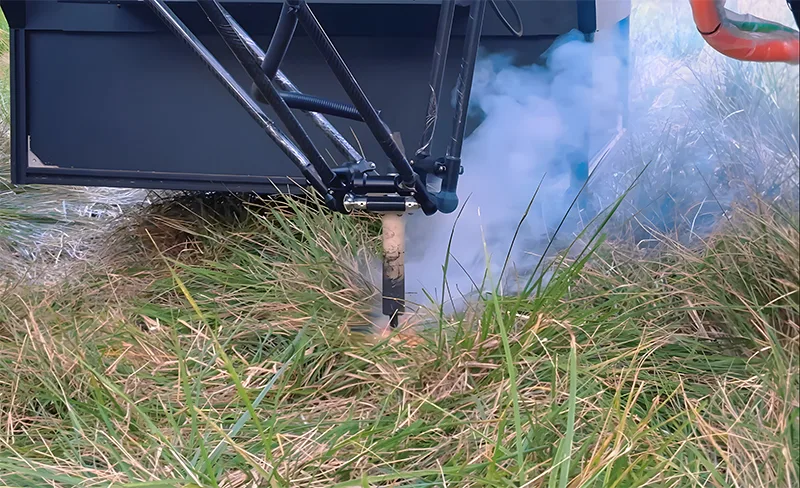
Back in Toronto, he spent a year trying to figure out a way to kill weeds without chemicals, finally arriving at a solution that, as he puts it, “wins on all counts, from efficiency to cost-effectiveness”: high-voltage electricity. That revelation turned into a machine he named the Blitz Electric Weeder and a company called BHF Robotics.
The heart of the Blitz is a robotic arm that, guided by AI and computer vision, distinguishes weeds from crops, emitting precise, rapid-fire bursts of electricity whenever it spots the former. The arms can be pulled by conventional tractors or housed in a weather-resistant autonomous vehicle that BHP also makes. The Blitz can kill weeds of any size and covers three acres an hour, on par with a traditional herbicide sprayer and, according to Tao, seven times faster than its chief competitor in the market, the LaserWeeder by American company Carbon Robotics — at a significantly lower price point. (For better or worse, LaserWeeder has also been endorsed by Joe Rogan and RFK, Jr.)
For Tao, weeds are just the beginning. BHP’s autonomous platform, which it calls Shire, can be outfitted with virtually any kind of farm implement, providing the capacity to harvest, thin and monitor crops. “One robot, not just for weeding,” Tao says, “but helping farmers solve labour problems and save money throughout the whole season.”
Labour pains
As with AI and white collar work, labour is the complicated crux of any discussion around robots and farming. On the one hand, proponents of automation argue that robots will only take the punishing, dangerous jobs that humans, given the choice, don’t usually want to do. There is no question that agricultural work fits that description, hence the sector’s long reliance on migrant workers who are often exploited. While the industry grapples with ways to improve working conditions, automation offers, at least theoretically, a way to circumvent complicated policy and economic questions.
Haven Greens, to cite just one high-profile example, has done away with labour altogether. The country’s first fully automated greenhouse, it produces 12,000 pounds of lettuce every day, without a single human being touching the greens at any point from growing to packaging. This hands-free approach has multiple benefits: lower labour costs and less chance of contamination.
But increased automation does have other consequences. As much as Canadians may not want to do those hard, tedious jobs, the money that seasonal foreign workers earn affords many of them and their families a better life in their home countries.
When those jobs disappear, where do those workers go and what happens to those economies? Local economies take a hit when the robots arrive, too. Last fall, after a Prince Edward County mushroom farm closed down, laying off 250 foreign workers, Wellington Mayor Steve Ferguson said he was “gutted,” describing the farm as one of the town’s largest employers. Highline Mushrooms, the farm’s owner, has invested in a new facility in Leamington, Ont., that is designed to support Mycionics’ robotic automation.
Not surprisingly, Glibetic takes a more nuanced view. As he’s introduced his robots to mushroom farms, he’s learned that there are limitations to his grippers — they can handle the bulk of the work but the more careful pruning or thinning is still best done by humans. As a result, he’s arrived at a kind of hybrid model for his pilots. “It’s a more modern automation approach where people and robots work together,” Gilbetic says. As he explains, humans handle the complicated, delicate tasks that would be too expensive and unreliable to automate, while robots take on the brunt of the backbreaking work. “We’re not here to take away a good job.”
For MaRS’s Katherine Festeryga, there’s an undeniable tension in the rise of farm robots: “They’re taking jobs — bad. But can they also make our food costs lower? Good. That’s the push-and-pull that I think is really interesting.” But she also points out that, just as the climate crisis is transforming every aspect of our lives, it may also be the thing, ironically, that finally makes robots a necessity in agriculture.
“In places like California and Mexico it’s going to be too hot, or with wildfires too smoky, to go outside and harvest any of the produce,” she says. “Can machines take the place of workers there? Because people aren’t going to be able to do that.”
Mission from MaRS: Food and Agtech aims to accelerate the adoption of solutions that can help build resilient food systems, establish reliable supply chains and reduce greenhouse gas emissions. Find out more about this special initiative here.
Main photo courtesy of Mycionics; second photo courtesy of BHF
-
 Jason McBride