Is this Canada’s moment of reckoning?
How to jump-start tech and science innovation
How do you solve Canada’s innovation conundrum and translate this country’s R&D excellence into commercial success? It’s a question that has launched a thousand white papers. And with all the renewed geopolitical tensions, intensifying climate shocks and rapid AI expansion, it has only taken on new urgency. At a recent MaRS Morning, experts weighed in on where Canada is succeeding, where gaps persist and the hard choices we have to make. Below, some of the conversation’s key takeaways.
Also, in this week’s newsletter:
Stories from the ecosystem, upcoming events and the hottest jobs this week
First the good news. A recent report from the Council of Canadian Academies reveals that this country’s innovation ecosystem continues to:
- Attract and develop talent
- Perform well on both the output and quality of our research
- Develop a good number of high-growth SMEs
But on the other side of the ledger, the trends are “abysmal and declining,” says Ilse Treurnicht, report chair at the CCCA. There are particularly worrying signs in terms of:
- Spending on both business and government R&D
- Continued loss of talent, particularly of recent graduate students
- Intellectual property is leaving this country
Most concerning, she says, is the number of companies that report that they are not adopting new advanced technology because it is not relevant to their business. “Now perhaps this global rupture will jolt us out of this dynamic,” says Treurnicht. “But one other factor that’s really clear is that this is not a problem that the government can fix on its own.”
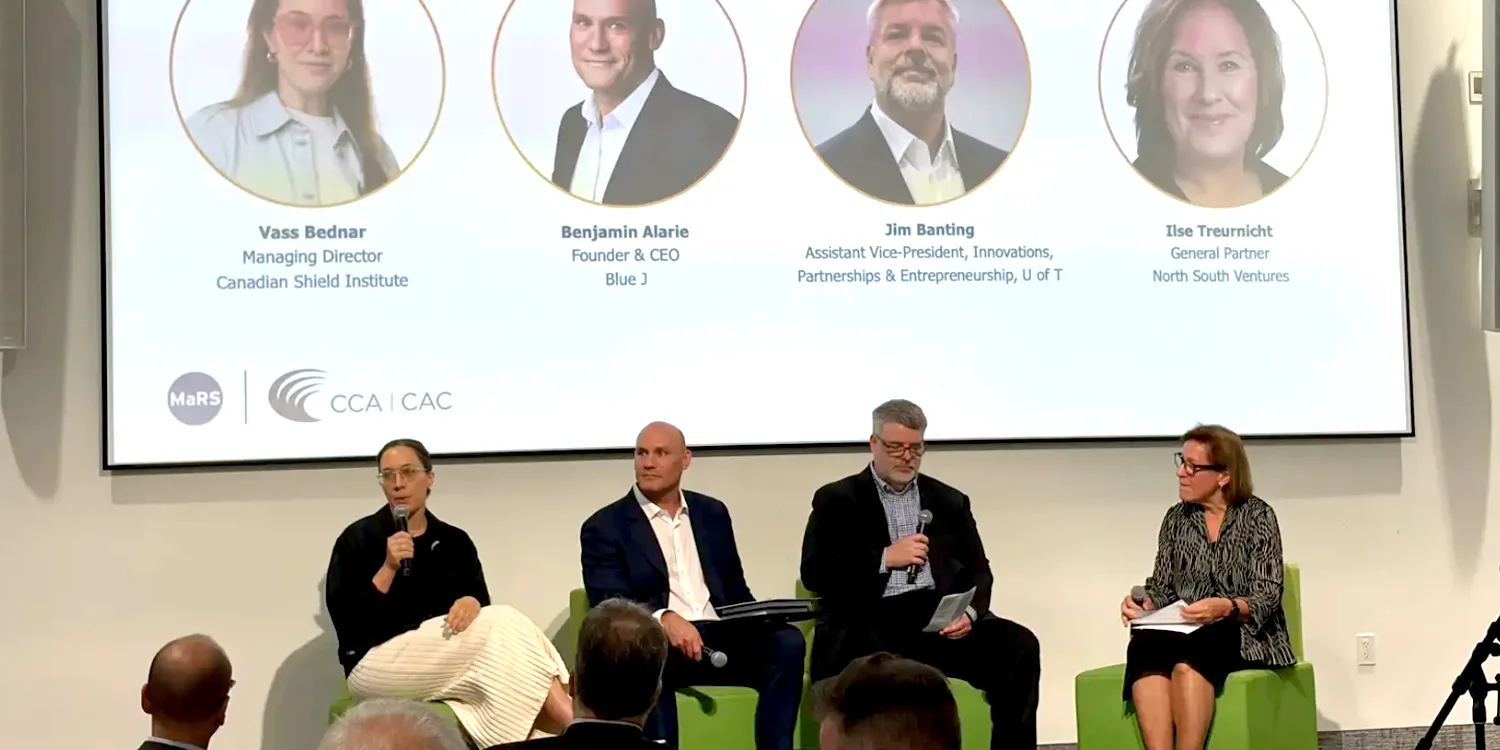
At the MaRS Morning event last week, she asked experts from Blue J, the Canadian Shield Institute and the University of Toronto for their assessment of this precarious moment and their prescription for change. Here’s what they had to say.
Treat data as IP and bolster our digital sovereignty
“We’re still not treating data and other intangibles like intellectual property as the assets they are. That’s the tip of the iceberg for us — we need to talk about what other national infrastructures we need to pull patents, to act defensively and offensively for firms so they can scale and grow longer here.” – Vass Bednar, Managing Director, Canadian Shield Institute
Make Canada the location of choice
“There’s a moment when firms make a decision about where to locate. And that is the single most important moment for a company — once you start in a given geography, it’s extremely unlikely that you’re going to move. If we can make sure that Canadian entrepreneurs feel that starting their company here in Canada is not going to compromise the probability, the speed or the magnitude of their success, we will be able to have that higher starting rate, which ultimately is going to translate into more successful companies.” – Benjamin Alarie, Founder and CEO, Blue J
Keep talent in Canada via procurement
“At the end of the day, people want to work on interesting problems, and would probably be willing to stay in the country if there’s interesting problems to tackle right in their own backyard. Focusing on procurement is a great way for companies to shape their own destiny, because if you’re bringing in revenue and you’re handling your expenses, you can continue to invest in R&D and build a company that way.” – Jim Banting, Assistant Vice President, Innovations, Partnerships and Entrepreneurship, University of Toronto
How do you think Canada should jump-start innovation in science and tech? Drop us a line at media@marsdd.com.
Stories from the ecosystem
AEROSPACE: In a struggling economy, Canada’s aerospace industry is flying high.
AI: How Alberta is fuelling its data centre building boom.
CLEANTECH: Electrovaya’s share prices soared last week after the Mississauga-based lithium ion battery company announced a deal with Amazon.
BIOTECH: OBIO’s Maura Campbell lays out what Canada needs to do to capture more of the value created by its life sciences sector.
PRODUCTIVITY: Companies are grappling with the high costs of AI usage.
This is not a drill

While the smoke has cleared and Toronto has thankfully lost the title of having the worst air quality on Earth, close to 200 fires are still burning in Ontario. If you missed this episode of the MaRS podcast, Solve for X, from last season, it’s worth a listen. Host Manjula Selvarajah sits down with John Vaillant, author of the Pulitzer Prize–nominated book Fire Weather: A True Story From a Hotter World, to talk about why we need to rethink our approach to adaptation in an increasingly volatile world.
Upcoming events
- The second session in the MaRS Better Building Adoption Accelerator pitch series features ventures working in high-tech retrofits: QEA Tech, RegenEAU and TwinGlaze. July 24.
- U.K.-based funding agency Advanced Research and Invention Agency is hosting “Toronto Funding at the Frontier,” an event where researchers and founders dish on what it takes to solve ambitious technical problems. July 28.
- Applications are now open for the RBC Women in Cleantech Accelerator, a two-year program helping women entrepreneurs scale their climate tech solutions. To learn more, attend an informational webinar. July 28.
- Innovation Cluster presents “Entering Canada’s defence market,” a practical overview of procurement, compliance requirements and market access opportunities in Canada’s defence sector. July 29.
- Jenny Lemieux of MaRS venture Vivid Machines talks shop with leaders from 1Password and PartnerStack at TechTO’s Together Toronto. August 10.
- Mark your Calendly. Early bird tickets are now on sale for MaRS Climate Impact. November 17 and 18.
For more, visit our events page
In the queue: What we’re reading, watching and listening to at MaRS
Karlee Silver is the CEO of Grand Challenges Canada, which recently announced a U.S.$50-million initiative to address the health impacts of climate change at the local level. Here, she shares her latest obsessions.
 A hard look at soft skills: “On the podcast The Curiosity Shop, Brene Brown and Adam Grant challenge each other on how to ‘live, lead and love,’ often by comparing the evidence base with lived experience. It’s a beautiful display of disagreeing and discussing the issue in order to advance thinking — something we don’t get enough of these days!”
- An argument for big, ambitious national projects: “I watched a lot of the World Cup, and I love this opinion piece about France being a training ground for, and exporter of, football (soccer) excellence, which also asks how this approach could apply to Canada’s current context. I believe Canada needs to be bolder in a more diversified way now to thrive in the future.”
- Kindling for a burning topic: “The why and how we work and how that changes is fascinating to me. So this Harvard Business Review click-bait title worked on me, bringing some fresh evidence to the ongoing remote versus in-office debate: ‘The Office Amenity That Actually Improves Teamwork.’”
Careers: The hottest jobs in tech this week
- Management software firm Event Mobi is hiring for several positions, including account managers, an integration specialist and an event success manager. (Vancouver, Berlin and remote)
- Intellijoint Surgical, which develops surgical equipment, has job openings for a customer service manager and a territory manager. (Kitchener, Chicago)
- Digital mapping company Ecopia is hiring a growth marketer, frontend engineer and backend engineer. (Toronto)
- Ayrton Energy, which develops hydrogen solutions, is looking for a senior mechanical engineer. (Calgary)
For more, visit our jobs page
Did you know that MaRS is a charity?
Your support helps us advance Canadian innovation and science, bring our community together and transform the world for the better. For instance, through our carbon removal donation program, you can help support Canada’s most promising CDR companies through tax-deductible donations. Learn more here.
Thanks for reading! See you in two weeks.
Main photo courtesy of Steve McCann
Sign up for our newsletter
-
 MaRS Staff