Made in Canada: How Elemental Trucks is navigating bumps in the global economy

CEO Jamie Ally hopes the company’s FOAK hydrogen-powered long-haul rig will help shrink the footprint of extremely large trucks on highways at home and around the world.
In this series, we explore how Canadian businesses are contending with global trade disruption.
Canada is home to some very large trucks — the kind that are classified as “heavy duty” and can haul weights up to 63 tonnes (the equivalent of 126 male polar bears). It’s also home to a hydrogen and fuel-cell sector known for pioneering new technologies. And now, Canada is home to a massive truck powered by hydrogen fuel.
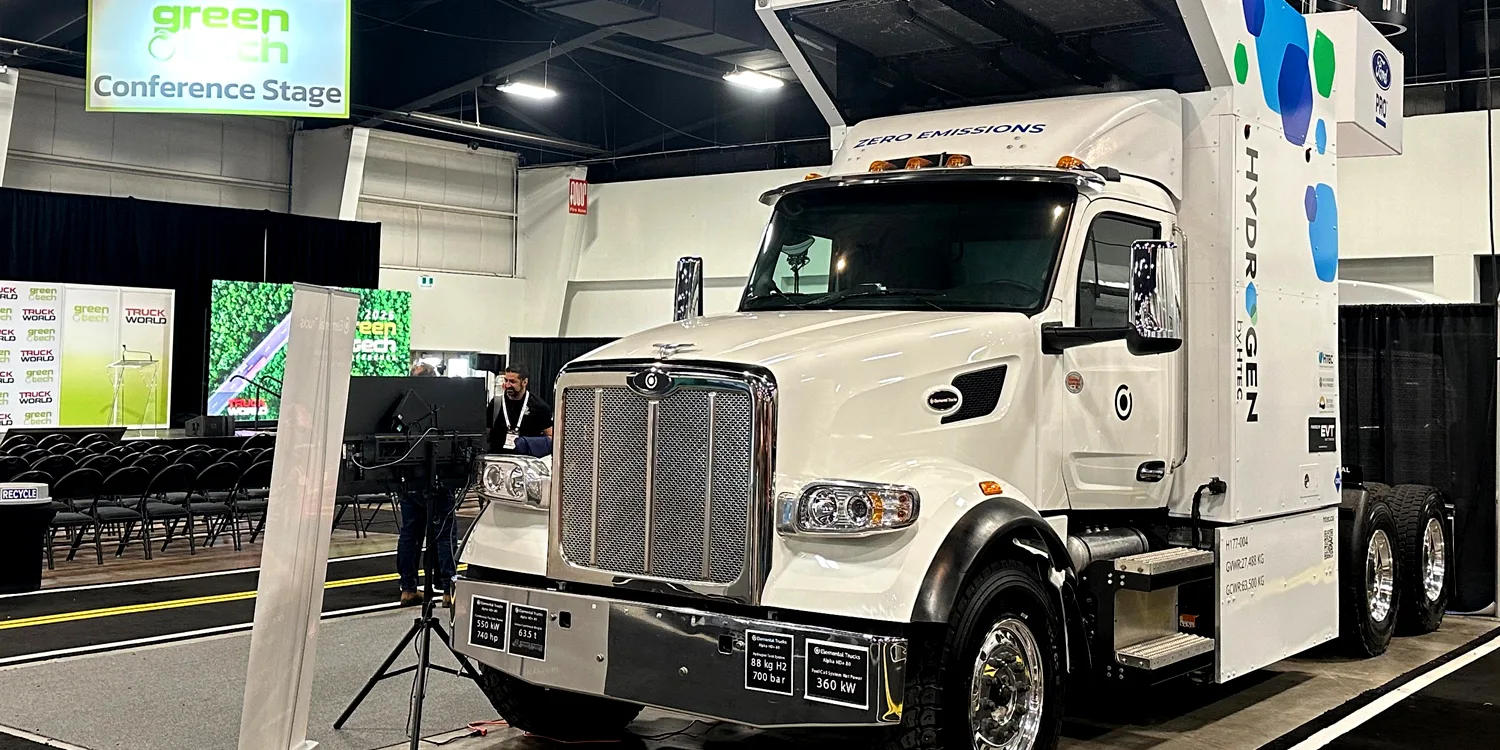
Last month, Etobicoke-based Elemental Trucks unveiled the first generation model of its hydrogen-fuel-cell-electric truck to help address a burning problem: the trucking industry’s supersized carbon footprint. Freight vehicles accounted for between 48 and 65 megatonnes of the country’s greenhouse gas emissions in 2019, while the transportation sector as a whole is responsible for 25 percent of our total emissions.
The first-of-its-kind long-haul, zero-emissions truck is currently in the workshop, and the company plans to start fulfilling orders in the coming months. “It’s going to a customer in British Columbia later this year,” says Elemental’s CEO Jamie Ally.
Here, Ally talks about the nuts-and-bolts challenges of building the zero-emissions truck Canada needs, how geopolitical tensions are affecting his business and when the first of his fleet will be hitting the road.
Why does the world need your very big hydrogen-electric truck?
Sixty-three tonnes isn’t a common weight class in the U.S., but it is in other parts of the world and here in Canada. There are Canadian fleets that only operate 63-tonne trucks and they’re trying to electrify. For those customers, there was no offering on the market. Elemental was born to address that need. We build the heaviest zero-emission trucks on the road.
What are the challenges of developing a 63-tonne zero-emissions truck?
Our powertrain is unique. We have a lot more power and a lot more torque and we have a very heavy-duty chassis. Solving for the amount of power we have on board this vehicle and the components needed to run that powertrain is a huge technical challenge. We found that the only way to achieve those goals was to use hydrogen fuel cells. So we also have the complications that system brings.
I imagine that you need novel components for your truck. Where are they coming from?
We’ve managed to do a large chunk of materials by reassembling existing components. For example, the powertrain, the hydrogen storage system, the way the fuel cell modules are used — we’re taking off-the-shelf components and assembling them into unique subsystems.
How are geopolitical tensions and trade disruptions affecting the trajectory of your business?
It’s super dynamic.
That’s a nice way to describe it.
We launched in 2022, when there was a lot of capital being allocated, lots of startups, lots of existing OEMs launching in this space, lots of interested customers. In November 2024, things went into a period of uncertainty. We had originally planned for a U.S. expansion in 2025, but watching how the politics were developing, we decided to hold off on that and doubled down on our Canadian focus. There are still very localized good markets for zero-emission trucks in the U.S., but it really became a play in Canada.
Are there specific recent U.S. policy changes that have affected your business?
Before the U.S. government essentially shut down a lot of the Inflation Reduction Act policies, there was a lot of work being done on hydrogen hubs in the U.S. That was leading to a huge market demand signal: Thousands of trucks a year were going to be needed for those hydrogen hubs and very large investments made to develop those proposals, and it went basically stone dead. I don’t think it was a surprise — we saw the politics changing — but that did freeze a lot of the interest in the U.S. market.
What do the opportunities look like today?
We see localized markets across North America where there’s still a lot of interest and policy support for zero-emission vehicles. We’re looking at the U.S. market again. As the situation in Iran causes volatility with oil prices, that tends to drive people to look at electrification and alternative fuels.
Has recent turmoil in the Middle East affected the economics of hydrogen fuel?
It hasn’t changed the economics yet for companies like us but I can see the sentiment changing. We’ve noticed an uptick in the interest in passenger EVs and hybrid vehicles. That tends to foreshadow an incoming uptick in electrification, hybridization and alternative fuels in the trucking space.
What role does government play in supporting the development of a cleantech solution like yours?
Trucking is one of the hardest sectors of the economy to decarbonize and emissions keep going up every year. Government mandates are probably one of the only ways to overcome the barrier to decarbonization by reducing costs. It could be through mandated uptake, like in California, where they had a target for a certain number of zero-emission vehicles every year. Or it could be through a rebate program.
What does the infrastructure for hydrogen refuelling look like in Canada?
“Chicken and egg” is a phrase that gets used all the time. If we ramped up hydrogen truck production too quickly, there wouldn’t be enough fuelling stations. There aren’t many right now, but this industry is growing from very small numbers. British Columbia is the leader in developing refuelling networks and Alberta is next, followed by Ontario. There’s a fuelling station in Toronto at Pearson Airport. And there’s a hydrogen innovation fund, which will lead to more fuelling stations and more mobility deployments in Ontario.
Who are the ideal clients for an Elemental truck?
Private fleets like Loblaws, IKEA, Canadian Tire are most likely to be the early adopters because they have mandates around emissions reductions, they have a willingness to try new technologies and they’re not deriving all of their profit from the transportation of goods. Third-party logistics companies are also great to work with, but the trucking industry is getting squeezed so they’re less likely to trial new technologies, even though they might have the interest and the intent.
What challenges have you encountered in driving adoption?
Upfront costs are the biggest issue. We can improve engineering and design but most cost reductions can only come with volume.
Diesel trucks are well optimized in terms of production. They’re using components that have been developed over decades and are designed for high production — hundreds of thousands of units — whereas we’re producing fives, tens, 50, 100. Volume is the key, but we don’t actually need that much volume to get a significant cost reduction. There’s a significant cost reduction at around 30 units per year, which we hope to hit in 2027–8, and another at 100 units per year, which will be around 2028–9.
What opportunities are you seeing for cleantech founders in Canada right now?
Canada has become a lifeboat for us at the moment. We seem to have governments that care about emissions reduction and cleantech in general.
We have found it to be a great place to develop a cleantech business because of the policy support that comes in the form of things like non-dilutive funding opportunities that you can apply for — with MaRS, for example. Federally, there’s the SR&ED program [Scientific Research and Experimental Development tax incentives], so there are a lot of good financial incentives to do R&D in tech in Canada.
And what challenges exist for startups in this space?
Canada has always been a global leader in hydrogen technology development, but we’re not great at being our own customers. We export what we make, which means we have this constant pull to set up manufacturing in the U.S. or to build closer to other markets.
It would be great if Canada was better at building the demand for this technology domestically. There’s not a lot of clarity from the federal government right now about the rebate program for zero-emission trucks, which was always scheduled to end in March of 2026. They extended that for another few months, and it’s not really clear what they’re doing following that program. So, we have a lot of policy uncertainty across North America.
As someone who has worked in cleantech in Australia and Canada, what do you see as the differences between how the two are approaching renewables?
Australia and Canada are both very, very lucky countries because we have so many resources. Australia’s got more abundant solar and wind resources, whereas, in Canada, we develop hydroelectric resources. The renewable industry in both countries has been really well supported, and there’s a lot of interest from the general population.
Australia is very good at expanding and implementing technologies, and Canada’s got a strength in developing technologies from first principles.
Is your truck out on the road?
We can drive it right now on closed tracks and private tracks and we will eventually put a plate on it and drive it on public roads. It was on display in April at both Truck World and the DiscoveryX conference.
What do you like best about your big rig?
We’re engineers, so we get pretty excited about the functional performance capabilities. We recently did a test where we pulled a 63-tonne load of concrete blocks. Everybody knows electric cars accelerate very quickly, but it was awesome to see 63 tonnes accelerate that quickly and quietly. A diesel truck would have gone through a bunch of gears.
Photos courtesy of Elemental Trucks
-
 Dominique Ritter