Technically Speaking: Breaking down the new realities of startup fundraising
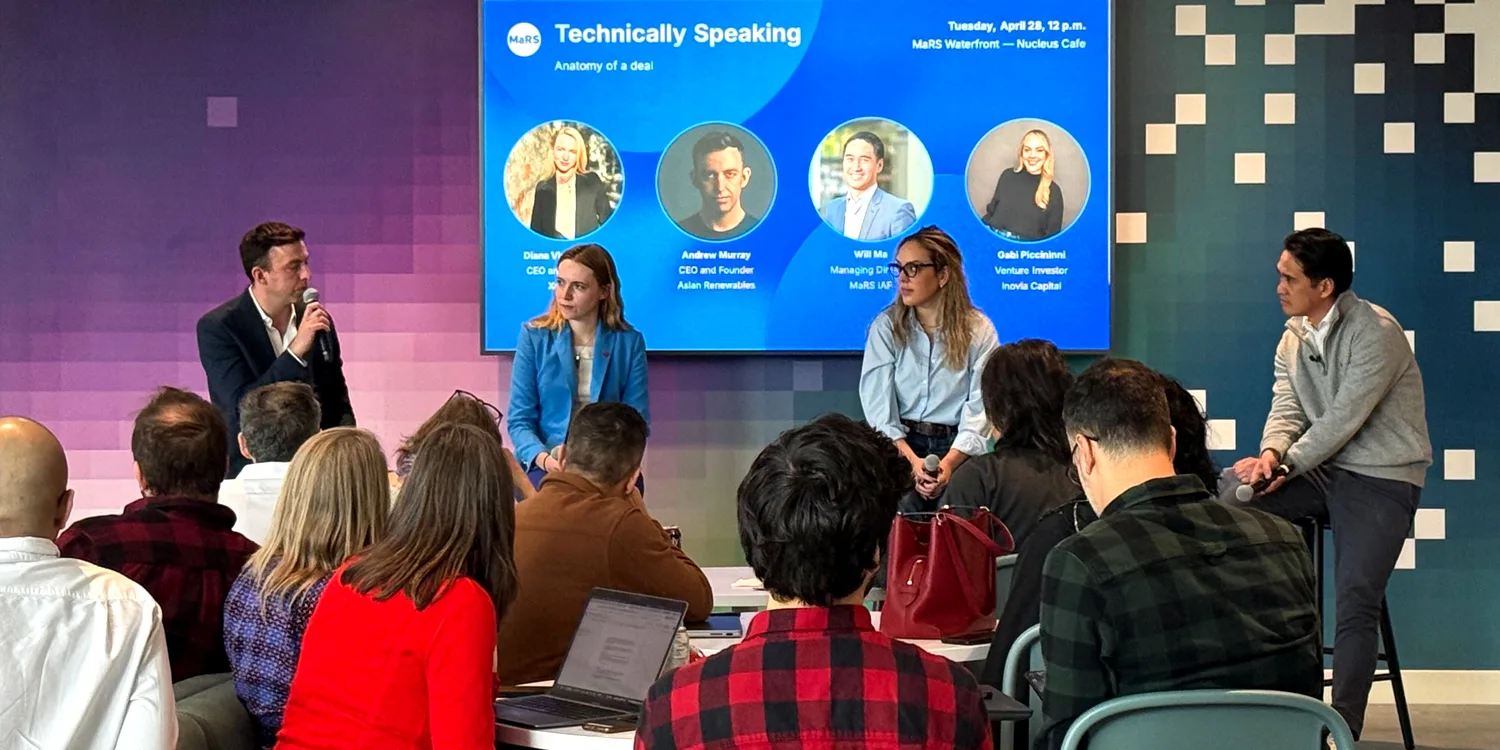
In this tight funding environment, founders need more than vision to secure investment.
It’s getting harder and harder for Canadian entrepreneurs to secure the investment they need to move from early growth to commercialization. Investors are becoming more selective, with both deal volumes and investment values falling for Series A rounds and beyond. And what deals are being made are increasingly concentrated in big-ticket rounds. In fact, the top 10 deals accounted for almost half of all investments made last year, according to a recent analysis from the Business Development Bank of Canada (BDC).
So how can founders navigate this increasingly difficult fundraising environment?
At a recent Technically Speaking event, a panel of tech leaders shared their advice for all stages of the fundraising journey, from networking to cap table:
- Diana Virgovicova, CEO and founder of Xatoms, a Toronto-based cleantech startup that combines AI and quantum chemistry to discover novel, light-activated materials designed to purify polluted water
- Gabi Piccininni, an investor with Inovia Capital, a leading full-stack venture capital firm in Canada with more than U.S.$2.5 billion in assets under management
- Andrew Murray, CEO and founder of Aslan Renewables, a Canadian clean energy company pioneering modular, distributed hydropower systems that deliver scalable, baseload renewable energy from existing water infrastructure
They shared their views in conversation with moderator William Ma, managing director of the MaRS Investment Accelerator Fund (IAF), one of Canada’s most active early-stage venture capital funds.
What was the biggest challenge you faced educating investors about your business?
Diana Virgovicova: It was very difficult at first. I didn’t know what to say. We set out to have as many meetings as possible. We would ask for feedback at the end, which we would put in the deck for the next time. As a first-time founder, you’re trying to accumulate knowledge. We would start with a personal story and explain why we are passionate about this. When you are building a deck, you’re selling the vision at first because it takes years to build.
Andrew, you raised funding with specialized VCs. I’m sure you talked to hundreds of generalists as well. How did those conversations differ and how did you calibrate those conversations in terms of time spent as well as messaging?
Murray: We had a deep tech fund that focused on Southeast Asia. We also spoke with a Canadian partner that looked for different things and invested for different reasons. The difference was the maturation of the markets. In Southeast Asia, they know about distributed energy resources. For them it was an incredible deal because they knew where it was going. We were able to develop a personal relationship. It was very much a founder fit. And Canada was very different. We had to go deep to show our markets were real. We did a lot of customer reference calls. It surprised me how collaborative some of these groups were.
What mistakes do founders make when pitching?
Gabi Piccininni: It depends on your stage. I get a lot of inbound from seed founders. I’m in a position where I need to see commercial traction. Get as much product validation as you can. I love founder-market fit stories early on. Why are you the only person who should be building this? Include any early ROI, or if you have amazing customer experiences you want to share, like efficiency gains in workflows. If you’re in healthcare, clinical ROI is important. In the absence of metrics and data, find a market fit and make sure you’re going to the right investors.
How do you think about capital mix and capital efficiency for the types of businesses you’re building?
Murray: It’s incredible what Canadian companies have learned to do with the dollar. When we go outside our country and talk about progress per dollar, what we can get done with a $1-million round is shocking. It’s a reputation as an ecosystem we should be proud to have because it was hard to build. Japanese investors are coming to Canada for deal competitiveness. You’re going to triple their standards with our work ethic and capital efficiency. Toronto’s capital starts as early as seed rounds in this country. Our investors want to know how they’re going to get a $1-billion to $10-billion return. If you’re raising a $5-million round, you have to know how that round is going to qualify you for debt facilities that were previously reserved for multi-billion-dollar development enterprises.
Virgovicova: We have 12 employees and some are specialized engineers. We have six PhDs. The good thing about Canada is the talent is amazing. It’s so much cheaper than in the U.S. We can hire many people doing good work. We stay in Canada because we can leverage many grant opportunities. Stay in Canada if you want to go far because you can multiply every dollar.
Do you think the Canadian VC market is too focused on capital efficiency?
Murray: You don’t have a choice of discipline, especially in the early stage. It’s more of an access to capital question. You’re not going to have a VC say, “I’ll give you a $500,000 cheque, but I want this for us.” We are clear about the return to the VC at a certain stage and the company’s outcomes. For example, we worked hard to sign up a tonne of commercial traction before working backward to the product because we knew we had to de-risk it at that level to raise.
Diana, during your fundraise last year, there was a point where you were in a different city every day. Talk about the tolls of fundraising, the lessons learned and how you kept momentum within your company.
Virgovicova: It’s a full-time job. When we didn’t have that much commercial traction because we’re super early-stage, we were going to events where we would speak or just pitch. At that time, it was helpful to meet different investors.
Now our approach is to be selective about the opportunities. I was at the World Economic Forum, and that was a life-changing conference because we had the chance to meet CEOs and companies where we were able to spend time. We’ve been selective about who we talk to and preparing for people we are going to speak with at each conference.
For founders that are just starting, there are many opportunities and meetups where it becomes distracting at some point. People invite you to speak and that’s the time you would spend building a company. Be careful because your time is valuable.
What should founders consider when thinking about who should be at their cap table?
Piccininni: Make sure the investor is appropriate for your stage. If you’re a highly specialized company, the best boards have a market specialist, they may have a generalist, they may have a fund that has a platform with talent access. If you’re raising a Series A, what do you need to execute on milestones to get to a B and beyond? If the next 24 months are going to be heavy on go-to-market, then opt for a VC who specializes in that or has connections. A lot of VCs are ex-operators, so you can ask them where they spiked as an operator if they were a go-to-market specialist. Diversify across your cap table. Talk to other founders.
What do founders generally underestimate about the fundraising process?
Piccininni: We ask stupid questions. We don’t know your business as well as you do. Be ready for a lot of questions. If I’m asking 10 to 20 follow-up due diligence questions, if I’m asking for customer calls, that’s a good thing.I would never ask to be introduced to your customers unless I’m super serious. The more irritating I get, the better it is for you.
For founders thinking about fundraising in the near term, how should they prepare?
Piccininni: Build a pipeline of investors you think are the right fit. Get warm intros from people. You should be fundraising around an inflection point. Think about what’s going on that could be an exciting story. Then plan around that. We love to meet the rest of your talent. I love when the product people do the product demos and the AI guys are geeking out. A CFO or finance person may not feel comfortable going through your model.
Virgovicova: If you start fundraising, have your data and your pitch deck ready because that’s what happens as the next call. You want to keep the momentum.
Murray: Speak to other founders, specifically outside your direct ecosystem. We have a great community in Toronto. But you have to go outside it. You’re going to get people saying the same stuff to you. Get out of your immediate comfort zone. It doesn’t mean you need to do a road show. Reach out to founders in other markets like New York or Singapore or the Valley. Talk to them about deal terms and their experience. That way you’ll know what’s acceptable, what’s going to work for you and get real feedback.
At the next Technically Speaking event, Azam Khan, CEO of Trax, and Darren Perlman, co-founder of Spotwork, share effective strategies for bootstrapping your business. Register here.
Photo by Tracy Leung
-
 MaRS Staff