These nine startups are helping build Canada’s climate resilience
Ventures in the inaugural cohort of the MaRS Adaptech Accelerator are working to scale solutions that help communities predict, prevent and respond to extreme weather events.
The costs of climate change keep rising. Last year, ice storms, flash floods, wildfires and other climate catastrophes caused $2.4 billion in insured losses and another $1 billion in uninsured damages, making 2025 one of the costliest years on record. And experts warn that such climate disasters will only become more frequent and severe in the years to come.
This stark new reality underscores the value of technologies that help us adapt to a changing world. The global market for adaptech is expanding rapidly, with investors recognizing climate adaptation and resilience as a major growth opportunity.
A new generation of innovators is poised to meet this demand, but they need support to commercialize their solutions. To help spur adoption, MaRS has launched a targeted Adaptech Accelerator program. Over the coming nine months, selected startups will receive access to labs, tailored advisory support, market research, PR support, investment connections and partnerships with governments and industry.
“We need to build for a climate that has already changed,” says Scott Jenkins, founder of ZS2 Technologies. “This program will help us expedite bringing our technologies to a world that needs them.”
Meet the nine startups in the inaugural Adaptech Accelerator working to build more resilient communities.

Founder Colin Daniel developed a modelling platform to help organizations understand wildfire risk.
ApexRMS forecasts wildfire risks before they ignite
What it does: Ottawa-based ApexRMS helps organizations prepare for wildfires. Colin Daniel, a landscape ecologist with a background in systems design engineering, founded the company in 2007 to help decisionmakers access ecological science. According to Daniel, most world-class research on ecological forecasting and climate risk remains “buried in academic papers, complicated government research products or commercial tools that aren’t validated.”
The company’s SyncroSim modelling platform creates digital twins of cities and landscapes. “You can model the current state of a landscape, project how it will change under different futures and test what impact various management actions might have — all before actually taking any actions on the ground,” says Daniel.
Apex’s companion product, the Canadian Wildfire Hazard Data subscription service, delivers annually updated wildfire hazard maps at 30‑metre resolution for all of Canada, giving users a ready‑to‑use baseline to use alongside the platform.
How it can help: ApexRMS helps organizations move from reactive responses to proactive planning: Insurance companies can assess wildfire risk before underwriting properties, utilities can better plan infrastructure corridors, municipalities can make more informed zoning decisions, and Indigenous communities can protect their land and people.
Latest milestones: SyncroSim has been adopted by organizations across North America, including the U.S. Geological Survey, U.S. Forest Service and the Nature Conservancy. In collaboration with Natural Resources Canada, the company developed BurnP3+, a wildfire risk modelling tool designed for non‑technical users. This year, it partnered with Property Guardian to distribute wildfire risk data nationwide.

Norman Zhou co-founded AquaSensing with fellow University of Waterloo professor George Shaker in 2019.
AquaSensing detects water leaks before it’s too late
What it does: After years of researching nanomaterials for energy harvesting and water treatment at the University of Waterloo, engineering professors George Shaker and Norman Zhou set out to tackle one of the costliest problems in the built environment: hidden water leaks. “Water leaks are often detected too late, and the systems meant to catch them are either expensive to maintain or unreliable at scale,” says Zhou. In 2019, they founded AquaSensing.
The startup’s solution is a self‑powered sensor made from moisture‑enabled nanomaterials. When it gets wet, it generates its own electricity — enough to record environmental data and send an alert to a mobile device. These small sensors can be installed in difficult-to-access areas where battery replacement or wiring isn’t feasible, eliminating maintenance and chemical waste associated with battery‑based devices.
How it helps: AquaSensing’s technology allows building operators, utilities and municipalities to catch leaks sooner, saving water, preventing structural damage and reducing maintenance costs. “Even small leaks, when multiplied across buildings and systems, represent a significant loss of treated water and embedded energy,” Zhou notes.
Latest milestones: AquaSensing has advanced from research to functional prototypes, with pilot deployments at Evergreen Brick Works, Simon Fraser University and FireBot, a U.S. company that makes fire detection and suppression technology.
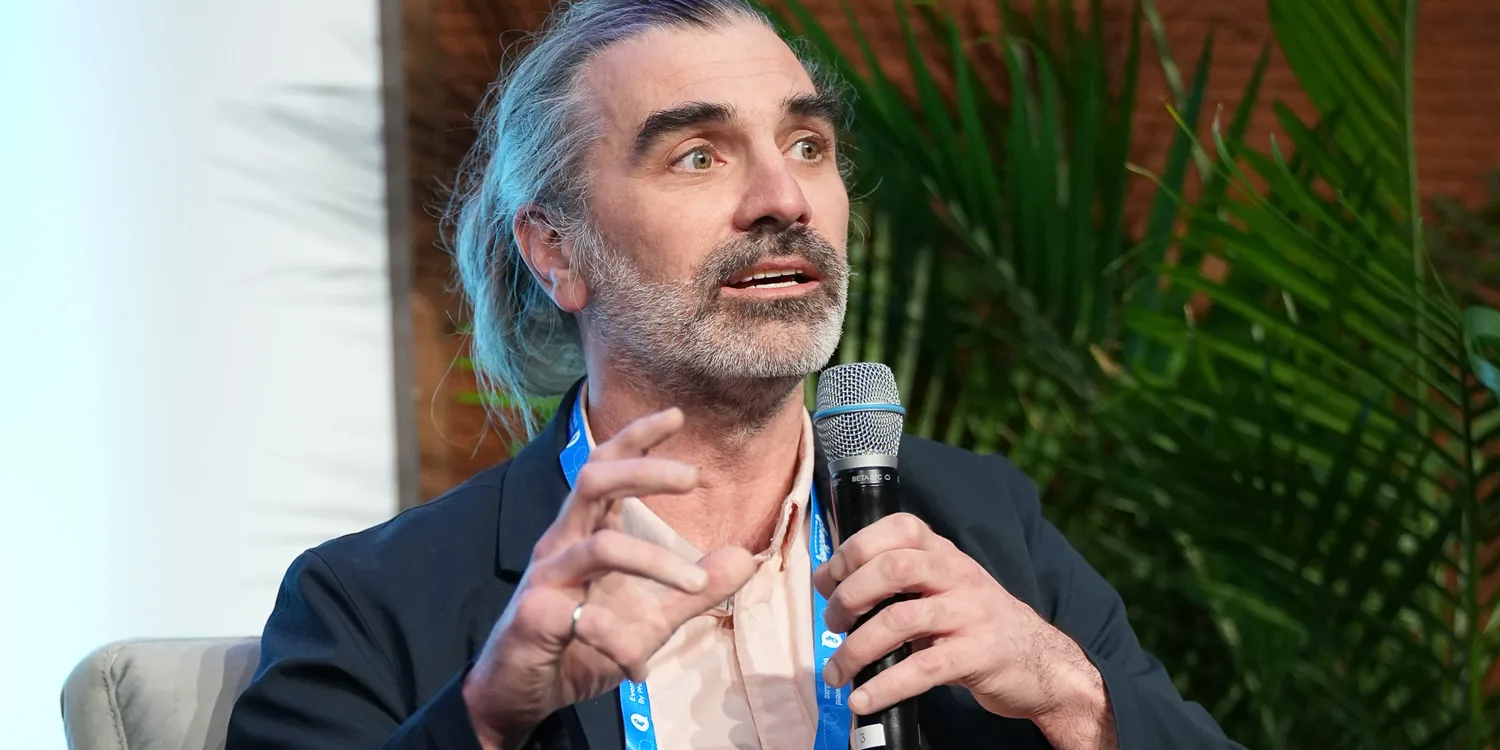
Mike Williams is the president and co-founder at ClimateFirst.
ClimateFirst helps real estate owners protect their portfolios
What it does: Dave Bullock, Michael Soligo and Mike Williams co-founded ClimateFirst in 2023 to scale up climate risk assessments. They had been working at a consulting firm, helping building managers understand their climate risk. The challenge was they could only address one building at a time. “We quickly realized we were only scratching the surface of a massive global problem,” says Williams. “To truly scale to millions of buildings, it needed to be a software‑driven solution.”
They developed a climate‑risk platform for real estate owners and managers. Clients upload property data, and it analyzes each building against future climate hazards — flooding, extreme heat, wildfires, storms — based on each building’s location, construction and systems. The output is a financial risk score that shows potential costs and asset value impacts, plus prioritized recommendations for resilience upgrades.
How it helps: “Traditional approaches tend to stop at identifying hazards,” says Williams. “We’re focused on commercial real estate, so we connect risk directly to building systems, dollars and actionable solutions.”
Latest milestones: The company has completed more than 1,000 assessments, partnered with major real estate and climate‑data firms and expanded from Canada into the U.S., Europe and Asia, positioning its software as a go‑to climate‑risk platform for global property portfolios.
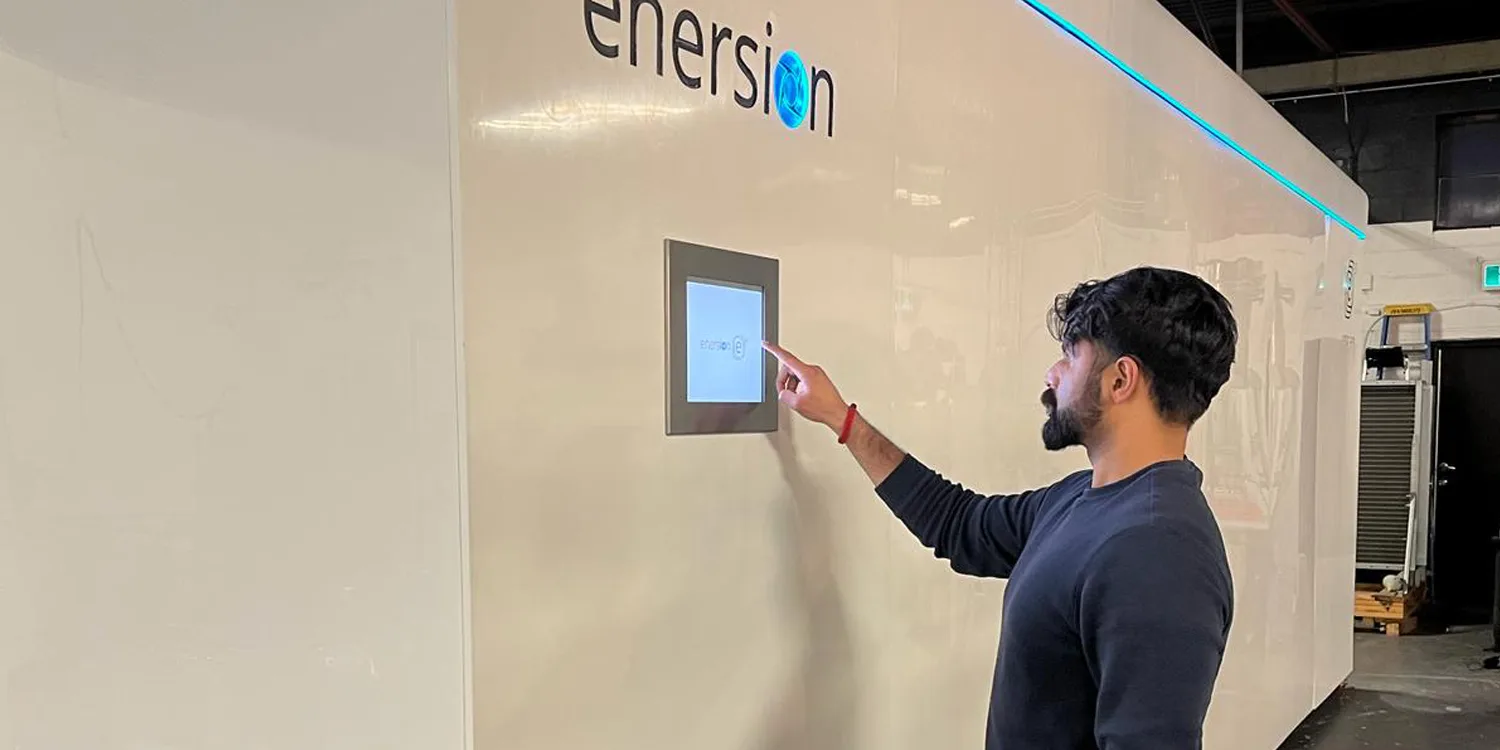
Enersion’s heating and cooling system uses up to 15 times less electricity than conventional devices.
Enersion reimagines cooling and heating without refrigerants
What it does: Enersion has developed a breakthrough alternative to conventional heat pumps. Many traditional systems depend on electricity‑hungry compressors and synthetic refrigerants that contribute to global warming and ozone depletion. The startup has developed a method that uses water as the refrigerant and nanoporous materials in place of a compressor.
The unit, which consumes up to 15 times less electricity than conventional devices, can be powered by low‑grade heat from such sources as data centres, solar thermal collectors, steam condensate or combined heat‑and‑power (CHP) systems — harvesting waste energy that would otherwise be lost. They can capture heat from the sun, or recover waste heat from industrial processes, data centres or HVAC systems — and store it for later use to power a cooling system. The system can respond to signals from the electrical grid, ramping up or down based on grid conditions, electricity prices or peak demand.
How it helps: By cutting electricity demand and running on recycled heat, Enersion’s technology reduces operating costs and emissions for commercial buildings, government facilities and data centres while improving resilience during peak‑load or extreme‑weather events.
Milestones: Enersion holds 16 patents worldwide, with installations across North America, including Con Edison headquarters in New York, SunEarth Headquarters in California, and industrial customers in Alberta and Ontario.
Among the company’s key achievements is operating at a 58 degrees Celsius regeneration temperature — the temperature needed to drive the cooling cycle. (Most chillers require temperatures of 80 to 120 degrees Celsius or higher.) A lower regeneration temperature unlocks more heat sources, using less expensive equipment — opening up the technology to more buildings and facilities.

Co-founder Hachem Agili and his team have developed a high-resolutions modelling platform.
Geosapiens help insurers, banks and public institutions assess climate risk
What it does: Quebec City–based Geosapiens specializes in high‑resolution flood and wildfire modelling. Hachem Agili co-founded the company in 2017 with a research team from the Institut national de la recherche scientifique (INRS) to close the gap between climate science and real‑world decision‑making. Through research and collaboration with organizations working on flood risk, Agili says it “became clear that most climate models were developed at scales too coarse to support concrete decisions by insurers, governments or communities.”
Geosapiens’ modelling combines advanced geospatial data, hydrology, AI and climate science to generate property‑level hazard and financial‑loss insights. Its SaaS and API solutions integrate directly into insurers’ underwriting tools, banks’ lending platforms and governments’ planning systems.
How it helps: By making climate risk visible and measurable at the local scale, Geosapiens helps organizations plan where to invest, what to insure, how to design infrastructure or which mitigation measures to implement.
“Communities can prioritize the most vulnerable areas, insurers can price and manage risk more sustainably and businesses can make informed decisions about assets and operations,” says Agili.
Milestones: Geosapiens has deployed its models nationwide, supporting major insurers and financial institutions with property‑level risk data. A strategic partnership with Co‑operators, one of Canada’s leading insurers, marked a major step in bringing climate analytics into real‑world underwriting. The company has also built a full enterprise platform accessible via web portal and APIs, enabling integration of climate‑risk intelligence into underwriting, portfolio management and resilience planning.
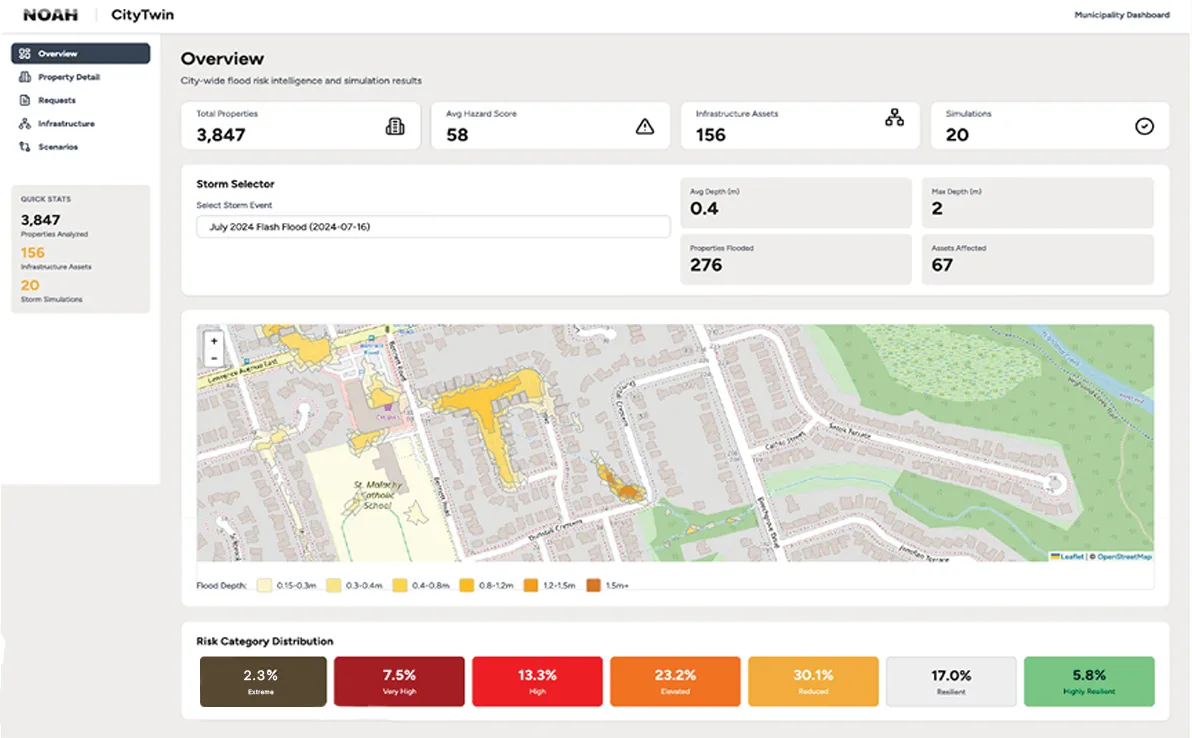
Noah Intelligence helps property owners assess their flood risk.
NOAH Intelligence models flood risk at the property level
What it does: NOAH Intelligence was born out of a simple but urgent reality: Cities and buildings are facing flood risks they were never designed for, and existing tools aren’t built to manage that shift. Founded by water resources engineer Steve Van Haren and technology entrepreneur Chris Godsall in 2024, the startup creates digital twins of entire cities — every contour, road, bridge and sewer line — and uses physics-based simulation to model how rainfall moves during storms. Their technology simulates how fast water moves, where it pools and how deep it gets. It can zoom into a specific address and tell a property owner what their risk of flooding is, how costly the damage would be and how they can avoid it. NOAH’s platform lets them rapidly run “what if” scenarios on infrastructure upgrades and identify the interventions that deliver the greatest risk reduction across the widest number of properties.
“We turn complex climate and infrastructure data into simple, property-level insights that show risk, potential damage and practical steps to reduce it,” says Godsall.
How it helps: NOAH moves adaptation from theory to action by identifying where risk exists, showing what steps could reduce it and measuring the financial impact these interventions could have over time. This enables property owners, cities and institutions to invest in resilience with measurable outcomes.
Milestones: NOAH has generated more than 480,000 property-level flood risk scorecards and partnered with major Canadian cities including Calgary, Burlington, Markham, Richmond Hill and Vaughan. It has rolled out its platform across commercial real estate portfolios and evolved from pilot projects to scaled deployments across insurance, finance and infrastructure sectors.

Myrna Bittner is the co-founder of RunWithIt Synthetics, which creates high-fidelity digital twins of cities and landscapes.
RunWithIt Synthetics models tomorrow’s cities
What it does: Founded in 2014, RunWithIt Synthetics (RWIS) is a woman-led, Indigenous company based in Edmonton that helps governments, researchers and industry leaders prepare for complex and uncertain futures. Its platform creates high‑fidelity synthetic twins: digital environments that replicate not only infrastructure and landscapes but also the people, systems and evolving conditions that define communities. Clients can explore a range of scenarios, from policy to economics to climate impacts. For example, RWIS worked with NASA to model the community impacts of wildfires, showing who would evacuate or shelter in place, who would be exposed to dangerous smoke levels and where evacuation bottlenecks would occur.
Unlike traditional models that rely on historical data, RWIS uses current data from the public realm covering demographics, land use and zoning, transportation and mobility, as well as health and social services. It also incorporates local knowledge, working with community stakeholders to validate assumptions and incorporate lived experience that doesn’t show up in datasets.
How it helps: According to co-founder Myrna Bittner, by testing the resilience of systems before events occur, RWIS helps communities to “prepare, prevent, respond and recover in ways that protect our most vulnerable people, our investments and economies, built environments and critical systems and our planet.”
Milestones: Over the past decade, RunWithIt Synthetics has partnered with agencies such as NASA, FEMA and NERC to test large‑scale disaster and energy scenarios. They won the United Nations Global Call for Decarbonizing Growing Urban Environments and ASTech Innovation of the Year.
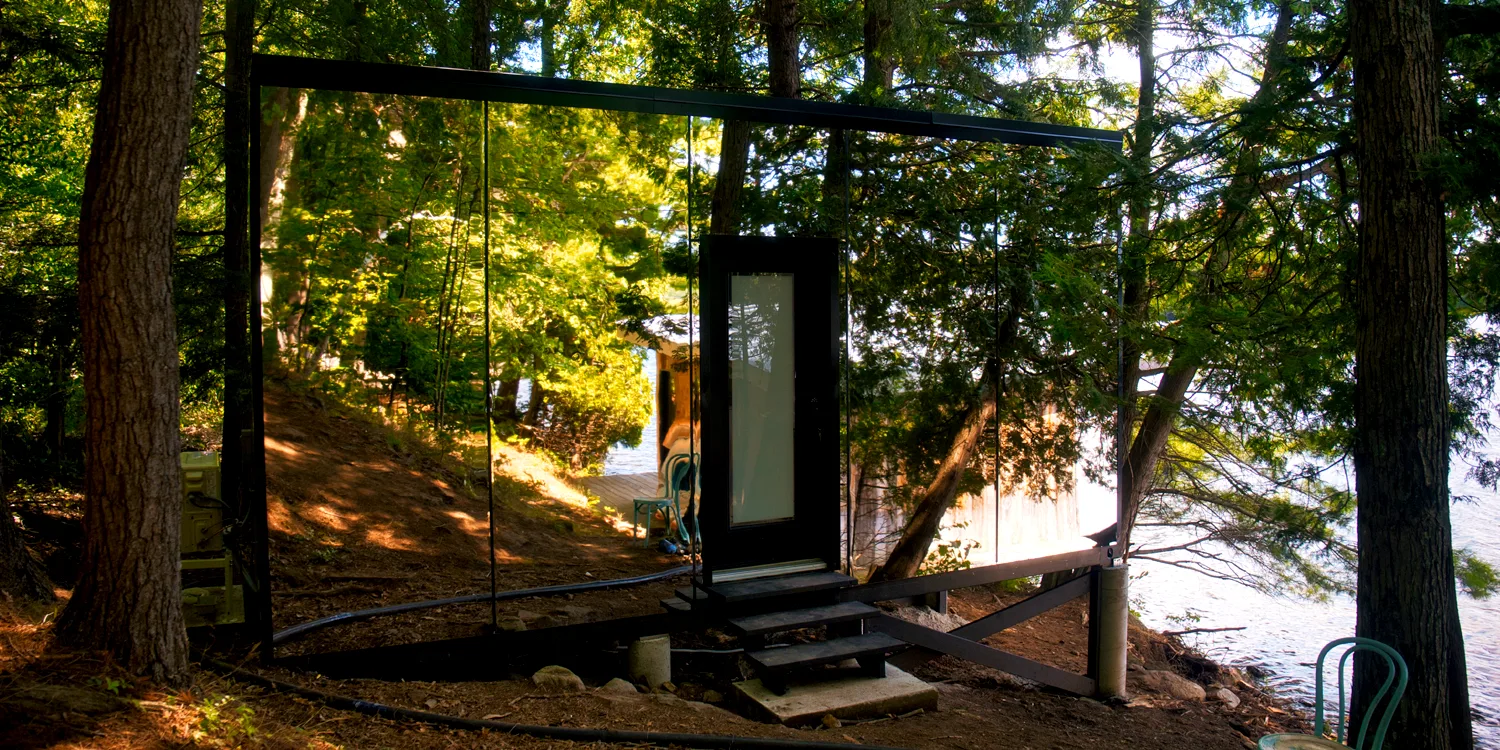
Tinybox Systems’ modular homes are designed to be readily assembled without heavy equipment.
Tinybox Systems builds climate‑resilient modular homes
What it does: Tinybox Systems builds rapid‑deploy, modular housing built to withstand extreme weather conditions. Its proprietary system combines ultra‑insulated structural panels, deep foundation systems and flat‑pack logistics with optional off‑grid water and sanitation systems to deliver durable, low‑dependency housing in as little as 48 hours. No cranes, concrete or heavy equipment required.
“Unlike conventional prefab construction, our system minimizes on-site labour, reduces reliance on concrete and heavy equipment, and can operate independently of municipal water and sewer systems,” says co-founder Oliver Zhang.
How it helps: Tinybox homes can withstand a range of harsh climates and conditions, from the Arctic cold to fire-prone regions. They are naturally fire-resistant, earthquake-resistant and can withstand severe storms.
Milestones: Tinybox has built units from California to northern Quebec. The company’s homes have been used for backyard studios, off‑grid resorts and remote workforce housing. Its ability to ship easily, assemble quickly and operate sustainably has drawn growing interest from Indigenous communities, municipalities and developers focused on climate adaptation. This year, Tinybox is gearing up to deliver one new structure per week, including projects for resorts in British Columbia and housing for communities rebuilding after wildfires.
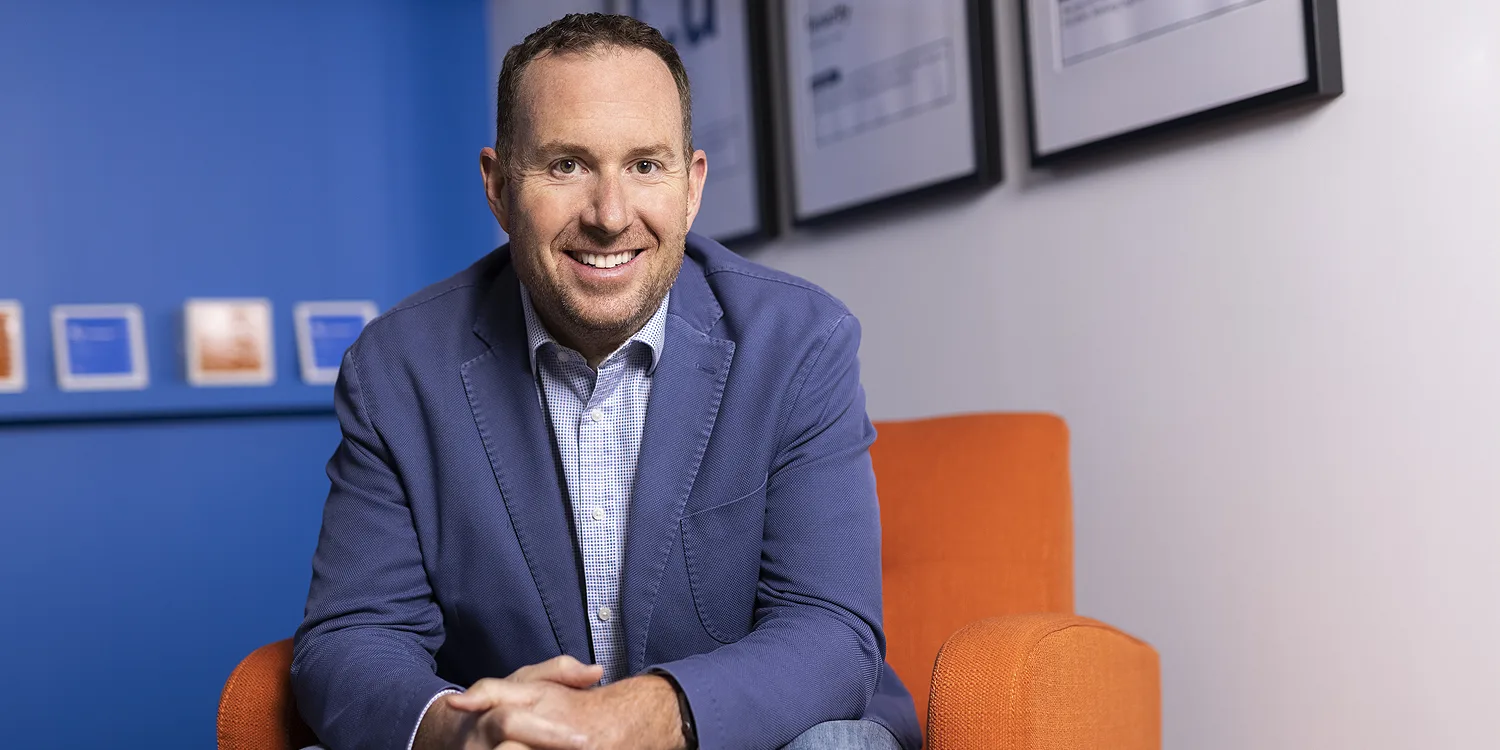
Co-founder Scott Jenkins and his team creates lower-carbon building materials that are climate-resilient.
ZS2 Technologies is reinventing cement
What it does: Calgary-based ZS2 Technologies develops magnesium‑cement building systems designed to be safer, cleaner and more resilient than traditional cement. ZS2 uses carbon dioxide captured from industrial point sources, such as concrete plants, steel mills and power generation facilities in its pre-cast cement products, which include structural panels, cladding, stone veneer and floor tiles.
How it helps: By using mineralized carbon dioxide, ZS2’s magnesium cement products are stronger, 30 percent lighter and in some cases carbon‑negative. Its solutions have already proven their resilience: a women’s transition center built for the Tetaskweyak First Nation in northern Manitoba survived days surrounded by wildfire, emerging intact. ZS2’s products are also certified for Category 5 hurricanes and recognized by Aviva Insurance under its Preferred Partner program.
“The need for climate resilient and cost-effective building materials continues to grow throughout North America,” says co-founder Scott Jenkins. “While building codes are adjusting slowly to this new reality it is the nearly $10-trillion annual insurance industry that is driving and accelerating change.”
Milestones: The company has now completed more than 150 projects across North America, earned support from the National Research Council, Emissions Reduction Alberta and CMHC. ZS2 has secured multiple patents and received global recognition from the Solar Impulse Foundation for its climate‑resilient materials.
Want to learn more about Canada’s emerging adaptech market? Read our recent report.
Photo illustration by Stephen Gregory; Images: Unsplash
-
 Brett Tryon