Colour block: When it comes to water, can the textile industry clean up its act?
Clothing manufacturing is responsible for one-fifth of the world’s industrial water pollution. On this episode of Solve for X, we dive into this ecological crisis — and explore how one electrochemical solution could make an enormous difference.
The fashion industry has its fair share of dirty secrets, but one of the lesser-known is how much it pollutes our waterways. Every year, garment factories use as much as 2 trillion gallons of water to dye clothes, and most of that water, now filled with harmful chemicals, flows untreated into rivers, streams and lakes. Those pollutants can turn rivers black, harm marine life and cause cancer. Macarena Cataldo, a chemical engineer based in Vancouver, has come up with an ingenious way to remove these contaminants before they even reach the water. In this episode, Cataldo talks to Manjula Selvarajah about the global water crisis, how her technology works and efforts to get major fashion brands to change their ways.
Featured in this episode:

Macarena Cataldo is the CEO and CTO of Viridis Research, which she co-founded in 2019 to solve various global water challenges by eliminating pollutants from water sources. She has a PhD in chemical engineering, and has spent more than 15 years applying electrochemistry to drinking and wastewater treatment working with the European Space Agency, the Metropolitan Water Company of Turin and others.
Further reading:
- Asian rivers are turning black. And our colourful closets are to blame
- Why colouring clothes has a big environmental impact
- World enters era of “global water bankruptcy”
- Water crisis in Chile: Are we close to day zero?
Subscribe to Solve for X: Innovations to Change the World here. And below, find a transcript to “Colour block.”
Narration: Clothes are a dirty business. Before that shirt on your back lands in a hamper — in fact, before it even gets to the store — it’s already made a big mess. The textile industry turns out about 20 percent of the pollutants that contaminate the world’s water supply each year.
Macarena Cataldo: So they can damage fish, they can generate problems like cancer or other sickness in water, they can as well change the characteristics of the rivers and lakes where they have been discharging.
Narration: That’s Macarena Cataldo. She’s a chemical engineer and the CEO and co-founder of Viridis. It’s a B.C.-based company that’s found a novel way to remove contaminants from water.
Macarena Cataldo: It’s not just about the water that we drink, it’s all the cycle. And I think that a very important part of this is the dignity of people around water. How we dignify life by protecting water.
Narration: I’m Manjula Selvarajah, and this is Solve for X: Innovations to Change the World, a series where we explore the latest ideas in tech and science. Today, we’re diving into the textile industry’s water crisis.
Manjula Selvarajah: So take me back. I want to get into the technology soon, but I want to hear a little bit about your background. I hear that there is this experience that you had when you were much younger that got you thinking about water. Tell me about that.
Macarena Cataldo: Yes. When I was younger, I was teaching science to kids at social risk in Chile and I had the experience to visit a very poor neighbourhood. It was almost 30 minutes away from my neighbourhood. I asked, “Oh, could I go to the washroom?” And I noticed that they didn’t have drinking water or sanitation at all. And I was like, “I can’t believe it.”
Manjula Selvarajah: What does that mean? You mean that they don’t have taps? So they just don’t—
Macarena Cataldo: Nothing. Nothing. And I was like, uh, I felt that I was living in a bubble.
Manjula Selvarajah: Wow.
Macarena Cataldo: So at that time I was studying chemical engineering and I started to think about water a little bit more. So I decided to do a PhD in the field, in water treatment. So in that way I could combine my inspiration to clean water, to protect the water and then dignify a little bit the life of people.
Manjula Selvarajah: It’s kind of interesting when I think about that. There’s so many things that stand out to me in that story. Like I haven’t really thought about how much water that I’ve used today at all. Is that a thing, do you think? That we don’t truly appreciate the value of water or the access to water that we have?
Macarena Cataldo: We don’t appreciate it. At all. We don’t even know how much water it takes to have an apple or, um, or jacket or computers. We talk about CO2 sometimes, but we don’t have an idea about how much water was in that process. In all the processes. It’s not just about the water that we drink, it’s all the cycle. And I think that a very important part of this is the dignity of people around water, how we dignify life by protecting water. So if we think about water as any other problem, who is going to be paying the consequences of water crisis are going to be historically marginalized communities. The poor people in my neighbourhood.
Narration: Water scarcity has taken an especially brutal toll on Chile. While the country has one of the longest coastlines of any nation on the planet, a decade of drought has dried up its fresh water reserves. And the mining industry has further compromised the country’s rivers, which means there isn’t enough clean water for agriculture or even to meet the basic needs of communities.
Macarena Cataldo: Part of the water crisis is related with the lack of governance at different levels. Kind of fiscalizing the amount of water that the industries are taking, and at the same time providing to the citizens with the right solutions for water.
Manjula Selvarajah: I heard that actually cities were getting water trucked in at one point, is that right?
Macarena Cataldo: Yes, but it’s not just here. I mean not just in Chile. I think it’s very important to highlight the conditions that remote communities and First Nation communities are living here, and the lack of drinking water that they have here in Canada.
Manjula Selvarajah: Access to water is a problem here, too.
Macarena Cataldo: Access to water is very important. And people spend hours driving from one city to another to just buy gallons of water. So how, if you have a baby or you have a family — that responsibility tends to be part of the role for the women — so that women cannot have a normal life because it has to be taking care of the water for the family.
Manjula Selvarajah: That it becomes this huge task—
Macarena Cataldo: Exactly. So it’s like we need to kind of think of beyond our own reality because it’s — we are not alone living in this planet.
Manjula Selvarajah: I don’t think I fully appreciate that turning on the tap for a glass of water is actually a luxury. That for people — for some people — that is maybe a five-kilometre trek and then they might even still not get clean water at the end of that.
Macarena Cataldo: It relates with the numbers for lack of education of women because they can’t — they don’t have sanitation so they don’t want to go to school when they become a teenager. So many problems that are related then, again, with historically marginalized groups that we need to kind of think about it. And we talk about drinking water, but water that they use, that the community requires, those waters are like less than 10 percent of the total water resources. The other part is mainly agriculture and industry. So what is the problem? That people think, “Oh, we need to do this new not-for-profit organization to generate more drinking water and clean the water.” But actually, if we are not polluting the rivers and lakes in the first place, we don’t have to clean it later.
Manjula Selvarajah: Because the usage, as you said, is about 10 percent
Macarena Cataldo: Exactly. So little in that percentage.
Manjula Selvarajah: I want to ask you about this concept that I read about, this concept of Day Zero. This is the day that a city runs out of water, when the taps actually run dry. Now researchers are projecting that we’re gonna see a startling increase in these events around the world. What could that mean?
Macarena Cataldo: That means the same that the fires mean in California — rich people going in helicopters and paying private flights to take care of their houses, and poor people losing everything. The same is going to happen with water. People who can pay for it at a higher cost, they’re going to have it anyway. It’s the rest of the population that is not gonna be able and this is going to just get worse.
Manjula Selvarajah: Worried that it will be the marginalized that actually suffer the most because other people, like you said about the fires, people who are wealthy have a way to kind of escape these problems.
Macarena Cataldo: Yeah.
Manjula Selvarajah: I’ve noticed that in conversations that I hear about climate action, there is quite a bit that is being said about carbon. Are we paying enough attention to water?
Macarena Cataldo: Not at all. No. In fact, like each time that we talk with investors, grants, even the government, it’s not any kind of incentive for reducing water or cleaning water. So it’s very difficult for us to kind of somehow compete with other cleantech companies because we don’t have tax credits or carbon credits as CO2 emissions.
Manjula Selvarajah: Now you’ve decided to focus on the textile industry, specifically dyeing materials. Why is dyeing so bad for the environment?
Macarena Cataldo: In general, they are very complex molecules and they are difficult to decompose in the environment. So they can damage fish, they can generate problems like cancer or other sickness, and they change the characteristics of the rivers and lakes where they are discharged. So it’s very important to degrade them before they reach any kind of water source.
Manjula Selvarajah: So it’s the actual chemicals that are involved that are part of the problem.
Macarena Cataldo: Exactly.
Manjula Selvarajah: Is it also how much water it takes to do dyeing? Is it also —
Macarena Cataldo: Yes.
Manjula Selvarajah: —water intensive?
Macarena Cataldo: So for each kilogram of black cotton, you’ll need around a hundred litres of water.
Manjula Selvarajah: Really?
Macarena Cataldo: Yes.
Manjula Selvarajah: That’s insane. I had no idea.
Macarena Cataldo: Just for the dying process without counting the amount of water that you need to pretreat the material, the cotton, and all the distribution.
Manjula Selvarajah: How do dye mills deal with that now? I mean, we’re talking about a substantial volume of water and we’re talking about these chemicals that are sitting in this water that they have to remove one way or the other I would imagine. How do they deal with it now?
Macarena Cataldo: It’s a very low percentage of the textile mills that are currently treating the water.
Manjula Selvarajah: But you are talking about places where there are dye mills where regulations may be lax.
Macarena Cataldo: Mm-hmm.
Manjula Selvarajah: What about places where they do have strict regulations about discharge? How do they do it there?
Macarena Cataldo: It depends on like where we’re talking about. Because even in North America, some factories that have been working for more than 40 years are under old regulations and they’re still discharging the water without treating the dyes.
Manjula Selvarajah: Is it impossible in those scenarios, with what equipment that they have, to reuse that water once the chemicals are in? Do they do any kind of reuse at all right now?
Macarena Cataldo: Not really. The technologies that are available are not the best fit for cleaning the water. They require infrastructure, huge infrastructure, so it’s difficult to implement. If you already have a factory, maybe you don’t have that amount of space. At the same time they generate a sludge or brine that then you have to do a secondary process or dispose them. So you are moving the problem from the liquid to a solid phase, but you are not ending the problem. So it has been a little bit difficult to find the right technology for cleaning the water and the right motivation. But right now I think that’s changing a little bit, which is very positive.
Narration: To understand the scope of this problem, it’s helpful to get a sense of what’s involved in dyeing textiles. Humans have been using dyes to change the colour of materials for tens of thousands of years. Up until the 19th century people turned to organic sources: blue from indigo flowers, purple from sea snails, red from insects.
But these days, most manufacturers rely on synthetic dyes. Unlike paint, which sits on the top of a surface, dyes are dissolved in water and basically stick to the fibres of the material being dyed. It’s why your blue jeans stay blue. But that process requires a lot of water — as much as 150 litres to dye one kilogram of fabric.
Manjula Selvarajah: So, Macarena, what’s your solution? How does your technology work?
Macarena Cataldo: So, basically, we use electricity to clean water.
Manjula Selvarajah: So let me ask this the way that a grade five kid would — are you zapping? Are you zapping the chemicals? Is that the way to describe this?
Macarena Cataldo: It’s more like a burning in water. It’s like a combustion reaction, but with water and electricity instead of fire.
Manjula Selvarajah: Tell me again what it turns into. You said it’s carbon dioxide?
Macarena Cataldo: Yes, nitrogen and water gas.
Manjula Selvarajah: It’s kind of strange to think that you are actually combining water and electricity.
Macarena Cataldo: When I explain to people electrochemistry and they don’t see it, it looks like magic. And I kind of like it. It’s just my own trick [laughs].
Manjula Selvarajah: It feels magical. What you’re talking about is magical. Is there a limit to the type of, or the kind of, contaminants that it can handle?
Macarena Cataldo: We can handle organics. Any kind of organics. Organics are molecules that have a carbon bond — let’s say, dyes, PFAs —
Manjula Selvarajah: Wastewater, perhaps?
Macarena Cataldo: Wastewater from drugs, fertilizers. However, we don’t remove any kind of metal or ions. So that is out of our scope.
Manjula Selvarajah: How do you know it works?
Macarena Cataldo: It’s my bread and butter. I have been studying this for 15 years, so it’s like—
Manjula Selvarajah: But are there tests that you do at the end of the process that say —
Macarena Cataldo: Oh, yes, of course. We test all the water before and after. We analyze different parameters, like total organic carbon, the pH, if it’s the right pH. We analyze the colour, turbidity. So we have a set of parameters that we analyze to be sure that it’s working. It’s science. So we cannot lie — like, it’s working or it’s not working.
Manjula Selvarajah: So there’s a potential here for this to be used — treating wastewater is a huge issue for cities. I mean, there’s all sorts of issues around wastewater. We did a podcast episode on it and I learned so much about how difficult that is. And actually cities can’t even handle most of what they have now. Is there a potential there? Is there an opportunity there?
Macarena Cataldo: Yes, in fact, we are starting a collaboration with Metro Vancouver too, that we are very excited about. It’s a long-term project that is going to take probably at least five years if we execute it. But we started with a couple of feasibility studies and it was working well.
Manjula Selvarajah: So there is a, so potentially a pilot down the road, but just an analysis for now.
Macarena Cataldo: Exactly. For now, we want to focus in the textile industry because we are a startup and we need to be focused. But we are open to expand to different markets once we are profitable and have enough resources to do it.
Narration: Treating water in a lab is one thing. But Macarena has a bigger vision. What if you could treat dye water and recycle it, so it never has to leave the system? Her proof-of-concept came out of an entrepreneurial meet-cute. During a corporate event, she started chatting with a stranger in the women’s washroom about the challenges involved in scaling a business.
Macarena Cataldo: And we were talking and she asked me if you — one thing that you need for your business that is not money, that is going to help you to go to the next stage, what it is, tell me it, it’s very difficult to get. I need a textile factory in Canada willing to test my technology for cleaning water.
Narration: Macarena had no idea she was talking to Katherine Homuth, the founder, and then CEO of Sheertex, a Canadian company that makes tights.
Macarena Cataldo: And she said, “You know what, I have a factory.” I said, “Are you kidding me?”
Narration: Katherine invited Macarena to run her first pilot at the factory in Montreal. They used Viridis’s technology to clean water from a dyeing process and then re-used it to colour more black tights.
Macarena Cataldo: I’m wearing them now [laughs].
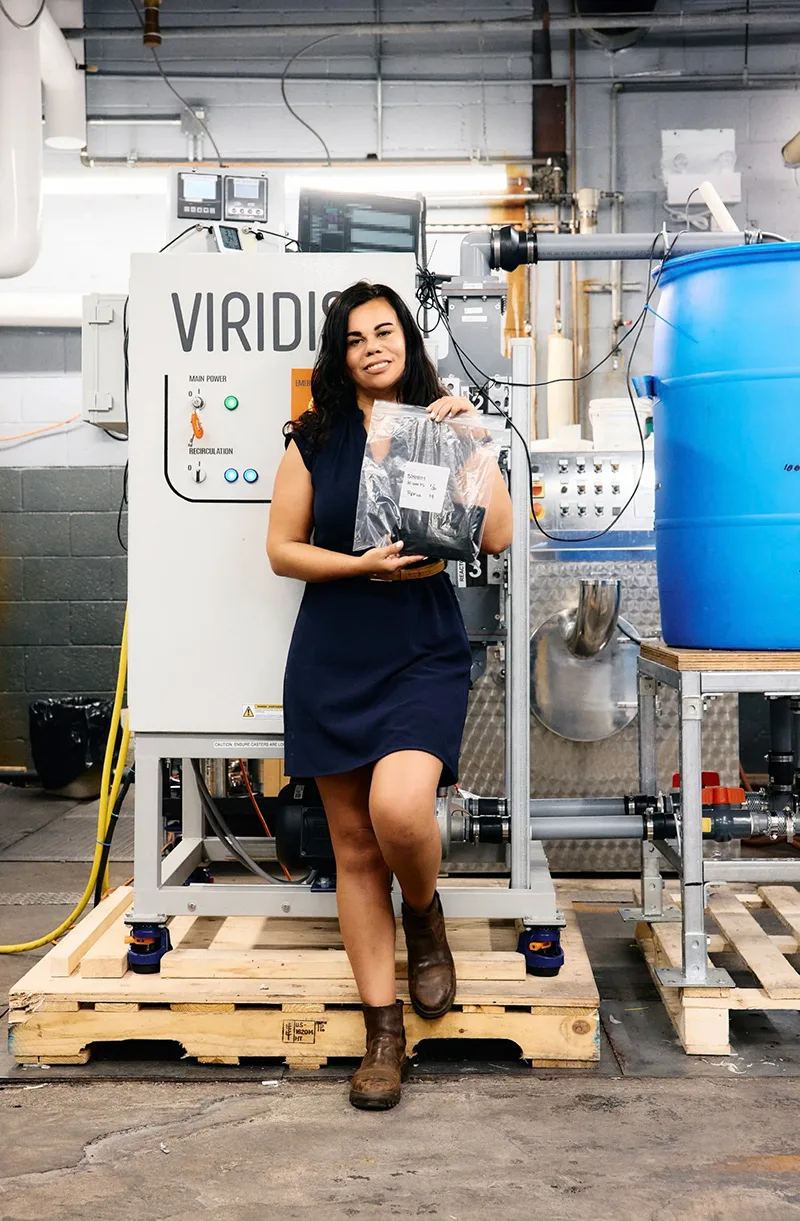
Manjula Selvarajah: Oh, you’re wearing them now? That’s incredible. So here you have this, this idea that you have in the lab, you have some proof-of-concept. You’re wearing the proof-of-concept right now. You have this sense that this could change how materials are dyed. What challenges do you have to overcome to have this work in a real-world setting?
Macarena Cataldo: Oh my God, so many challenges. We are selling equipment to factories. And there is a part that I really love about them, like interacting with other chemical engineers and visiting factories and understanding their problems. But there are other parts I don’t like. That is, raising money because we have to anticipate the capital to manufacture units before selling them. So that part is difficult because building a hardware business takes longer than SaaS. So it’s an investment that requires more time.
Manjula Selvarajah: So there’s the hard tech component, your hard tech as opposed to software.
Macarena Cataldo: Exactly. So that is the difficult part to — to find people aligned with our mission and values that really want this technology.
Manjula Selvarajah: I wonder also if there’s some kind of buy-in needed from the industry? Because this would be an added — at some point, would be an added expense for the fashion industry. What do you think would motivate them to make this change?
Macarena Cataldo: So, in the way that we are currently working, one of our main partners are H&M, that we met because of Sheertex. And their main motivation, its manufacturing excellence, because in Europe they are pushing to be more conscious about their supply chain at all the different levels.
Manjula Selvarajah: So they have to comply with regulations.
Macarena Cataldo: It’s not a binding regulation, but they are starting to push a little bit more to make it more rigid, more strict. But we know that more important for the textile mills that have very low margins is to be profitable. Because they need to keep the business alive. So our business is not based in sustainability, even if it’s our main part of our mission. It’s an economical sell because we are providing 25 to 30 percent of reduction of water cost. So they save money by using our technology.
Manjula Selvarajah: So that’s gonna be —
Macarena Cataldo: — the motivation —
Manjula Selvarajah: — the motivation for the industry. That’s interesting. Do you feel that that’s resonating, or maybe it’s too early to tell right now. What stage are you at?
Macarena Cataldo: So now we are running more pilots, and after those pilots we expect to get our first commercial units in those factories. We have very big brands as potential customers and we are currently collaborating with them. So, mainly in Bangladesh, as well in Korea and Central America.
Manjula Selvarajah: It seems to me — correct me if I’m wrong — that a lot of dyeing of materials happens in the Global South. Which also means that some of these problems that we’ve talked about around water pollution, running out of water, all of those sorts of issues, also fall on these areas. How do you see your work addressing the inequities and harms there?
Macarena Cataldo: Honestly, I don’t think that we care enough. We should care enough. The majority of the products that we have — our computers, our dresses, our clothes or whatever, is mainly manufactured in the Global South. So we are not conscious about the impact of all the stuff that we buy every day. And I think that we should be a little bit more conscious. And it should be even regulations that make the business to be more conscious about where they are buying and the conditions of the products that they are producing in those countries. Because it’s true, in the end, like the Global South is suffering the consequences of the industrialization and they are not getting the benefits.
Manjula Selvarajah: Now you do have plans to test in Bangladesh?
Macarena Cataldo: Yes.
Manjula Selvarajah: What are you hoping to learn there?
Macarena Cataldo: So, we want to understand what are the textile mill needs for real? We know that they want to clean the water. We want to understand how much they are willing to pay, what are their problems, and how we can fit in a way that is beneficial for them. So we bring the unit to a hub that has multiple factories and we want to treat the water from three different materials to show that it can be all the way to hundred kilometres an hour of water treatment.
Manjula Selvarajah: That’s a lot. You don’t mean that in a day, do you?
Macarena Cataldo: An hour! A hundred kilometres an hour.
Manjula Selvarajah: An hour. That’s substantial.
Macarena Cataldo: Yes.
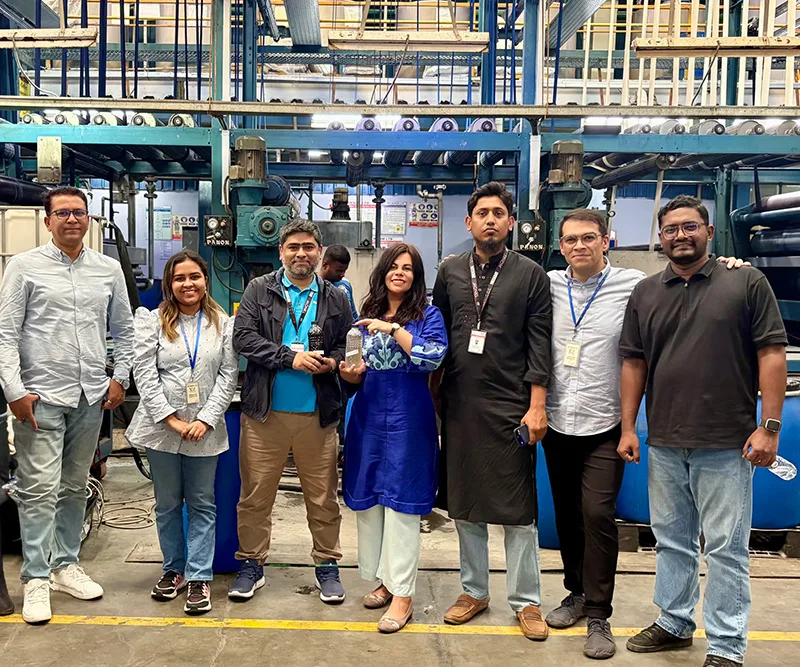
Manjula Selvarajah: Now, the other thing that I find really interesting about this idea of Bangladesh is, it’s actually a pretty significant part of their economy. There’s a lot of sort of manufacturing around textiles that happens there. Is that also something that you’re thinking about?
Macarena Cataldo: Yes. Bangladesh, It’s one of the strongest producers in the textile industry. I think that is the third one after China and India. So for being a smaller country — I mean, in comparison with India and China — it’s a very strong economy. And it’s one of the main businesses there. Which is bad for them because they have a lot of water pollution. But at the same time, easier for us to bring our model there because we are thinking at some point to have our own team working in Bangladesh and we can reach more textile mills.
Narration: Viridis isn’t the only company that has harnessed electrochemistry to remove toxins from water. I asked Macarena where else her competitors are working.
Macarena Cataldo: Semiconductors and pharmaceuticals.
Manjula Selvarajah: Pharmaceuticals.
Macarena Cataldo: But we are going to get that market later.
Manjula Selvarajah: Why would you not go for the semiconductor industry?
Macarena Cataldo: I mean, the impact first. I know that the company has to be profitable. But the main reason why I started this company is because I wanted to protect water sources and generate impact. The consequence was building a profitable company.
Manjula Selvarajah: Got it.
Macarena Cataldo: And I really am crazy about water. Like, I think about it all the time, like I’m a little bit obsessed with it.
Manjula Selvarajah: Why? What do you mean? Like, how do you think about water all the time? You mean like you’ve been thinking about water all day?
Macarena Cataldo: Yes, but not just water treatment. In fact, when I have spare moments, I walk around the beach to just listen to the ocean, and that is the best part of my day. So it’s like I relax with water. I love water. When I think about inequality, I think about water. When I think about how to build a better society, I think about water. When someone is talking about AI, I say, “Do you know that you spend one litre for each question?” Like it’s kind of — everything is water. Our body, it is 80 percent water. So it’s like, how you escape from thinking about water? I look very crazy now, but it’s true.
Manjula Selvarajah: But it’s like a lens. Your lens is water.
Macarena Cataldo: Uh-huh. The amount of water in the planet is huge. So it’s easy to think that it’s an unlimited resource. Because we see it there. However, I think that 4 percent of that water is drinkable. It’s the water that we are sharing with animals and with everything in life that has life. That is not the ocean, of course.
Manjula Selvarajah: And to a certain degree, the other problem is that a lot of manufacturing processes actually don’t tap into the 96 percent, they tap into the 4 percent.
Macarena Cataldo: Exactly. That is the water that they’re using from the total water that we have available for drinking water. Which is a very small percentage.
Narration: After my conversation with Macarena, I wanted to find out more. Turns out the proportion of the Earth’s water that is actually drinkable is even smaller. Although fresh water accounts for about 3 percent of all the water on the planet, only about a 10th of it is usable by humans. We’re talking 0.3 percent.
Macarena Cataldo: And the other thing is if you are not living in the Global South, you’re not seeing the consequence of your water consumption or your indirect water consumption. That is your water footprint, like your cotton shirt or whatever.
Manjula Selvarajah: Does that exist, this idea of a water footprint?
Macarena Cataldo: Yes.
Manjula Selvarajah: Do you know what the water footprint of some clothes would be? Like a white T-shirt perhaps, or a pair of jeans?
Macarena Cataldo: Oh, a pair of jeans are, I think that, if we count the full process probably around 500 litres. Counting the cotton, any kind of treatment, and the dyeing.
Manjula Selvarajah: You don’t think we should live without the colour, or that that’s a change we need to make?
Macarena Cataldo: I mean, no. We can improve the practices. Like colour exists from even before having the Industrial Revolution. First Nations were using colours. It is the way that we have our factories and the model that we are living right now that is not sustainable. but it’s not the colour responsibility by itself. We can find more sustainable practice for dyeing or developing new dyes that are not damaging the environment. But, like your computer requires more water than your tablecloth. Are you gonna live without a computer right now in this society? It’s almost impossible.
Manjula Selvarajah: So you would like to see more regulations then around —
Macarena Cataldo: Yes.
Manjula Selvarajah: — around these companies and the manufacturing processes that they use.
Macarena Cataldo: Yes. And as well, the consumers, I think they should be more conscious too, about limiting their consumption.
Manjula Selvarajah: Ah, you’ve brought up consumption. Because I was thinking about that. We’ve been talking about technology all this time. We also have to contend with the fact that the way that we approach fashion now is, you know, we love new stuff. We love colour. We also like it when it’s cheap, right? This is a thing and, and I feel like it’s that cheapness and fast fashion is an even bigger thing now than about a decade ago. Talk to me about how much that matters and if change is possible in that way.
Macarena Cataldo: I think that if we start to think a little bit more critical about our life, maybe if we just live in our bubble, it’s never gonna happen. Of course, I think that regulations are playing an important part in this change. However, we can do small things like, maybe don’t get 10 different pants, get one. Or go to the thrift store and get a second one. There are ways to be more sustainable. I love wearing dresses, but it doesn’t mean I’m gonna buy one every single week just because I don’t know what to do during my weekend. This is like, we can improve our practices, too.
Manjula Selvarajah: You think the consumer, too, there’s a role for the consumer here, too.
Macarena Cataldo: Yes, for everyone.
Manjula Selvarajah: And in two ways actually, to kind of really consider their own consumption. But also to push for clothing that is manufactured in a certain way?
Macarena Cataldo: Yes, for instance, brands have been made an analysis about consumers. And if you interview anyone on the street, they’re gonna say that they care about sustainability. However, when they have to pay 10 times more for a T-shirt because it’s sustainable, they are not gonna do it. So they say that they are more conscious, but in practice they are not. So it’s not a real factor for changing practices right now.
Manjula Selvarajah: Hmm. Thank you. It’s been such a pleasure speaking with you.
Macarena Cataldo: Me too. Thank you so much for inviting me.
Solve for X is brought to you by MaRS. This episode was produced by Ellen Payne Smith and written by Sarah Liss. Lara Torvi and Sana Maqbool are the associate producers. Mack Swain composed the theme song and all the music in this episode. Gab Harpelle is our mix engineer. Jason McBride is our senior editor. Kathryn Hayward is our executive producer. I’m your host, Manjula Selvarajah. Thank you for listening.
llustration by LOLO; Image source: iStock
-
 MaRS Staff