As the AI frenzy continues, what’s an investor to do?

Greetings from MaRS.
If you’ve been to San Francisco lately, you’ll have noticed that almost every billboard and bus-shelter advertisement is hawking some AI product or other. As a consumer, it’s tricky enough to know which of these apps and agents are actually useful. And if you’re an investor, it can be increasingly difficult to know which AI companies hold real promise. Below, a few ecosystem experts share their thoughts on the subject.
Also, in this week’s newsletter:
Stories from the ecosystem, upcoming events and the hottest jobs this week
Value judgment
It was the pivot that raised a thousand eyebrows. In mid-April, Allbirds, Silicon Valley’s favourite shoemaker, announced it was getting out of the sneaker business and moving into AI compute. More specifically, they were turning a U.S.$50-million cash infusion into “high-performance GPU assets,” with the company eventually becoming a GPUaaS and AI-native cloud solutions provider. Oh, and they were also changing their name — henceforth, they would be known as New Bird AI. As weird and confusing as this 180 was, it was lucrative: Allbirds shares jumped more than 500 percent.
It also seemed to sum up our overhyped AI-driven market. As Wired put it, “startups used to make things; now they buy processors.” Every other startup now has AI in their name, and it’s becoming increasingly difficult to distinguish real value from false promise. What’s an investor to do? When evaluating a company, how can you discern whether AI is integral to a company’s success or simply a trendy add-on to an otherwise mundane product or service?
We posed these questions to a few trusted experts: RareBreed Ventures founder and managing partner (and new MaRS advisor) Mac Conwell; Rehber Lookman, founding partner at 6SV (also a new MaRS advisor); William Ma, the managing director of MaRS IAF and Janet Bannister, the founder and managing partner of Staircase Ventures.
Given the unparalleled growth of AI right now, how as an investor do you separate the wheat from the chaff?
Mac Conwell: “Many of these AI companies are growing so fast, with real revenue and almost no workforce. When you’ve got three people running a company making $10 million in annual revenue in less than 18 months, that’s very different from anything we’ve ever seen before. That skews the way investors look at other companies. The easiest way for companies to stand out is to be growing fast, have a large set of revenue with low overhead. That’s not the smartest way to invest. We can’t say we know what makes a good company in AI yet, because we’re so early on.”
Janet Bannister: “A lot of customers are testing multiple AI solutions so customer trials and even revenue is not the best measure of product-market fit. We want to understand the ongoing user engagement, whether it is delivering real value and whether the company has a track record of ‘land and expand’ within their target customers.”
William Ma: “In a world where building is easier, the real edge is judgment about what customers will actually pay for, and whether AI solves that problem materially better than before.”
How do you differentiate between short-term growth and sustainable traction?
Rehber Lookman: “Traction is simply a signal for the value exchange between the customer and the business. When we think of sustained traction, it implies a certain set of attributes: from consistency, predictability and durability to economic viability, customer tightness and diversification. Critically, many of these attributes and behaviours don’t really surface in early stages or when the traction is limited/short-term in nature.”
Ma: “A big part of the work is talking to the end user and understanding how they are evaluating the product: what problem they believe it solves and whether it’s saving time, improving output or just feeling novel. It also means understanding the internal buying dynamics: which team is sponsoring it, what budget it is coming out of, who the real decision-makers are, and what other stakeholders need to be convinced for the product to become part of the operating model. Sustainable traction starts to look more real when the product survives that internal evaluation process and becomes something the organization budgets for, relies on, and would genuinely miss if it disappeared.”
Where are you currently seeing the most compelling opportunities in AI?
Conwell: “I’m excited about the future of manufacturing — robotics for customization and how AI is going to support that. I have several deep tech consumer companies — robots that handle consumer needs. I have one company that has a robot that braids hair. I got another one that makes custom nail polish. It’s basically a custom vending machine that will make nail polish or concealer from a picture or a colour wheel. And we’re going to see a ton of growth in just day-in, day-out business intelligence. There’s going to be a day when you have an AI tool as your marketer. It’ll handle all your Facebook and Google marketing, right? It does all the analysis on the fly and gives you reports. Paid media is an entire category of marketing that could be replaced by three or four AI tools.”
When you’re evaluating a company, how important is it that they’re leveraging AI in terms of productivity?
Bannister: “Product and engineering teams that leverage AI will win in the market because they will be able to launch new and better products faster. Sales and marketing teams that leverage AI will achieve greater spend efficiency, enabling them to build a larger and more effective go-to-market engine, outpacing the competition. Importantly, these advantages compound over time. I believe that it’s almost impossible for a startup to win today if they have not incorporated AI in every aspect of their internal operations.”
Ma: “AI does not replace strategy, customer demand or product judgment. But teams that use it well should be able to build faster, learn faster and get more leverage from smaller teams. Not using AI well may not kill a company immediately, but it is increasingly hard to see how it does not become a handicap.”
Do you find yourself looking more to companies that are not using AI at all?
Conwell: “They become more appealing in the sense that you’re seeing more unique ideas. But they become less appealing because even those might be more stable companies that can weather the test of time, those companies are going to have a harder time raising in today’s market.”
Lookman: “Not all market problems are best solved or should be solved using AI, so I don’t really look at it from this lens. As a technology, AI offers a set of capability and utility that can potentially solve problems in ways never done before. That means, at the very least, all companies should be exploring and experimenting with AI to see if and how it can shape their business. Companies that embrace that perspective and are open and willing to stress the limits of what they do, technologically or otherwise, ultimately will position themselves better for whichever way AI unfolds in the future.”
Ma: “The real question is whether the company is using AI where it can meaningfully improve how the business runs. A company does not need to market AI loudly to benefit from it. But ignoring it altogether increasingly feels out-of-touch.”
Stories from the ecosystem
AI: To protect ourselves against AI-enabled attacks, the best solution is to fight fire with fire, says Feroot co-founder Ivan Tsarynny.
HEALTH: For biotech founders, the path to commercialization is riddled with obstacles. Entrepreneur Kyle Brigg is working on a new — and uniquely Canadian — framework to make that journey easier.
ENTREPRENEURSHIP: Survey says: Canadian entrepreneurs are feeling cautiously optimistic about scaling their startup here at home.
M&A: Cohere’s merger with German Aleph Alpha gives the Canadian AI company a leg up on competitors in Europe.
CYBERSECURITY: The key question business leaders need to ask is “who can access your data?,” says Jordan Thompson, senior vice president of product development at Fortinet.
HEALTH: The finalists in the Rural and Remote Community Cancer Screening Challenge share tips on increasing screening participation.
Solve for X: Gene genie

In the latest episode of the MaRS podcast, Structural Genomics’ Rachel Harding decodes what the recent Huntington’s breakthrough could mean for the treatment of other rare diseases.
Upcoming events
- At the next Technically Speaking event, William Ma, the new managing director of MaRS IAF, hosts a panel discussion on the new realities of raising capital. April 28.
- Discover solutions that could help address the housing crisis at “From blueprint to building.” April 28.
- The International Society for Heart & Lung Transplantation’s 46th annual meeting and scientific sessions takes place in Toronto April 22–25.
- As AI becomes more embedded in the information ecosystem, how can we ensure transparency and accuracy? Nicole MacIntyre, editor in chief of the Toronto Star, unpacks the issues at the next MaRS Monthly. April 30.
- Top tech leaders trade battle stories and share hard-earned lessons at Together Toronto. May 4.
For more, visit our events page
In the queue: What we’re reading, watching and listening to at MaRS
Pat Lynch, who recently joined Toronto AI company Blue J as the head of brand, is always on the hunt for great storytelling. Here’s what he’s been consuming lately.
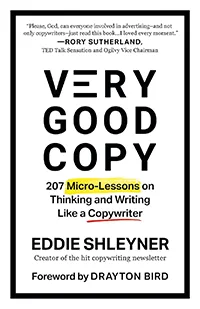 A must-read for copywriters: “I’m the new guy at Blue J and I’ve got some messaging to deliver, so I’ve been re-reading Eddie Shleyner’s Very Good Copy. Shleyner’s a master copywriter and the book is a compendium of micro-lessons he’s collected over the years. Full of vignettes and human moments, it makes a nerdy obsession with persuasion as cool as Don Draper.”
- A podcast that’s a professional education: “Dave Gerhardt, the brain behind the Exit Five community, has been podcasting since 2014. Gerhardt is probably one of the first B2B SaaS marketers to tap into the profession’s need for independent learning — Exit Five’s premise is that ‘no one goes to school for B2B marketing.’ (Seriously, no one would.) The Dave Gerhardt Show delivers tips and tactics from people who’ve been there, done that. It has saved my butt pre-meeting on more than one occasion.”
- A binge-worthy series that’s not relaxing in the slightest: “After two seasons of The Pitt, I know one thing is true: I never, ever want to visit an emergency ward in Pittsburgh on a holiday weekend. If you’ve ever felt stressed by your job or imagined that your desk-bound decisions carried life-or-death consequences, take solace in the insanity of this American ER. You’ll never complain about pressure again.”
Careers: The hottest jobs in tech this week
- Telehealth platform Maple is looking for a client success manager, manager of provider network operations and a service design and delivery manager. (Toronto)
- Blue J, an AI-powered tax and legal research platform, is hiring a partner development manager and a manager of partner marketing. (Toronto)
- Sustainable agtech company Vive Crop Protection is actively recruiting a senior biologist. (Remote)
- OTI Lumionics, which develops advanced materials for electronics, is hiring a production technician. (Mississauga)
For more, visit our jobs page.
Photo illustration: Stephen Gregory; photos: Unsplash
Sign up for our newsletter
-
 MaRS Staff