Bringing prosthetics to people in need
Almost 40 million people require prosthetics or orthotics, but only 10 to 15 per cent can access them. The Victoria Hand Project has developed a sustainable way of creating customized upper limb replacements anywhere in the world.
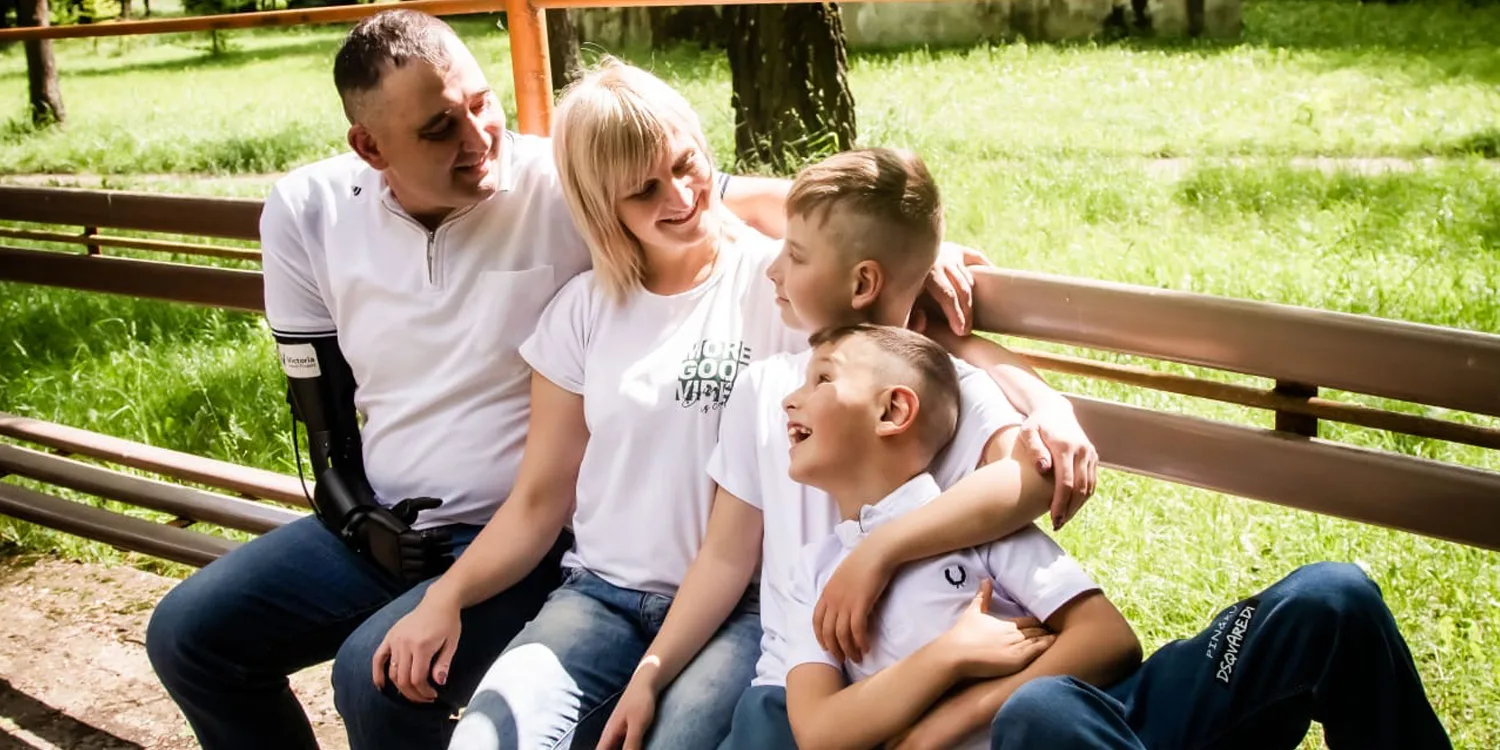
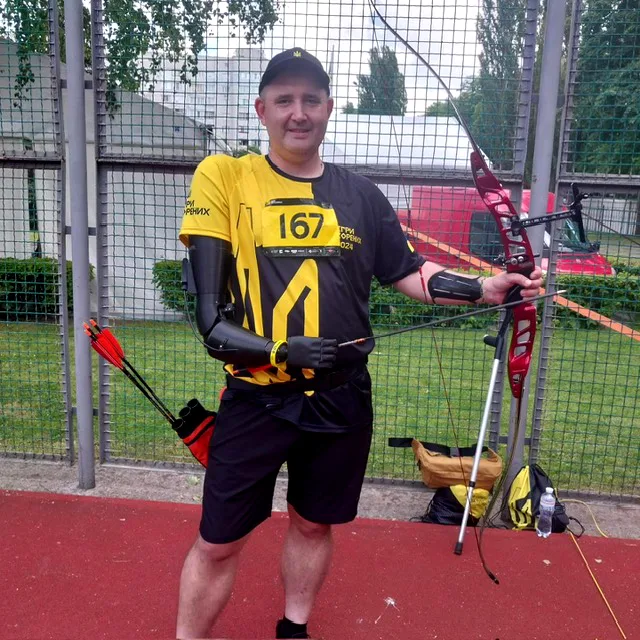
“I love my hook!” enthuses Andriy Kramar, lifting up his prosthetic arm to the camera during an interview from his home in Ivano-Frankivsk, Ukraine. In 2022, Kramar was sent to the front to defend against Russian incursion. A few months later, the 41-year-old father of two, a builder by trade, lost his right arm during an explosion. Now employed as a security guard, he has been fitted with a range of prosthetics that allow him to do various tasks. To demonstrate, Kramar clamps a sewing needle securely in his hook-like device and threads it. He looks as proud as a toddler who’s just learned to walk.
“He cooks. He washes dishes, too,” his wife, Ivanna, adds, laughing.
All this joy, dignity and independence have their origin in a charity almost 9,000 kilometres away, in Victoria, British Columbia. In 2023, Kramar became one of the first amputees in Ukraine treated by the Victoria Hand Project (VHP), which had set up a clinic at the Arol Plus prosthetic centre in Lviv.
For nearly half a year, Kramar had waited for a prosthesis from the Ukrainian government. The war has exhausted medical resources and there is no standardized care for amputees. But VHP has devised a deceptively simple method of creating upper limb replacements, 3D-printed from anatomy scans using technology that requires little or no experience. Within a week, and at absolutely no cost to himself, Kramar had a new hand.
Building a better prosthetic
VHP founder and chief technical officer Nikolai Dechev designed his first hand about a quarter-century ago, but it languished on a shelf in his lab until engineering students at the University of Victoria, where he currently teaches, spotted it in 2011. Two years later, Dechev received a grant to trial the device with amputees in Guatemala in collaboration with the U.S.–based Range of Motion Project. The VHP team soon realized that for their prosthetic service to be sustainable, they needed to provide training to local clinicians who had not previously used 3D printing or computer design tools. The goal was to create a “micro-factory” that was easy to maintain and use.
Incorporated as a charity in 2015, VHP set out a sustainable, decentralized operational model on how to scale up. “It’s all about the training,” says VHP CEO Michael Peirone, who has seen the project through all its stages, from research to not-for-profit enterprise. “We travel to the locations to do in-person training because we don’t want to introduce technology that they can’t easily use. We also then provide ongoing support from Canada with calls and help as needed, refining workflows and automating the process so it’s more hands off.”
How the VHP hand works
Almost 40 million people in the world require prosthetics or orthotics, most in developing countries, and only 10 to 15 per cent get access, according to the World Health Organization. For some, it’s the lack of medical facilities and experts. Cost is also a significant barrier.
Prosthetics with AI, sensors and neural feedback can cost upward of $30,000. But a device doesn’t have to be bionic to profoundly transform someone’s life.
VHP prosthetics are body-powered. The material cost is roughly U.S.$150. Professional prosthetists, who have been trained by VHP team members, create a plaster mold of an amputee’s remnant limb, which is then 3D scanned. “The prosthetic is printed in one or two days, offloading the time-consuming work of fabrication to a machine, which frees up prosthetists to do other clinical care with amputees.
The VHP prosthetic, which has a ball-and-socket wrist, is fitted over the remnant limb. The patient wears a shoulder harness like a knapsack and operates the device by cables that run the length of the device to the palm. The cables are pulled by moving the shoulder in different ways.
Quick access to prosthetics is crucial. “Fresh amputees need to use their arms and legs soon so the limbs don’t atrophy,” says Jerry Evans, an electrical engineer and entrepreneur with Nia Technologies, a non-profit social enterprise that produces digital prosthetics and orthotics. Swelling in the limbs can also cause issues.
At VHP, prosthetics can be re-measured quickly. As the remnant limb adjusts, the amputee can be fitted with more accurate sockets. In a short amount of time, quality of life improves. People can work and perform daily tasks. The limb may be low-tech, but it fulfills a crucial need..
While VHP is not the only enterprise creating 3D-printed prosthetics, it is uniquely suited for deployment in under-resourced areas. Open Bionics, a for-profit organization in the U.K., creates 3D-printed prosthetics that are electric and therefore more costly. Others produce inexpensive 3D-printed prosthetics but lack the local clinical expertise.
VHP partners with local health practitioners in more than 11 countries, including Ukraine, Nepal, Kenya, Pakistan, Canada and the U.S. In Ukraine, VHP has helped more than 150 amputees. In 2017, they set up a clinic in Egypt and then in 2025 added to that initiative to help Palestinian refugees.
Fine-tuning the device
VHP team members are constantly tweaking their prosthetics based on user feedback. “Our most recent model has laser-cut stainless steel linkages through all the fingers, and in various other parts, which enhances the overall strength of the device,” says Peirone.
Andriy Kramar has been fitted with three prosthetics, each an improvement on the last. Most recently, VHP added a rotating elbow joint with the ability to turn to the left and right, not just up and down.
He has competed in Invictus Games in Ukraine. He rides a quad bike. He goes fishing, his favourite hobby. When he leaves the house, he puts on the prosthesis that has a realistic hand-like fitting.
“Our children think it’s very cool,” Ivanna says. “Like Iron Man.”
Discover other ground-breaking solutions on MaRS Connect, a curated digital platform designed to accelerate real connections between Canada’s top startups and serious adopters, investors and ecosystems leaders.
Photos courtesy of The Victoria Hand Project
-
 Sarah Hampson