How AI can help assess the growing risk of climate change
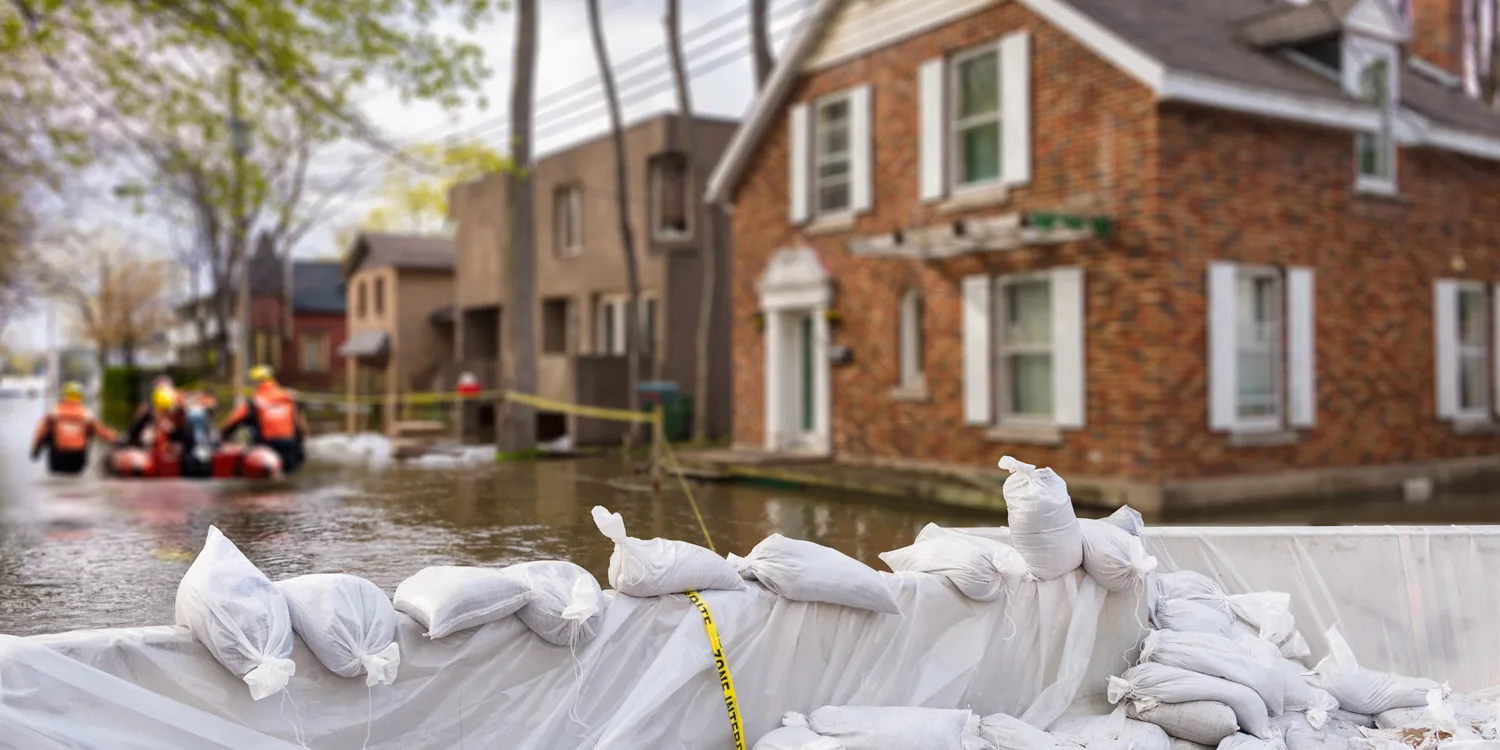
Quebec company Geosapiens has developed a smart platform that can provide a window into potential extreme weather events.
Until fairly recently, studying the past was essential in determining what might happen today, tomorrow and in the months and years ahead. And when it came to the weather, certain patterns usually prevailed: summer breezes, cold November rain and hazy shades of winter we could all reasonably rely on (and sing about). But our rapidly changing climate is increasingly defying forecasts grounded in historical data, prompting new demands for more rigorous tools to predict everyday weather and anticipate the risk of extreme climate events.
In April, Environment Canada and Climate Change Canada announced plans to improve the accuracy of forecasts by combining AI with traditional physics-based modelling to better understand and estimate short-term outlooks and major weather phenomena. Last fall, the World Meteorological Association endorsed the use of AI to boost early-warning systems of dangerous climatic conditions, which could help save millions of lives. And, increasingly, agentic AI is playing a role in guiding high-stakes financial decisions tied to our rapidly changing climate.
Geosapiens, a startup based in Quebec City, has developed solutions using AI and geospatial data to help the insurance industry improve assessments of the climatic risks and better equip Canadians to protect themselves from the hazards of wildfires and flooding. We spoke to the company’s chief research officer, Chiranjib Chaudhuri, about how this tech resists succumbing to hallucinations, whether 100-year storms are becoming more frequent and why humans still have a necessary role in AI-powered forecasting.

Geosapiens CRO Chiranjib Chaudhuri
Can you walk me through the basics of the climate risk modelling solutions you’re providing to your clients?
Geosapiens was established in 2017 with a project from the city of Gatineau. The purpose of that project was to give very accurate, high-quality forecasts during the flooding season. In 2019, the company decided to pivot to solutions for the insurance market. From that point, we released different products, including riverine, coastal, fluvial and rainfall modelling. And recently we released a wildfire model. These models take historical data and understand their distribution. A lot of them are called AI, but traditionally speaking, it’s a deep learning model.
How is your framework different from common AI coding, where blips like hallucinations occur?
With AI’s generative modeling, the major caveat is that we don’t have any control or understanding of the uncertainty of that data. That’s what we call hallucination. Our method uses something called geospatial artificial intelligence, which has the ability to quantify those uncertainties.
Predicting uncertainty is a concept that I have a really hard time wrapping my head around. How would you explain that to someone at a party?
In traditional deep learning, we have a set of historical data and we try to predict what the value will be. For example, we have 30 years of data, but we want to predict a 100-year storm. In traditional machine learning or deep learning, that’s not possible because we are bounded by the data quantity: with 30 years of data we can only interpolate a 30-year storm. Here the concept of distributional extrapolation comes in.
By “distributional extrapolation,” you’re talking about estimating situations or values beyond the range of the data that was used to train the AI model — as opposed to prediction that relies solely on existing or known data points, correct?
In our case, we want to know what that data distribution will look like, and whether it’s single-modal or multimodal, whether it has extrapolation capability. Where we predict the parameters of distribution to extrapolate that distribution parameter to get the 100-year storm.
Environment Canada recently announced plans to incorporate AI into its forecasts. How do you think that will affect weather predictions — which have historically been so unreliable that it’s become a universal punchline. Are they actually going to get more accurate?
Yeah, I think so. It’s not like AI is reinventing a modelling strategy or solving a new kind of differential equation to create the model. Mostly we have to know how these AI models, like Google’s GraphCast, are built. Most of the cases are based on historical data, so those AI models are as good as the historical weather models, which may not be correct. Right now, if we can create a model that absorbs actual observations like the precipitation on a very large scale and understand the historical patterns among them, that would be [more accurate].
Given that we’re increasingly living in unprecedented times, how do you teach AI that history is only history, and not necessarily an accurate predictor of what’s going to happen?
We need a mechanism to understand the non-stationarity.
You mean controlling for the variability of weather and climate data?
Even though the weather is like constant non-stationarity, there are still physical mechanisms among weather variables. If there is an instance of non-stationarity, they will vary accordingly. The model should be able to understand that part and then extrapolate.
What does that mean for municipalities who are making planning decisions based on AI predictions?
There’s a contrast between insurance and long-term planning. For insurance, the question is, what would be their premium for the next year? As long as they have a very good model for next year’s prediction or premium calculation, they’re very happy with that.
With municipal planning, they have to look at what their 100-year plan would be. So in those cases, they look at what is the meaning or magnitude of the same intensity of storm in a climate-change scenario? For example, there are locations where a 50-year storm now will become a 100-year storm. The municipality will have to make decisions based on that understanding. Just relying on historical data is not enough for long-term planning.
So, what role do humans play in interpreting AI modelling?
Deep learning has become so complicated — especially in Gen AI. Nobody knows what is going on inside the model. Human interpretability has to be baked in. If a model is designed to be like a black box, then we cannot interpret it. But if we design the system in such a way that it readily becomes interpretable, this is where the human can come in. The next generation of scientists are working toward interpretable AI. Especially for insurance and where a human dimension is involved, mismanagement or misdesign can affect billions of dollars and [many] lives.
There are a lot of different things that are impacted by AI, and we have to be very careful. We have to introduce AI in a meaningful manner, and we have to be responsible for what is affected, be it a dollar value or a human life. Accountability is becoming a scarce commodity right now, especially in AI coding. We cannot just hand things over to AI and trust the model blindly without a human in the loop to take the accountability.
Geosapiens is part of the Adaptech Accelerator, a special program that helps startups speed up development of climate change adaptation and resilience solutions. Read about the other ventures in the cohort here.
Image source: iStock; Photo courtesy of Geosapiens
-
 Dominique Ritter