Meet the nine women-led startups scaling Canada’s cleantech solutions

The ventures in the latest RBC Women in Cleantech cohort are developing new battery storage solutions, building materials, lower carbon jet fuel and other technologies that can help tackle the climate crisis.
We need more people deploying climate solutions in Canada — and that means supporting more women-led startups. According to the 2022 Cleantech Industry Survey by NRCAN, only 13 percent of cleantech firms are owned or managed by women. This gap reflects who gets funded, not who has the ideas.
MaRS is working to close that gap. The RBC Women in Cleantech Accelerator takes nine women-led ventures through a two-year program aimed at scaling their climate solutions. This is the fourth cohort to receive a dedicated business advisor, a curriculum built by sector experts and program alumni, mentorship, market intelligence and connections to investors and corporate partners.
“Scaling a company can be very isolating,” says Lark Meadow, co-founder of Aeon Blue. “WIC flips that script and provides you a support system, a network and feedback as you scale.”
Here, the nine companies who are turning their big ideas into a more climate-friendly reality.

Aeon Blue turns seawater into drop-in clean fuels
Lark Meadow spent 20 years as an entertainment project developer and organizational founder. Then her brother Deóis Ua Cearnaigh, an electrochemist at the Los Alamos National Laboratory, asked her to help commercialize the innovative fuel reactor he had developed. “When I looked at what he had, I realized this was something that could be truly revolutionary for clean fuels,” says Meadow. In 2018, the siblings founded Aeon Blue. Cearnaigh’s reactor uses electricity to convert saltwater into hydrogen, chlorine and sodium hydroxide. The sodium hydroxide reacts with carbon dioxide from the air, converting it to dissolved carbonate. About a quarter of this carbonate is then turned back into CO2 and combined with hydrogen to produce methane, which downstream equipment converts into synthetic jet fuel. The remaining carbon dioxide is sold as a feedstock or permanently stored through geological sequestration or mineralization.
How it helps: Aeon Blue’s eFuel is a drop-in replacement for Jet-A, standard kerosene-based aviation fuel. Every tonne removes 30 tonnes of carbon dioxide from the air — equal to a flight from Toronto to Vancouver. It also burns cleaner than fossil fuels, containing virtually no sulphur or heavy metals. And because the process runs on seawater, it’s a net water producer; the ultrapure water it makes can go to other synthetic fuel producers who would otherwise use municipal freshwater supplies.
What’s next: Aeon Blue plans to move from laboratory testing to a small pilot this year in Cape Breton, Nova Scotia, which will produce one tonne (1,200 litres) of eFuel.


BryoSphere grows moss to extract rare plant compounds
Liz Mahon and Hila Behar met while completing doctorates in plant biotechnology at UBC — Behar engineering moss to produce enzymes, Mahon giving plants new biochemical pathways to make valuable chemicals. They realized Behar’s moss would be easy to engineer and extract compounds from, and in 2022 co-founded BryoSphere Biotechnologies in Vancouver to make skincare ingredients. The company’s first product, BryoBright, is a moss extract rich in aureusidin, a compound that blocks the enzyme that produces melanin, and thus reduces dark spots. Strain development happens in their Vancouver lab, while production is at the Verschuren Centre in Sydney, Nova Scotia.
How it helps: Sourcing botanicals conventionally is costly and resource-intensive: Producing a third of a teaspoon of aureusidin requires 20,000 kilos of flower petals and costs $2,000. BryoSphere’s technology can produce the same amount for about a dollar. It also requires less land and fewer harsh solvents, and the company recovers and reuses up 95 percent of the ethanol used for extraction.
What’s next: The company is now making 250 litres of ByoBright, enough for 20 brand samplings a week. Two more ingredients are in development, which target collagen loss and redness-prone skin. Bryosphere has plans for other products, but, as Mahon says, “Skincare comes first because it’s the fastest path to revenue: fast regulatory pathways, strong demand for new clean activities and ingredient prices that support a new manufacturing platform.”

COROL Corp makes custom bio-polyols with Canadian seed oil
Growing up in Nigeria, chemical engineer Cynthia Ene saw firsthand the devastation caused by the petroleum industry in her community. After graduating, she chose to work instead in water treatment and development, where she explored bio-based materials for construction and industrial applications. In 2022, she met three University of Alberta researchers — Jonathan Curtis, Tolibjob Omonov and Ereddad Kharraz — making bio-polyols she thought were ripe for commercialization. They partnered in 2024 to found COROL Corp (formerly NunaFab) in Oakville, Ontario. COROL’s patented two-step reaction converts Canadian seed oils like canola into bio-polyols, and it can customize each batch to a customer’s specifications, making it a drop-in replacement for synthetics.
How it helps: Polyols are found in many products, including foams, paints, coatings and fertilizer. More than 90 percent are made from petroleum. Every tonne COROL replaces prevents two tonnes of C02 emissions. It also helps bolster the Canadian agriculture sector by using unsold canola (currently stuck tariffed at ports with bio-polylol manufacturers importing castor oil from Southeast Asia).
What’s next: “We’ve partnered with one contract manufacturer here in Ontario, and we’re onboarding a second facility in South Carolina,” says Ene. “They’re going to be making our product according to our specs and agreements and shipping the product out for us to various clients under our brand.”

Elektra Industries makes solid-state sodium batteries for grid storage
An applied physicist, Shantel Butler has spent a decade commercializing advanced technologies. In 2017, her company Geometric Energy contracted the University of Calgary’s AISEL lab to develop a solid-state sodium battery. Butler led the project for eight years, then acquired the IP in 2023 and founded Elektra Industries, recruiting her co-founders, Dr. Sumaletha Narayanan and Dr. Sanoop Kammampata, from the academic group. Like other sodium-based batteries, Elektra’s patent-pending battery uses sodium ions instead of lithium, but it is also non-flammable, can operate in extreme temperatures and its energy density (i.e., how much energy a battery stores for its weight) exceeds commonly used lithium-ion systems, with projected energy densities ranging from 205 to 225 watt-hours per kilogram.
How it helps: Grid storage typically uses lithium-ion batteries, which come with a massive environmental footprint. Salt, however, is vastly more abundant and easily sourced. And because Elektra’s battery doesn’t catch fire like lithium ones do, it doesn’t require expensive fire suppression and cooling systems. Butler estimates that her system can save a Battery Energy Storage System (BESS) developer 50 percent in capital expenditures, as well as reducing operating costs and speeding up project approvals. The company’s target market is renewables integration for Indigenous communities, pairing lower-cost storage with projects those communities own.
What’s next: Elektra is working on a prototype in the lab and is anticipating initial third-party testing by the end of the year. The company is also planning a large-scale joint R&D and manufacturing facility with a BESS manufacturer in Calgary.

MicroMea converts food waste into on-site energy
Juliette Gagnon kept seeing the same problem during her bioenergy research at Université Laval: organic waste trucked long distances to centralized composting and anaerobic-digestion facilities, driving up transportation and waste-management costs. “Instead of bringing the waste to the plant, why not bring a micro-plant to the waste?” she wondered. In 2025, she co-founded MicroMea in Quebec with Marie-Ève Morissette, a senior auditor at EY with expertise in strategic and financial planning. Their proprietary anaerobic digestion system fits into a modular shipping container, and can convert organic material to biogas in four to 14 days (it takes a conventional plant 30). The units are used on site by organizations like food manufacturers who generate 500 to 10,000 tonnes of waste a year and have high disposal costs and on-site energy needs.
How it helps: In Quebec only 33 percent of industrial organic waste is recovered. Not only does MicroMea divert this waste from landfill but its biogas can feed directly into a client’s boiler, saving roughly 600 tonnes of carbon dioxide emissions per 1,000 tonnes of waste.
Milestones: MicroMea is testing two-litre and 200-litre pilot units at CNETE, an applied-research centre in Shawinigan. Next up is a mobile unit to test customer waste on-site, then a 20,000-litre commercial demonstration.

Moltra Metals decarbonizes steelmaking
Megan O’Brien is a mechanical engineer with a background in reactor design and high-temperature industrial processes. After spending six years working on direct air capture at Carbon Engineering, she believed it would be more useful to prevent emissions at the source in hard-to-abate sectors. “I felt it was likely cheaper and more efficient to avoid creating emissions in the first place than to capture them after they’ve entered the atmosphere,” she says. Ironmaking was a natural fit for that ambition — steel production accounts for 7 to 9 percent of global emissions — and her experience with high-temperature chemistry and reactor design. Traditional ironmaking strips oxygen from iron ore with coal or natural gas, releasing carbon dioxide, but O’Brien and a fellow engineer, Isabelle Callaghan, use electricity for process heat and natural gas as a feedstock, designed so that carbon is left as a solid co-product, capable of being sold as material for use in other industries. In 2025, she and Callaghan founded Moltra Metals in Squamish, B.C.
How it helps: Steel generates the equivalent of 4 billion tonnes of greenhouse gas emissions annually. Moltra estimates its process cuts that by roughly 90 percent.
What’s next: Moltra will begin engineering work on a large prototype within two months, with the unit to be built this winter.

Moon Trades brings autonomy to mineral exploration
Wintta Ghebreiyesus trained in aerospace engineering and hadn’t planned on mining — until she attended a webinar bridging the mining and space industries and learned how expensive and inefficient mining exploration is. “Every hole that misses is money, time, energy and land disturbance that didn’t need to happen,” says Ghebreiyesus. “And it’s happening right when we need critical minerals most for the energy transition.” At the same time, space exploration requires us to become very good at reading terrain from limited data — you can’t just send a drilling crew to the moon. “I realized those same tools could help mining companies here on Earth decide where to drill before they ever break ground.” Moon Trades, which Ghebreiyesus founded in 2024, is developing a metre-long sensor stack that mounts on a vehicle and works alongside geologists, capturing more than 50 times the data points a single geologist can gather in 20 days. Its AI model runs more than 30 layers of analysis and returns a ranked shortlist of drill targets.
How it helps: Moon Trades’ technology reduces labour costs and requires fewer drill holes, fewer metres into the subsurface, and less ground disturbed. It also accelerates the discovery of minerals like lithium, which are needed for electrification. And it has potential for off-Earth exploration as well.
What’s next: Ghebreiyesus is running a feasibility study with a Seattle partner to gauge how well her technology can be applied to sustainable resource extraction in space.
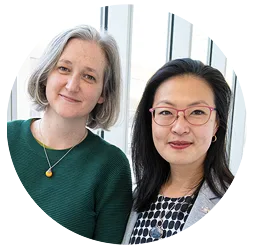
Seafoam Materials stores carbon in your walls
What it does: Amy Yang and Chloe Doesburg are both architects and repeat founders who turned their climate grief into a practical question: what climate solution could they build and scale? Their answer came from a surprising source: seaweed. “It’s a powerful natural material with regenerative potential,” Yang says. “It grows incredibly fast, doesn’t require land or freshwater to grow, and has the ability to sequester carbon that’s comparable to forests, without risk of loss by fire.” Yang and Doesburg saw enormous potential for the material in the construction industry and founded Seafoam in 2024 to develop seaweed-based insulation. Their product, both batt and rigid-board insulation, uses a seaweed-based binder — combined with wood waste and recycled cardboard. The seaweed, which comes from both cultivated and invasive sources, replaces the petrochemical binders that even other bio-based products rely on, yielding insulation that’s plastic-free, non-toxic and compostable.
How it helps: Insulation is the second highest-emitting material in Canadian residential construction after concrete. In addition to seaweed’s ability to sequester carbon, the recycled fibre used comes from local waste, diverting about a tonne per home. The company estimates that capturing just 5 percent of the North American market would abate the equivalent of 278,000 tonnes of GHGs a year.
What’s next: Seafoam is moving into pilot manufacturing, with wall-assembly testing currently underway at Toronto Metropolitan University.

Tydra Labs turns waste into chitin
What it does: Entrepreneur Jaiya Varshney was researching sustainable textiles when she and her co-founders discovered a bacterium that converts food waste into chitin, the strong, pliable biopolymer found in crustacean shells, insect exoskeletons and fungal cell walls. “Nature has been using chitin as a high-performance building material for millions of years,” she says. It also, it turns out, has a range of applications in medicine, agriculture, packaging and cosmetics. Chitin is typically derived from crustacean shells, but Tydra Labs takes theirs from waste streams, so production doesn’t depend on seafood harvests or seasons. TYDRA ONE, the company’s first product, is also the first chitin ingredient that’s never dried; kept hydrated, it retains the fibrillated structure that makes it useful.
How it helps: Most chitin is dried powder extracted with harsh acids. Because TYDRA ONE stays hydrated, it can thicken, emulsify, form films and fight microbes — letting cosmetic formulators consolidate several ingredients into one.
What’s next: Tydra Labs has closed pre-seed financing, with cosmetics companies signing letters of intent and testing TYDRA ONE in their formulations. “The most exciting milestone isn’t simply raising capital,” says Varshney. “It’s seeing people outside of our company take the material, put it into their own products and start asking what else they can do with it.”
Learn more about how the RBC Women in Cleantech Accelerator is helping innovators build a sustainable future.
Photo illustration by Stephen Gregory; Images: Unsplash
-
 Brett Tryon