This U.K. firm helps companies optimize through next-level visualization
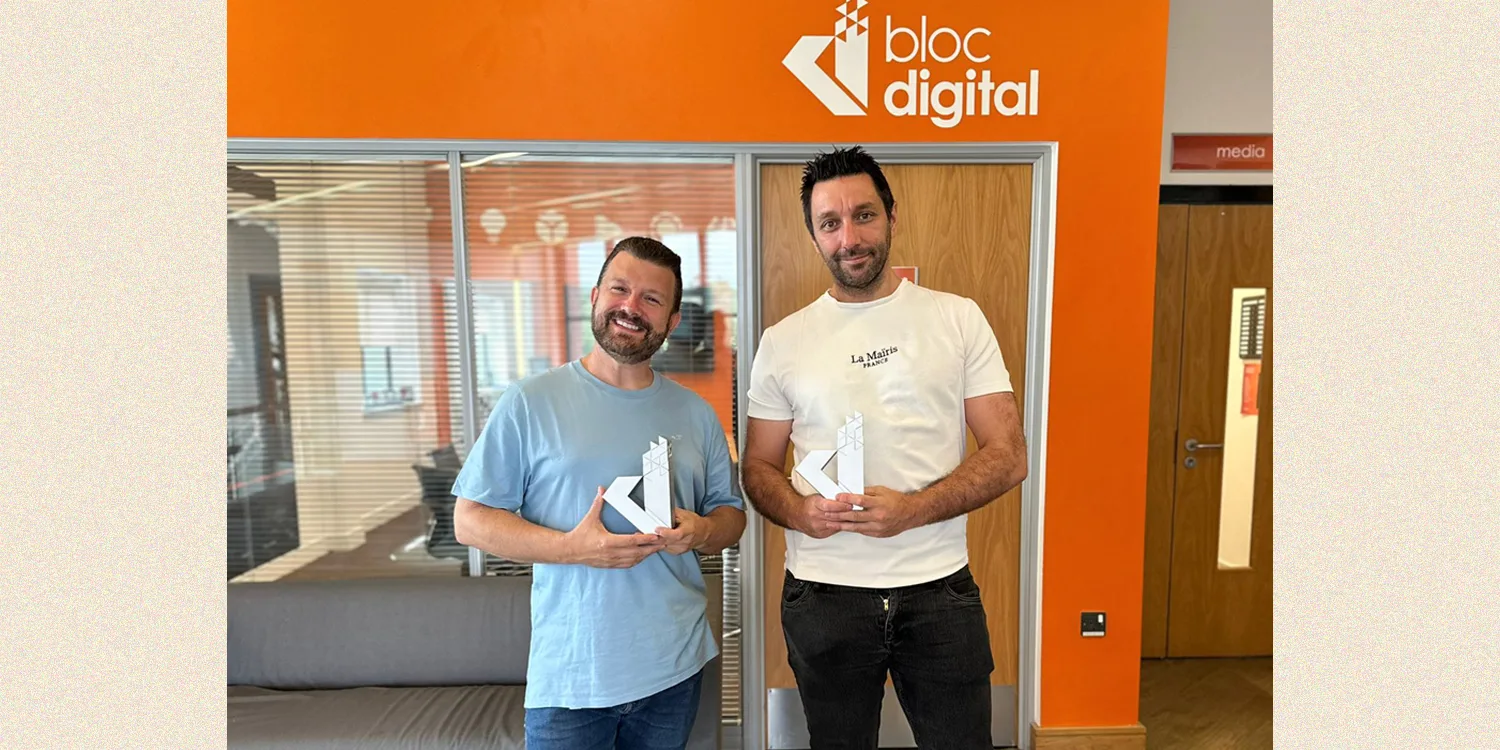
Once a two-man bedroom operation, Bloc Digital has evolved to meet the market.
Keith Cox and Chris Hotham co-founded Bloc Digital in Derby, U.K., as a two-man graphics house back in 2000. Although the pair started out working on 3D modelling and creating animations for aircraft engines at Rolls-Royce, the company has grown and evolved to respond to the shifting needs of the accelerating tech landscape. Today, their innovative visualization technology drives training, marketing and digital transformation solutions for a range of clients.
“What do you do?” may seem like a basic question, but it can be a complicated one for the Bloc Digital team to answer. Depending on the customer and the challenge at hand, the company’s work can involve anything from developing e-learning modules for training to designing fantasy-inspired ads for turbojet engines. This agility has fuelled Bloc Digital’s growth, which has kept pace with the exponential evolution of the tech sector as a whole.
In 2023, the company set up a new home base in Cleveland, Ohio in order to work with Rolls-Royce Defence (a division focused on developing solutions for military vehicles). Now, Bloc Digital is looking to make further inroads into the North American market as one of eight participants in the Made Smarter Innovation program, a collaboration between MaRS and Innovate UK. Here, Cox shares some insights about how his company has evolved with the market, where he thinks digital visualization is headed and why Bloc Digital scored an invitation to visit NASA.
How did you become interested in digital visualization?
When I was 19, 3D was still in its infancy and I was in year three of a four-year course in technical illustration. This was just in the early stages of when CGI was starting to become a thing — it was old-school pen-and-ink and airbrush illustrations of technical items such as cars and planes. Rolls-Royce was interviewing fourth-years, but I asked if I could go just for the experience. Then they offered me the job — making animations of 3D aero engines. I left the course, didn’t actually graduate and moved halfway up the country to Derby at 19. Looking back on it, that’s quite a ballsy thing to do!
When you and Chris Hotham co-founded Bloc Digital, were you looking to fill a particular gap in the sector?
You are giving us far too much credit for forward planning! Chris was a window fitter, but we both ended up working evenings at a bowling alley, doing laser tag as a side gig. He asked me, “How do you do that cool stuff for Rolls-Royce? Because I’m fitting windows, and sometimes it gets cold.” Over the next year, I taught Chris 3D modelling, Photoshop and all that stuff. One day, when Rolls-Royce needed extra support on a new project, I said, “I know a guy.”
In 2000, I needed to move back down to Southampton, where I grew up, due to personal circumstances. I handed in my notice at Rolls-Royce. But once I realized how expensive it is to live down south, I had to ask for my job back. When I explained the situation, they said, unbelievably: “Hey, we get it. Why don’t you set yourself up as an external freelancer?” Chris and I were both external freelancers working solely with Rolls-Royce, and then in 2005 we came together as Bloc Graphics Limited.
You’re still designing engine-building programs for Rolls-Royce, but how did you expand to work with new clients?
Until 2010, we were Rolls-Royce in all but name — I think from Rolls Royce’s point of view, we were an external creative agency that was basically joined to them at the hip. We realized we needed to find somebody that could come in and help us grow because when you’re small, you’re so busy doing that you don’t have time for business development. Steve, who is still with us, joined us from BAE Systems, which is a UK defence company. His remit was to help us grow our clients, but also to help us do other things with 3D — at that point, we were still just an animation studio. He told us about augmented reality back in 2007.
But the growth of Bloc from the two of us in a bedroom to the 70-odd people we’ve got now — that was all organic. We found that, when an engineer or a trainer at Rolls-Royce left for Airbus, for example, they took us with them. Our roster is basically 25 years’ worth of good relationships. As the requests changed from animations to training packages to digital twins and transformations, our mindset has always been: “The answer is yes, what’s the question?”
What kinds of projects are you tackling these days?
There’s digital transformation — digital tools or solutions that help an engineering or manufacturing company make their product faster, smoother, more cost-effective and better for the environment. We’ll pull data off live machines — say, a Rolls-Royce jet engine that’s halfway across the Atlantic — and then have a 3D version of that engine, a digital dashboard that updates in real time, twinning what’s happening over there in real time. Then there’s immersive training, which involves VR training on something that’s not yet built. You can get a whole team around the world training together through immersive VR.
Can you talk a bit about the work you’re doing with the space industry? You recently got tapped by NASA, correct?
We did one project with the European Space Agency where we were rendering 3D visualizations of satellite data. You can map that data onto any area — if you’re a farmer, for example, you can zoom in on a field and know it’s the right spot to plant wheat. We’re now based in Ohio, and NASA’s Glenn Research Centre is just down the road. We’ve been invited to show our capabilities to their graphics visualization team. We did a show and tell, they did a show and tell, looking at augmented reality, virtual reality, visualizations. It’s government stuff, so a) you can’t talk about it; and b) it takes a very long time to come through. But space is definitely an area where we’re going to be growing.
You’ve said your client base has changed over the years. Are you looking to focus on anything in particular moving forward?
Historically, we’ve been a project-based company, but in the last few years, we’ve wanted to start supporting our clients in three areas: training, marketing and digital transformation. We’re now building an off-the-shelf model, where clients can ask for tweaks. We’ll still have the odd bespoke stuff, but we’re expanding to a product-based business that complements the existing service base.
We’ve been implementing AI and machine learning for a while, but now it’s become more mainstream. Some training packages used to be an e-learning course with multiple choices. But now, instead of doing multiple choice, you have a conversation with a training bot. That integration of AI into training and marketing is a natural progression of the digital solutions we’ve been creating.
Obviously, Bloc Digital has been exploring North American markets through the Cleveland outpost and your participation in the current cohort program. Beyond that, what’s your growth strategy?
A lot of people say, “You’re a tech company! You should be in Silicon Valley!” But we don’t want to be where our competitors are, we want to be where our clients are. After Cleveland and Wichita, we’re looking at New Orleans for our next office. In Canada — where the MaRS program has been nothing short of exceptional for information and support — it’ll probably be Montreal, where most of the engineering is. On the international side, we’re also looking in Singapore and Germany.
Final question: Of all the projects you’ve worked on, is there one in particular that stands out?
My favourite animation is this dragon we made for the Rolls-Royce Orpheus turbojet engine, because it’s so cool. With any new client, we say, “Check this out.” And their response is always “Wow, wow, wow!” They think it must cost a quarter of a million dollars, but with us, it doesn’t. We’re very cost effective.
Check out the Manufacturing Disruptor Showcase on April 1 to find out more about Bloc Digital and the other members of the Made Smarter Innovation cohort. And click here to learn how MaRS and Innovate UK are bringing new breakthroughs to Canada.
Image courtesy of Bloc Digital; Keith Cox (left) and Chris Hotham co-founded Bloc Digital in 2000
-
 Dylan Adamson