The coming storm: How AI can help us forecast and harness the weather
Climate change is making extreme weather the new normal. In the latest episode of the Solve for X podcast, we explore technology that could help us predict what’s coming and address water shortages.
Recent advances in AI have fundamentally changed how we predict the weather, making forecasting cheaper, faster and better — we can now track even the most unusual weather event with almost pinpoint accuracy. Such accuracy has never been more urgent. With climate change making weather more extreme, unpredictable and dangerous, knowing how much rain a storm may bring, or how long a drought could last, can be a matter of life and death. In this episode, we explore this quiet revolution in forecasting, why this knowledge must also drive policy change and, in the face of growing water shortages, how AI is helping us tap an unexpected new source.
Featured in this episode:
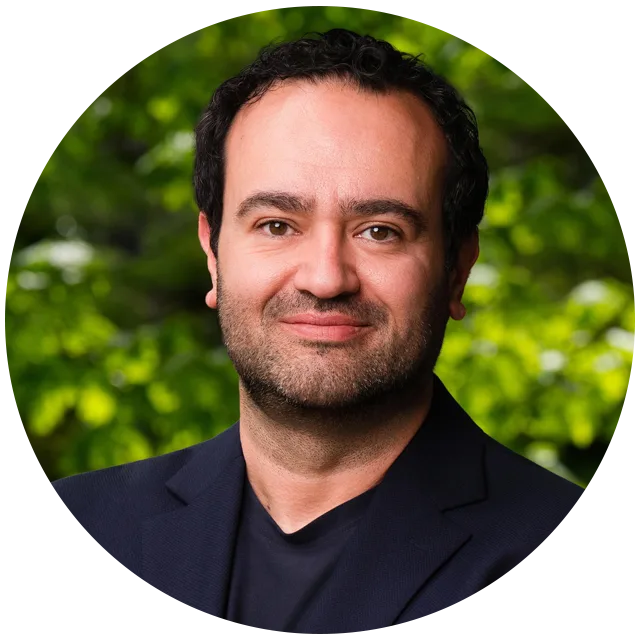
Pedram Hassanzadeh is an associate professor in the department of geophysical sciences at the University of Chicago and director of the AI for Climate Initiative at the Data Science Institute.
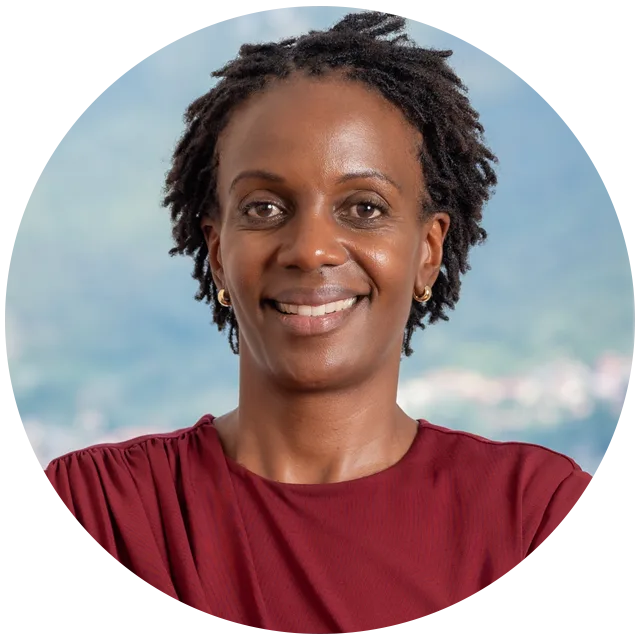
Catherine Nakalembe is an assistant professor in the University of Maryland’s department of geographical sciences, founder of the Xylem Lab and the Africa program director for NASA Harvest.

Tatiana Estevez is the founder and CEO of Permalution, a startup working on fog water collection technology and climate adaptation solutions.
Further reading:
- Forecasting the future: The role of artificial intelligence in transforming weather prediction and policy
- Designing probabilistic AI monsoon forecasts to inform agricultural decision-making
- AI can predict disaster, but it can’t save you
- Seeds of impact: Catherine Nakalembe’s trailblazing path
- Fight Canada’s water shortage with fog
- Permalution: transforming fog into water for climate adaptation
- The end of the European summer
Subscribe to Solve for X: Innovations to Change the World here. And below, find a transcript to “The coming storm.”
Narration: Last year, 38 million farmers across India received a text message with a vital piece of information. The monsoon rains that had been announced were a false alarm. Several more dry weeks lay ahead.
That text message may have saved thousands, maybe even millions of farmers from planting their crops too early and watching them wither in the sun, and it was generated with the help of artificial intelligence because it turns out AI is surprisingly good at forecasting the weather, like really good.
Pedram Hassanzadeh: I mean, it has fundamentally changed how we forecast weather. It went from solving equations that we all love and we all sort of know what these equations do to using this black box that is trained on the past data, but this black box turns out to be doing very good weather forecasts. Which is still very surprising.
Narration: Our weather isn’t just becoming more extreme, it’s also getting more unpredictable. This year alone, Europe has sweltered in 48-degree heat while Florida of all places had snow. AI is helping scientists make sense of the chaos, and it’s helping communities adapt to a changing climate even in some surprising ways — like finding new sources of water from fog.
But these advances in forecasting are also raising new questions. Like who has a right to this information, and what does it mean to know a disaster is looming if there’s nowhere to run?
Catherine Nakalembe: I use this analogy that a better prediction does not build a sea wall. Like, I will predict it’s going to be five feet of water. I can predict it maybe to the centimetre. But it does not build a sea wall that will protect me from five centimetres of seawater.
Narration: I’m Manjula Selvarajah, and this is Solve for X: Innovations to Change the World.
Around June each year, enormous rain clouds gather off Kerala, the southwest state at the tip of India. It’s the start of the monsoon season. I’ve seen it myself, and it’s actually hard to put into words just how dramatic it is. The rains sweep north, drenching everything in their path. In the space of three months, the monsoon drops 80 percent of India’s annual rainfall. For the country’s farmers, the onset of monsoon is the most important time of the year. It’s the moment when they plant thirsty crops like rice, cotton and soybeans that help feed one billion people. The stakes couldn’t be higher. But knowing exactly when the rains will come is anything but easy.
Pedram Hassanzadeh: I had a student from India whose family are farmers, and he was telling me they listen to the sound of the birds, which probably, for short-term forecasting, it works. I’m sure the birds know something about how the pressure is changing, but not for months ahead.
Narration: That’s Pedram Hassanzadeh, a professor at the University of Chicago who studies AI and the climate.
Pedram Hassanzadeh: Now, specifically monsoon and more generally rainfalls are always very hard to forecast. I mean, you might have this experience that, you know, temperature is usually, you know, the forecasts are good, but rainfall can be something that the forecasts are, you know, are less accurate, especially at longer time.
Narration: For many of us, that 10, 20 or 75 percent chance of rain we see on our weather app might decide whether we grab an umbrella on the way out the door. But for millions of smallholder farmers across India, knowing when the monsoon will arrive over their specific patch of land and having enough time to act can mean the difference between a good harvest or a total loss.
So for the past two years, Pedram and his colleagues at the University of Chicago have been chasing a question with the Indian government: What if AI could help produce more long-term localized forecasts for farmers?
Pedram Hassanzadeh: Like as a scientist, we spend a lot of time on our papers, and we spend years writing one paper, and we go through everything line by line. I wake up in the middle of the night thinking about, “Oh, that paper, that figure, maybe that number is not right.” But this was a whole different level, right? And also something that had to be done quickly. Yeah. I mean, the question of can AI models provide anything useful, we started working on that in September of 2024, and at the end, we had to make decisions in December, January, and this forecast went out from May. So it was a really short time that I think we developed a lot of tools and methods and worked very closely with the government who eventually — I mean, this was the project of the Indian government, right?
Narration: Now, India already has a highly sophisticated weather forecasting system. A number of weeks in advance, the government announces when they think the monsoon will start over Kerala in the south. But for a farmer thousands of kilometres away in the north, that’s not so helpful, and predicting exactly where the rains will go next with enough time for farmers to prepare, that’s another challenge.
Pedram Hassanzadeh: Because we are relying on these physics-based models that really need to solve for the clouds and get all of these things right, and it just becomes extremely difficult and computationally expensive.
Narration: To generate a weather forecast, you need to simulate the actual physics of the atmosphere — how heat, moisture, air pressure move and interact. Running these models requires some of the most powerful supercomputers in the world, and on top of that, the monsoon is one of the hardest climate systems to predict.
Pedram Hassanzadeh: Some of the processes in clouds that would lead to precipitation, to rainfall, they’re just so small to solve on a supercomputer. We don’t have the power to do that.
Narration: But here’s the thing about weather, it does follow certain patterns.
Pedram Hassanzadeh: Now, when AI started really to change, you know, many, many fields in medicine, in science and in engineering, some people in my field in around 2017 are starting to think, OK, what can it do for climate and weather? And so my group was one of the first groups who started thinking about this question of, well, you know, weather has patterns, right? And these methods are amazing in pattern recognition, so how about we just try to go back to this idea that weather can be predicted as an image processing problem?
And I should maybe take a step back and say that, before 1940s, weather forecasting was a pattern matching problem. This is actually how weather forecasting was done during World War II, for example, for the Normandy landing. That people had this catalogue of weather patterns and they’d look at them and they knew that when these weather patterns showed up, five days later it rained over France. So they had a catalogue of these, but of course, they were eyeballing them and looking at what is close to what. But anyway, this idea kind of died away because computers turned out to be very useful in doing weather forecasts.
Narration: So, decades later, when Pedram and other scientists started testing if AI could be trained on the weather, it didn’t immediately blow them away.
Pedram Hassanzadeh: There were some promising results, but nothing to the degree that you say this is going to really change how we do weather forecasting. But things changed in early 2022 when a model was introduced. It was developed by NVIDIA and my group, and a couple of other groups contributed to this. It’s called FourCastNet. It’s a big neural network trained on these 40 years of data. And it turned out that with that model, you can do weather forecasting with the accuracy very close to the best physics-based models. But then this neural net was like 100,000 times faster to run, tens of thousand times more energy efficient. It was open source. It was easy to use. It was easy to go inside and change this model, and it was basically, with the push of a button and a laptop, you could get global weather forecasts.
Narration: Since then, tech companies and government weather agencies alike have been racing to develop new AI forecasters. In the lead up to the 2025 monsoon, Pedram and his team put the best long-range ones to the test.
Pedram Hassanzadeh: So it was really like a blended model that provided the information, and we have shown that the blended forecast is better than each of the individual forecasts significantly.
Narration: By blending the models and feeding them over 100 years of Indian rainfall data, Pedram effectively tuned the AI to recognize the monsoon up to four weeks in advance. Typically, physics-based modelling can’t go beyond five days.
Pedram Hassanzadeh: So it was basically validated, cross-validated on, like, past data, and then it predicted the future.
Narration: The team then shared their predictions with the 38 million farmers in the form of carefully worded weekly text messages.
Pedram Hassanzadeh: I think like 150 characters that you could fit into that message. And these messages, you know, they’re all very cheap, but then, you know, when you multiply it with 38 million and send it weekly, it actually adds up, right?
Narration: But the AI really proved its worth once the rain started because the AI predicted something that none of the standard forecasting models expected. It said the monsoon clouds would stall over the southern part of India, prolonging the dry season for farmers in the far north. And the AI was right. The monsoon stopped for 20 days, a freakishly long break in the rain.
Pedram Hassanzadeh: You all know that weather is chaotic, right? The butterfly and the butterfly flapping is being over Brazil changing the weather in Texas. So, at the end of the day, even if you have like a perfect forecast model, because your information about the atmosphere is incomplete, you are going to have some error. But the key there is to have a cheap model so you can do many forecasts and create like a probabilistic forecast. You know, like for example, in weather forecast, like you see like a cone of uncertainty around a track of a hurricane, right? So to really constrain that cone of uncertainty, you want a cheap model so that you can do many, many forecasts and look at all the possibilities. Now, because AI models are fast, and there are now a bunch of them, they are perfect for this job.
Narration: Pedram’s colleagues, economists at the University of Chicago, including Nobel Prize winner Michael Kremer, are now trying to understand how the farmers reacted to the messages.
Pedram Hassanzadeh: Did they act on it? If they act on it, do they think they benefited from this? And there’s a question of how to even measure benefit. Is it about how much more money they made? So there’s like a complex problem that, so my colleagues are currently working on it. For some of the work that was done right after the last summer, I mean, there are farmers who say, “Yes, I paid attention to the text. I told my friends, and I made decisions. I changed, you know, my plans based on that forecast.”
Narration: That research is still ongoing, and the team just completed its second season in India this summer. Pedram now has his sights set on a new place with its own rainy season, Ethiopia.
Pedram Hassanzadeh: But Ethiopia is a place that generally, and generally Africa, that people think we even don’t have data that is good enough for these AI models to work there. So now showing that this can work over Ethiopia, I think that would be like the next step to really say, “Okay, we can even expand this over Africa.” But there is even a much higher demand for this weather forecast because the infrastructure is not there.
Manjula Selvarajah: I’ve been debating with myself if this will democratize forecasting. Do you think it will?
Pedram Hassanzadeh: Yes. That’s a term people have been using, like AI is going to really help with global democratization of weather forecasts. And I think the fact that these models are public and open source, I think that would be a major, major component of this because it makes a big difference. I mean, a big part of the work that we have done is, has been about benchmarking the models, and you cannot benchmark models that are really not open source. So we couldn’t use some of the models that looked great, but they were not open source, so we couldn’t do the forecast ourselves. We couldn’t do all the things we needed.
That was a big part of, I think, what enabled us. And so I think again a lot of credit goes to NVIDIA and Google and the European Centre and others who made models public, the Indian government that makes their, you know, the rain gauge data public, right? So I think a big part of that democratization would also be the open science aspect of these models.
Manjula Selvarajah: And the fact that it’s not this super computer at this one place, but it’s being done remotely and that they are training people, you know, hopefully across the world to do this.
Pedram Hassanzadeh: Yeah, absolutely. It helps a lot. I mean, it’s not even just having the super computer. You need to have electricity, and you need to have, you know, electricity without a blackout for several days or hours at least to do some of these calculations. And with AI models, a lot of those things become simpler. That might just be a matter of downloading some data, or you can do things locally.
Narration: Reflecting on Pedram’s story, the farmers, the scale of the effort, the coordination this took, what stands out is just how massive and ambitious this was. Almost like an AI moonshot for weather. But what if after all that effort, getting an accurate forecast is the easy part? It’s a problem that Catherine Nakalembe has been thinking about a lot. She’s an assistant professor at the University of Maryland and the Africa Program Director at NASA Harvest.
Catherine Nakalembe: The value of information is only useful if I have the means and the tools and the resources to act on it.
Narration: In her work in Sub-Saharan Africa, she specializes in using satellite imagery to spot early signs of drought, flooding and other extreme weather, and AI has revolutionized her work.
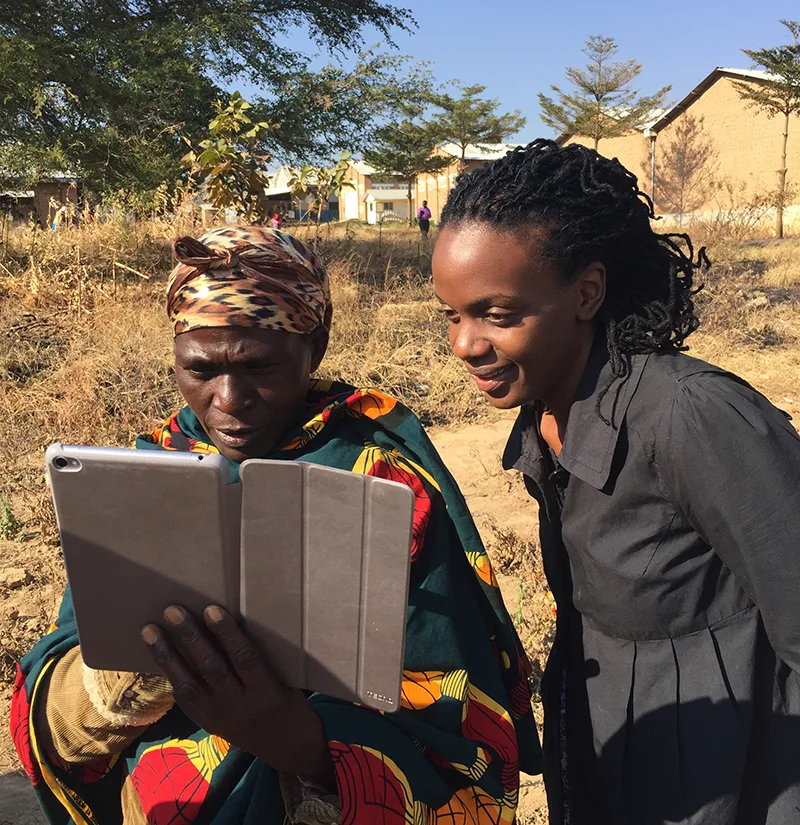
Catherine Nakalembe: Nowadays, I can process all of Ghana, all of Kenya, all of whatever, in a couple of minutes or hours, depending on what it is that I’m trying to do. So that is a huge, huge advantage. I can map anything anywhere. This is what I say nowadays. Obviously, it’s not as easy as I say it, but it is way easier than if you’d asked me in 2010 or in 2000s. I would be like, “Mm, well, now…” You know, I’d do some humming, et cetera. So that’s one advantage.
Narration: Catherine’s satellite imagery picks up more wavelengths of light than the human eye can see. That means she can detect early signs of water stress and the changing colour of vegetation before farmers on the ground even notice there’s a problem. When we spoke to her earlier this summer, she was already seeing the signs of an oncoming drought in Karamoja in northeast Uganda.
Catherine Nakalembe: So with the forecasting method that I now am pretty confident with, I can already tell what district crops will not recover. Not even right now, as of April, at the beginning of April, I already know one of the districts is already in a critical condition because what I’ve done is I’ve used the relationship between rainfall and vegetation conditions on average, how they relate, to build out a forecasting model. It’s a machine learning model that based on how the season has progressed, vegetation has hit this critical threshold, and it’s not going to recover.
What that means is in order to support that community, in order to reduce human suffering for that particular district, there has to be a plan for an intervention, and that’s, you know, the idea of what that forecasting will do.
Narration: There was a time in 2015 when the signs of drought showing up in her data were so alarming that she picked up the phone to the Ugandan prime minister’s office and got herself in a meeting with the country’s leader.
Catherine Nakalembe: So this meeting, I remember it is so life-changing for me. It was like September 3rd is when I made this presentation, and on September 5th, which was a Saturday, they sent the first food trucks to bring food aid to the region because it was so clear in the images and the map evidence that there had been, you know, a very serious thing. So in this case, the policy that is required, to have prepared better for that, didn’t exist. Like, there had to be some scrambling to pull together resources in order to respond. Even though the drought would have unfolded probably sometime in April.
Narration: Catharine estimates this one had been going on for several months before she was able to raise the alarm.
Catherine Nakalembe: So crops don’t just die, except of course, if they’re hit by a derecho or, you know — it’s not like suddenly they’re dead. They die slowly. If a policy had been in place that this place always experiences this and we need to respond this way, there’s no need for it to have gotten to that situation where I have to show photos of, you know, the frustration and suffering that is unfolding, that would get significantly worse over the following months without any intervention.
So, same thing in the case of Chicago this month. There’s been extreme rainfall, extreme heat, and in Chicago, people are always, you know, pumping water out of their basement. And so the policy has to be in place to ensure that either buildings are retrofitted or the people have the funding and income and resources to be able to not have to spend out of pocket. Because not everybody has tens of thousands of dollars to, you know, retrofit or fix their basement when there’s a flood.
Narration: This points to a bigger structural challenge behind adaptation efforts. It’s something Catharine wrote about recently in an op-ed for Yale Climate Connections titled “AI Can Predict Disaster, But It Can’t Save You.”
Catherine Nakalembe: I use this analogy, that a better prediction does not build a sea wall. Like, I will have, I will predict it’s going to be five feet of water. I can predict it maybe to the centimetre, and, you know, but it does not build a sea wall that will protect me from five centimetres of seawater. Does that kind of make sense? Like, that’s what it means to me. So I can forecast that there will be a severe extreme drought. That does not bring drought-resilient seeds. It does not bring an irrigation system.
Narration: Prediction, in other words, is only half of it. It’s part of the reason Catherine pushes back on what she sees as an AI-first or AI-only mindset.
Catherine Nakalembe: The idea that there’s this competition for every company or a lot of research groups that are like, “My map is better than your map. My algorithm is better than your algorithm.” But what has happened is this is being conflated with solving real-life problems. And me knowing or having the best possible data, it means absolutely nothing. It means absolutely nothing because I cannot provide food aid. I cannot build better roads. I cannot influence a policy that will be like, we need to have a safety net program. You know, even if a farmer had agency and had all the resources that they needed, some of the events that are being experienced are vast and so far beyond the means of individual farmers.
Narration: But behind the forecasting data, there are countless lives and livelihoods at stake.
Catherine Nakalembe: The level of destruction is so… unbelievable. So I thought about this a little while ago. When we see maps of extremes, I have this image of Cyclone Idai that hit Southern Africa in, I think, 2019. It’s like a huge area in Southern Africa that was flooded, covered in water. If you look at the map, it could be like, “Wow, this is an incredible map.”
But there are people under that map. There are buildings, people’s lives. Floods equal disease, people being cut off. But when you look at it from a map perspective, it kind of — I’m going to use the word sanitize for the lack of a better word — whereas, like, you know, this…I mapped this extreme flood, the best, highest resolution, and I know exactly the total area affected.
But there are lives and people under that. So there is, there’s that dimension of what is invisible, the human suffering, the actual conditions that happen. So that bothers me a lot. You know, the pathway from this map to a decision or support system is so, it’s so huge. The other dimension of it is usually the people who make decisions are rarely the people who are experiencing it.
Narration: And that really gets to one of the biggest questions hanging over the future of AI-powered forecasting. As Catherine sees it, navigating escalating climate risk requires pairing AI and data infrastructure with physical capacity. So for every cent invested in AI, she’d like to see $10 flow to support people and systems on the ground.
Catherine Nakalembe: And I think it’s our responsibility — I guess with great power comes great responsibility in this case. But there’s also a divide between what we’re able to do scientifically and in an engineering perspective than what we do with our policy and the choices we make with that information.
Narration: At the top of the episode, we heard one way of putting AI-generated forecasts into the hands of people who can act on them. Pedram’s monsoon text messages essentially airdropped information to farmers all over India.
Other scientists and companies are developing on-the-ground solutions to help communities affected by extreme weather.
Tatiana Estevez: My name is Tatiana Estevez. I am the founder and CEO of Permalution.
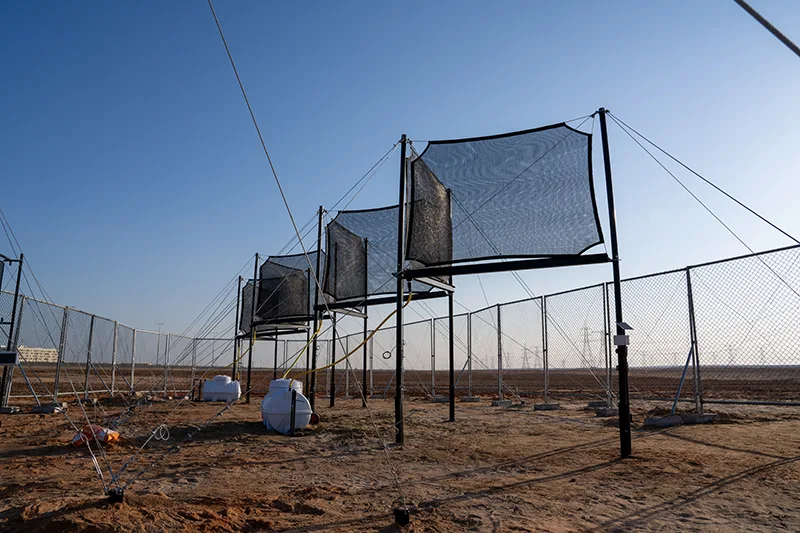
Narration: Her company has developed fog-harvesting technology to provide an alternate source of water. As the world warms, it’s putting more stress on the water supply. Tatiana saw this in 2015 while she was backpacking through California, as farmers struggled with an extreme drought.
Tatiana Estevez: That time, it was the worst drought in the state’s history. I remember having this heavy thoughts and looking outside the window, and I couldn’t see anything because of the fog in San Francisco. So that’s when I said, “This is tons of water that are passing above our heads. Why are we not using this water source?” Usually, there would be vegetations like conifers, sequoias, redwoods that would take this water back into the local hydric cycle, but nowadays there’s less than five percent of the vegetation that can do that job.
Manjula Selvarajah: You set up a pilot system in Nayarit, Mexico, that’s being used to help restore a particular kind of orchid. Can you describe to me what you learned there?
Tatiana Estevez: Yes. That was our first pilot that we set up, and it was for a natural protected area for wildfire mitigation and protection of two orchids, wild orchids that are on the brink of extinction, Cypripedium irapeanum and the Vanilla pompona. And we set up a fog water collector that irrigates a greenhouse, and orchids, they irrigate naturally from fog.
Tatiana Estevez: Some people, they were saying it’s magic. Like, you start to see this membrane that’s, like, sweating heavily and pulling water from just the fog.
Narration: Now, fog harvesting only works where there’s enough reliable, dense fog, like on coastlines, mountains or specific desert microclimates. But what if we could use our new predictive powers to help harness the weather, to help communities adapt?
Tatiana Estevez: So just to mention, taking a step back, fog and cloud water collection is as ancient as rainwater collection, but way less known because we need some meteorological factors to be met to have a successful project. For a long time it was a medieval practice to turn the spirit world into the material world. They didn’t understand why it happened, but they saw that there was water coming out of a particular point, and that’s what the predictive model and the set of sensors come to solve. Where do we set up these projects? In what, in what direction? It can change up to eight times the amount of water we get just by the direction towards the wind.
Narration: Tatiana says AI has been a game changer for Permalution. The company is using it to scour the world for fog hotspots.
Tatiana Estevez: Nowadays, fog and clouds are being measured in airports for visibility and mobility reasons, but not to be understood as a water source. So we found a fog spot that infiltrated through the mountains of Oman, and it was like the oasis that we see in the desert sometimes, these fog banks that happen, and we are identifying them.
So we are getting very surprised at the amount of fog exposure that it’s around the world. For example, now we’re in conversations for a project in the Atacama Desert. It’s the driest place in the world, not even one drop of rain a year. But they have all the ecosystem there flourishes because of the fog.
And it is way more predictable than rain and other sources of water that they have over there, especially because of the drought and the extraction from mining companies and other extractive industries that are in the region. So it’s an additional water source that they have. It is predictable. It’s more predictable than the other water sources.
But if we go to a place where they have natural lakes, like for example, here in Canada where the water is not perceived as a need, then it’s perceived differently
Narration: It’s not just Tatiana looking at the Atacama Desert. Researchers studying the region, in Chile, have been asking the same question. A study published in 2025 found real potential for the city of Alto Hospicio. As climate change puts more pressure on water-stressed cities, the researchers found that fog could serve as a complementary water source, important for resilience. Still, with all this promise, I wondered what’s standing in the way of scaling this up?
Tatiana Estevez: We see a lot of attention right now to carbon. Everything revolves around carbon and decarbonization, and we’re looking at these huge machines that are extracting carbon from the atmosphere. But in terms of the global or the bigger picture of how that affects communities or ecosystems, it’s still, there’s still a lot of work to be done. There is not one solution that will solve everything. There is no water solution that will solve all the water problems. We need a spectrum and a diversity of solutions, and not only consider the high-tech ones, but the nature-based ones as well.
Narration: When it comes to implementing solutions to help communities adapt to a changing climate, as Tatiana says, there’s still so much work to be done. According to the UN’s latest Adaptation Gap report, developing countries right now are getting just a fraction of what they need. And the gap is only growing wider.
What strikes me is just how many tensions are at play here. There’s the finance gap, even though investing in adaptation is shown to be good economics. Paying to prepare or avoid disaster can also save lives. Then there’s the accuracy gap. Right now, a five-day forecast in the US is as good as a one-day forecast back in 1980. In developing countries, that same progress lags way behind.
AI could help solve part of this, making forecasts faster, cheaper, and more accessible. But there’s also the glaring reality that the AI boom behind much of this progress is also fuelling a massive build-out of data centres, with real costs to the environment: in terms of energy and water. It’s worth acknowledging the complexity here.
Which brings us to an important caveat, one that Pedram Hassanzadeh, the climate scientist, really wanted me to understand.
Pedram Hassanzadeh: So we know that with climate change, the earth is changing, the oceans are getting warmer, and that can increase the likelihood — like something that was a grey swan, you know, 100 years ago, 100 years from now may not be a grey swan at all. It might be a very frequent event. Like, going to an example, there was a heatwave in Pacific Northwest that affected Vancouver and Seattle. You know, it was deadly and costly. Now, that event, when you look at the data, it was really at the edge of like any kind of temperature we had ever seen.
Manjula Selvarajah: Like what would be called a freak event.
Pedram Hassanzadeh: Exactly. Yeah. But with climate change, as you know, with everything warming, it is possible that that kind of event becomes more frequent. If something happens that nobody in the world ever, in the observational data that was used for the training of the model, something happens that we had never seen before, very different from things we have seen, then these models can fail.
Narration: So what do you do with a model that fails on exactly the events you most need it to catch?
Pedram Hassanzadeh: If you want to build the next generation of these models, right? If you want to do innovation, I think that’s the question. Like, that was the purpose of a paper that we wrote to show that the models fail for grey swans, because then it says, OK, there is something that these models miss. We should go inside, better understand what’s going on, and maybe —
Manjula Selvarajah: — figure out a way. Yeah, for the future —
Pedram Hassanzadeh: But I think that’s the thing that, like, taking a step back, like at the universities, I think that’s what we are thinking about, grey swans, things that these models cannot do and how to really show this so that everybody’s aware of these problems, but also we come up with solutions and, you know, kind of help with building the next generation of these models.
Narration: And that’s where things stand right now. AI isn’t replacing physics-based forecasting, at least not in Pedram’s view. But in a very real sense, it is transforming the field of meteorology. I want to know where Pedram sees this making the biggest difference.
Pedram Hassanzadeh: I used to live in Houston, right? And every time there was news of a hurricane coming, and at some point there was news that there are two hurricanes coming, they’re going to collide over Houston. I mean, that’s a big decision for a city to, okay, do we evacuate a city of several million people? Do we sit here? Do we stay? The question is how much certainty you have in the forecast you are producing, and maybe for decision-making, that’s actually the most important thing. So the AI models can really help with reducing that uncertainty.
And I think that, to me, again, from a decision-making perspective, is more important than, you know, is it like five hours earlier or five-and-a-half hours earlier that you can have something of the same accuracy? Because weather, it’s, I mean, there’s no, like, precise weather prediction, right? You cannot say it’s going to rain this much at this time over Montreal, right? But it’s, like, really the probability of what you can report, and with that, the AI models do amazingly better just because they are cheaper, and also, you know, there are all sorts of ways to make neural networks stochastic.
Manjula Selvarajah: So I love that. It’s the idea that they reduce the uncertainty.
Pedram Hassanzadeh: Mm-hmm. Yeah.
Narration: As we finished this episode, a super El Niño was gathering strength in the Pacific. When a similar event occurred 150 years ago, it set off a devastating series of droughts and famines. This year’s El Niño is already causing damage. It’s delayed the onset of the monsoon in India by nearly a month. And in Uganda, the drought Catherine identified earlier this year has now turned into a full-blown crisis.
It’s a stark reminder of just how much is at stake when it comes to forecasting. No matter where you look, whether it’s fires here in Canada or those burning across Europe, we’re seeing devastating news, all around the world, of ecosystems and communities pushed to their limits.
Catherine Nakalembe: There’s a picture from the fires in Greece where a family is looking at this fire, and it seems like they were watching TV, you know, but the fires were, like, on the other side. They could probably feel the heat on their faces.
And it is easier if you’re farther and farther away, and social media has not helped. It’s like if we’re watching a movie on our screens of things that are actually affecting people, and that lack of empathy, where we try to justify and assume sometimes, oh, they’ve got it, you know, they’re in Australia, strong infrastructure, they’ll get support. There’s, like… I think there’s a lot of that that is happening. I always think about what would I do? How would I feel? The level of frustration I would feel if all my hard work was washed away or flooded, how that compromises feeding my kids. I think, like, we need to empathize more. These things cannot be as things that happen far away on the other side of the world.
Narration: Solve for X is brought to you by MaRS. This episode was produced by Ellen Payne Smith and written by David Paterson. Lara Torvi, Sana Maqbool and Sarah Liss are the associate producers. Jason McBride is our senior editor. Mack Swain composed the theme song and all the music in this episode. Gab Harpelle is our mix engineer. Kathryn Hayward is our executive producer. I’m your host, Manjula Selvarajah.
llustration by Kelvin Li; Image source: iStock
-
 MaRS Staff