Amid the latest trade turmoil, Canadian startups are looking abroad

Some lessons on international expansion
Lake Ontario is now Lake America, hockey sticks have been hit with a 50 percent tariff and Doug Ford is Captain Canada again? The intensified trade war is absurd on so many levels, but for the startup community it’s yet another reason to look beyond the U.S. market. Below, in the lead up to Mark Carney’s big investment summit, we dig into the challenges and opportunities of international expansion in an era of geopolitical upheaval.
Also, in this week’s newsletter:
Stories from the ecosystem, upcoming events and the hottest jobs this week
Trading places
In two weeks time, Toronto will be teeming with celebrities — it’s of course film festival season — but this year superstars of the international investment world will also be flying in for the Canada Investment Summit. The inaugural event is being billed as 24 hours that could transform the country’s economic trajectory. Led by Mark Carney and two of Canada’s largest pension funds, the invitation-only event is bringing executives from nearly 100 global investment organizations from 28 countries to town. The goal: to remind the world that Canada’s a great place to park your cash.
A newly intensified trade war has made that argument considerably more complicated, however. Whatever long-term pain the tariffs will inflict is uncertain, but a destabilized Canadian economy will certainly be less attractive to investors. And with limited access to American markets, which has been a big selling point for Canadian companies for years, some sectors will need to find alternative ways of making themselves compelling.
All this trade turmoil adds yet more urgency for Canadian startups looking to expand. On September 16, the day after Carney’s summit, MaRS is hosting Innovation Exchange: MaRS Global Forum, an invitation-only summit for global startup partners, trade commissioners and international VCs. In advance of that gathering, we polled several startups about their current expansion efforts. Nearly half of the 50 respondents said that they are more focused on markets outside the U.S. than they were 18 months ago. Europe is their top priority market, followed by Asia, the U.K. and Australia.
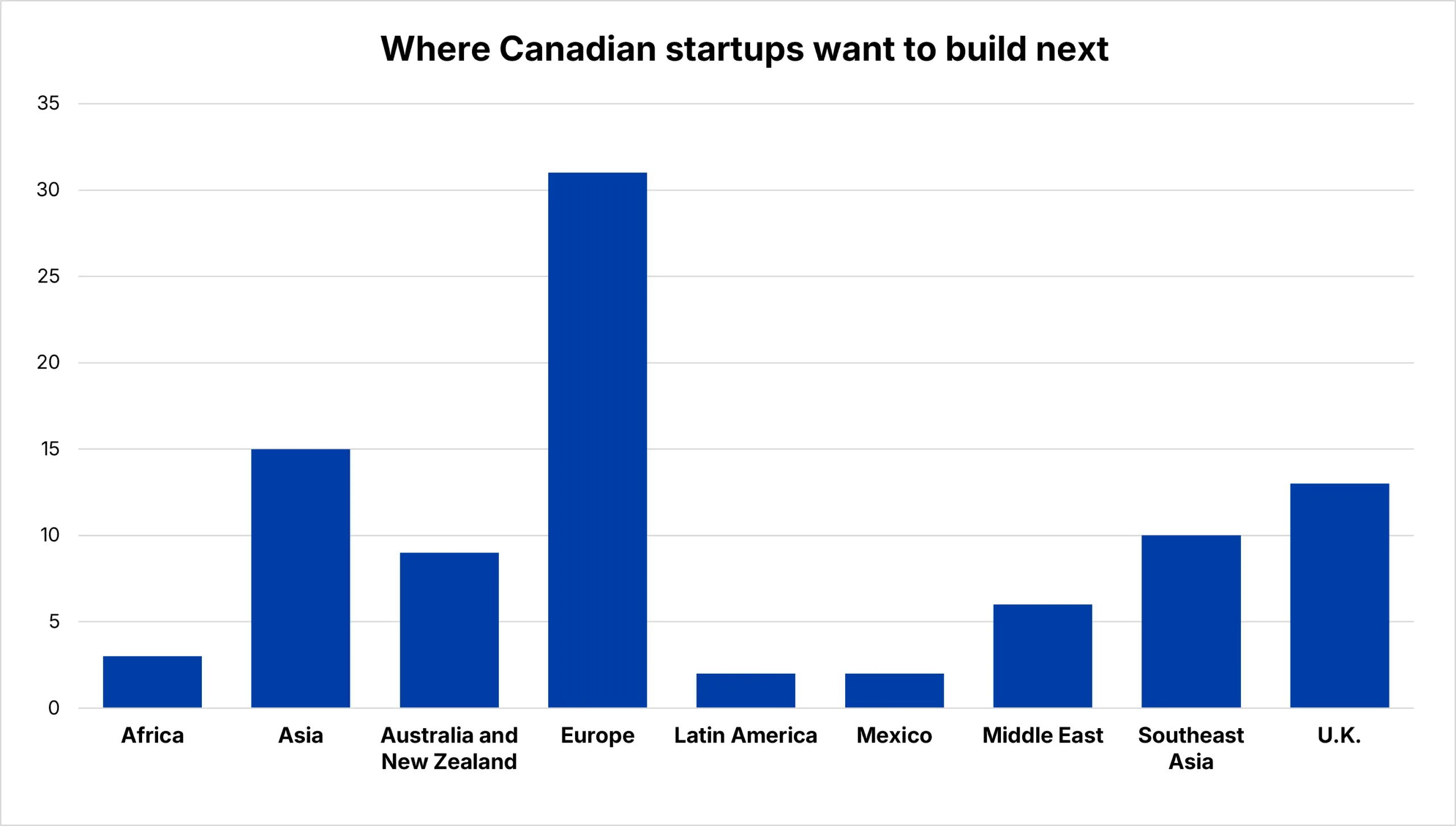
But how do you reach those markets? Expanding isn’t easy; for starters, it requires strong relationships and partnerships in foreign territories, understanding of new regulatory frameworks and ample capital. Then there are the basic challenges for anyone working in a different country: new languages, unique labour laws, unexpected cultural differences.
Litmus, which manages industrial data for AI, knows these challenges well. The company, which was founded in 2013, opened offices in Japan and Germany just a few years later. “They might be the two hardest countries in the world in which to open up a business,” says co-founder and CFO Sacha Sawaya. “In Canada or the U.S., I could spin up a new company in probably less than a day. There it takes months of back-and-forth and bureaucratic red tape. Just opening a bank account in both jurisdictions is a nightmare.”
In Japan, he enlisted local firms that could help him with taxes, payroll and other administration, but most crucial was finding a partner that could “validate” his company. Through JETRO, the Japan External Trade Organization, Litmus was connected to Mitsubishi, who eventually became both a partner and an investor. Such trade organizations are of keen importance to the companies we polled as well; 63 percent say a committed local counterpart would significantly advance their international growth.
When it comes to pricing and customers, Sawaya advises forgetting what you might have discovered in other markets and treating each one as distinct. “A lot of startups try to do the same thing they do in the U.S. or Canada,” he says. “It just doesn’t land properly because they’re not the same kind of buyers.”
Nymble Health, a Toronto startup that provides behavioural support for patients with chronic metabolic disease, has made inroads in Ireland and Germany. Founder and CEO Puneet Seth echoes Sawaya’s description of Germany — “one of the strictest markets from a data privacy and regulatory framework” — but insists that, if you can make it there, you can make it anywhere. Selling their product into Germany has opened doors to Denmark and Sweden, and Seth is now exploring several Latin American countries, too.
He offers two main pieces of general advice: one, get boots on the ground. “Business is all about relationships,” says Seth. “Virtual calls are great, but if you’re going to be doing business with a partner and you’re serious about it, you need to meet them in person.” Secondly, don’t listen to people who tell you expansion is a distraction, that you need to focus on Canada and the U.S. “Being able to deploy a product in different markets, especially software, is extraordinarily low,” he says. “As long as you have a thoughtful approach to how you’re going to manage regulatory items, it’s not that difficult to expand.”
Seth also urges startups to seize this politically fraught moment, arguing that Europe especially is eager to work with Canadian companies: “Now is the time to look at international markets and lean into the fact that you have a Canadian identity as a business. There’s a lot of scientific expertise in this country that we have struggled to monetize effectively. But it can be done.”
Mark Carney’s taking full advantage of this receptiveness. The day of his summit, he’ll be attending the EU’s State of the Union address. The next day, he will speak to the EU parliament. Recently, Ottawa has been on a European spending spree, signing contracts with many companies there, particularly in defence. Canadian startups should expect, and embrace, a technological two-way street.
Find out more about the Innovation Exchange: MaRS Global Forum here.
Stories from the ecosystem
AI: How Canada can overcome the backlash against AI data centres. (Globe and Mail)
VC: The Creative Destruction Lab is using data to reveal what makes startups successful. (The Logic)
AI: Why a former NVIDIA exec is building a Matrix-like model to train AI. (Toronto Star)
CRITICAL MINERALS: A new rock library could hold the key to Canada’s next critical mineral discovery. (Be Giant)
RESEARCH: Ottawa taps 64 leading scientists and scholars to boost Canadian research. (Globe and Mail)
AGTECH: How greater automation could give farmers a helping hand. (Toronto Star
Solve for X: The coming storm

Recent advances in AI have fundamentally changed how we predict the weather, making forecasting cheaper, faster and better. On the latest episode of the pod, we explore this meteorological revolution, and also ask: how can this knowledge drive policy change and, in the face of growing water shortages, help us find all new sources.
Upcoming events
- Applications are now open for the second cohort of the Mission from MaRS: Food and Agtech Venture Accelerator. MaRS is recruiting six to 10 Canadian ventures developing technologies that strengthen Canada’s ability to produce, manufacture and distribute food domestically while building a more resilient, low-carbon food system. Learn more at this information webinar on September 2 or apply directly here. Application deadline: September 25.
- “Beyond the Diagnosis: The Future of Neurodiversity” is the first of three public talks in the Ontario Brain Institute’s series on the evolution of brain health. September 12.
- At “The AI-first startup playbook,” this month’s edition of Technically Speaking, panellists will explore the practical realities of building tech ventures in the AI era, from retrofitting legacy SaaS platforms to defining the human-machine division of labour. September 15.
- Innovation Exchange: MaRS’s Global Summit is an exclusive, invitation-only summit for global startup partners, trade commissioners and international VCs. September 16.
- At “Building food intelligence: A conversation with RxFood,” our next MaRS Morning, RxFood’s co-founder and chief medical officer, Jeffrey Alfonsi, discusses how AI and computer vision are transforming everyday meals into actionable, clinical-grade data. September 17.
- The RBC Women in Cleantech Accelerator Showcase celebrates the achievements of the 2024–2026 cohort and officially launches the 2026–2028 cohort. Featuring a keynote by climate scientist Katharine Hayhoe. September 18.
- At the next MaRS Demo Session, four members of the Adaptech Accelerator — Enersion, NOAH Intelligence, RUNWITHIT Synthetics and ZS2 Technologies — will be showcasing their climate-resilience solutions. September 21.
- At the MaRS Capital Showcase, 20 of the most promising ventures in the MaRS portfolio (spanning climate, health, AI and more) will be pitching investors. September 22.
- Date the Funds, hosted by MaRS and Growth Partners, is a 90-minute lunch date with founders and funders matched by sector, model, stage and thesis. September 22.
- The Elevate Festival brings together tech leaders, startups, investors, policy-makers and media to spotlight Canadian innovation. On September 23, MaRS IAF’s William Ma hosts a roundtable, “Fundamentals of making your business fundable.” September 22 – 24.
- This year, Reaction Hub’s Innovation Summit is exploring nation-building projects. September 23.
- Liam Gill, manager of MaRS’s capital program, will be speaking at the Investor Reverse Pitch event at the HIN Venture Summit. September 28.
- Mark your Calendly. Early bird tickets are now on sale for MaRS Climate Impact. November 17 and 18.
For more, visit our events page
In the queue: What we’re reading, watching and listening to at MaRS
This week, Ahmed Korayem, senior manager of MaRS’s Momentum program — which provides strategic support for high-growth companies — shares his current obsessions.
 Startup strategy from an insider’s insider: “On Lenny’s Podcast, Lenny Rachitsky asks better follow-up questions than most interviewers in the venture space, and his guest lists consistently skew toward people actually building and scaling (rather than talking heads). Having built his own venture — acquired by Airbnb — puts him in a unique position and makes every episode a gem!”
- The latest from an enduring indie folk trio: “Daughter’s music holds up better than most bands of their era. Their most recent album, Stereo Mind Game, is another brilliant work of art, and I’m in awe of how consistent they’ve remained over the years.”
- A bestselling classic of behavioural science: “Dan Ariely’s Predictably Irrational argues that decision-making, including financial and investment decisions, follows predictable but irrational patterns, rather than the rational-actor model most frameworks assume. It’s an argument that stands the test of time and continues to help me make sense of very irrational behaviours.”
- An operating manual for ambitious entrepreneurs: “Life at the Speed of Play: Launch Products People Love! is Zynga founder Marc Pincus’s playbook for building products fast in the AI era. It’s built around the idea that your instinct is usually right but your first idea is usually wrong.”
Careers: The hottest jobs in tech this week
- Phoenix, a digital health company, is hiring a pharmacist, head of brand, nurse practitioners and several other positions. (Multiple cities)
- Xanadu, a quantum computing company, is hiring a senior cost engineer, an IT support specialist and a product management director. (Toronto)
- Obsidi, a networking platform for Black professionals, is looking for a senior technical product manager, a senior data analyst, a senior conversation manager and several other positions. (Multiple cities)
- Evercloak, which develops sustainable cooling systems, is hiring a QA/QC lead, a mechanical technologist and a coating technologist. (Kitchener-Waterloo)
For more, visit our jobs page
Did you know that MaRS is a charity?
Your support helps us advance Canadian innovation and science, bring our community together and transform the world for the better. For instance, through our carbon removal donation program, you can help support Canada’s most promising CDR companies through tax-deductible donations. Learn more here.
Thanks for reading! See you in two weeks.
Main photo illustration: Stephen Gregory; photos: Unsplash
Sign up for our newsletter
-
 MaRS Staff