How one startup triumphed over tariffs
If we want true local, we need to go beyond the label.
A chaotic, tit-for-tat trade war has hurt companies and consumers on both sides of the border, but it’s also compelled some firms to come up with creative work-arounds: finding alternative suppliers, developing new markets, rethinking product lines. But, as Dominique Ritter writes below, one MaRS startup is dealing with a late-breaking counter-tariff by leaning into the innovation at its core.
Stories from the ecosystem
The hottest jobs this week
Dam right, Canada
Any beaver would tell you that a good dam doesn’t just control the flow of water, it also acts as a filter.
Andrew Murray, the CEO of Aslan Renewables, understands this better than most non-beavers. His P.E.I. startup, founded in 2021, has designed a modular turbine to reanimate unused small-scale dams and provide clean, local hydropower. Keeping organisms and debris from jamming up the works is vital to smooth operations, but, with their first commercial deployment scheduled to hit Canadian waters in October, they encountered a new impediment: tariffs.
Aslan’s filtration system includes a U.S.$80,000 piece of steel called a T-intake screen. That essential off-the-shelf component — which is used in data centres and the oil and gas industry — was hit by one of Canada’s retaliatory counter-tariffs, announced on August 25. Aslan, like 70 percent of small Canadian businesses relying on ties to the U.S., was faced with a stark new financial reality.
“That was a really scary moment for us,” says Murray. “It has a huge impact for a company like ours because of our early stage. I mean, we’re still a baby company. But it also affects our total cost enormously, and we have been working for years to make sure that the cost of the system is very low.”
With no made-in-Canada equivalent on the market, it was back to the whiteboard for Murray and his team. Luckily, Aslan had already been steadily optimizing their turbine with better, more affordable components — an exercise that kept resulting in steel being swapped out for another material. In a post-tariff brainstorming session, Murray wondered, Could the filter be made out of fibreglass? The answer was yes.
In the span of two weeks, Aslan went from existential threat to designing its own filter, finding a local company to produce it and saving money in the process.
“Tariffs forced us to think deeper about our solutions,” says Murray. “And what came out is a much more sustainable answer. I feel like an idiot now. I was using a hundred-grand piece of U.S. steel! Now that just feels lazy.”
According to a September 10 report by the Canadian Federation of Independent Business, there are more than 50,000 small Canadian businesses feeling the impacts of U.S. tariffs, counter-tariffs or both. Trade disruptions are particularly onerous for small enterprises, which account for nearly half of the country’s private sector GDP and employ about a quarter of the population. How companies mitigate the mayhem is taking many forms, from drumming up more interprovincial sales opportunities to cooperating with competitors to offer made-in-Canada products.
In the end, Aslan viewed the tariff as just one more “pitfall” — Murray’s word — in the development of their solution. “That’s how we treated it,” he says, “as opposed to a more severe, deeper geopolitical problem.” And while every business is different, Murray still offers peers dealing with similar obstacles this pearl of wisdom: “Remember who you are.” — Dominique Ritter
For more on Aslan’s hydropower tech, check out the latest episode of our podcast, Solve for X.
Stories from the ecosystem
CLIMATE: The carbon removal tech sector sizes up new markets. (Toronto Star)
INNOVATION: Canada’s top growing companies of 2026, ranked. (Globe and Mail)
TRANSPORTATION: How one Toronto company is boosting EV infrastructure. (Toronto Star)
DEFENCE: Canada’s $180-billion defence buildup is already out of date. (The Walrus)
CLIMATE: Why Germany is building an ark for U.S. climate data. (YaleEnviroment360)
Solve for X: Tapping the source

Aslan Renewables’ modular turbine systems tap into dormant infrastructure as a new source of hydropower. On the latest episode of the pod, founder Andrew Murray talks about how small-scale power generation could build a more resilient grid.
Upcoming events
- At “If I were mayor: Competing for the future,” co-presented by MaRS and the Toronto Star, Jennifer Keesmaat, Armine Yalnizyan and Marissa Kassam discuss how the city’s next mayor can advance an innovation agenda. October 1.
- The MaRS Better Building program is hosting an information webinar for owners and operators of hotels, motels, gyms and spas interested in joining its next Hospitality and Recreation cohort. October 6.
- “Unpacking trade turbulence: What do ventures need to know?” is a 75-minute workshop, co-presented by MaRS and EDC, on how Canadian startups, founders and operators are adapting in real time as U.S. trade deals rapidly change. October 7.
- More than 2,000 leaders from agriculture, aquaculture, agribusiness, policy and investment are descending on the Food Forward Summit to explore the future of food. MaRS’s Katherine Festeryga will be discussing why the food sector needs to be recognized as critical infrastructure. October 8.
- The Innovation Cluster is hosting “Hacked: What every founder needs to know before it’s too late,” a workshop on cybersecurity for startups. October 8.
- At “Pitch decks and playdates,” this month’s edition of Technically Speaking, MaRS startup advisor Katie Hayes hosts a panel discussion on how to juggle parenting demands while scaling a venture. October 13.
- At this month’s MaRS Morning, “Growing up with the algorithm,” Diana Fox Carney, Beeban Kidron and Ava Smithing explore what a safer digital world for the next generation looks like — and how we get there. October 20.
- At the 2026 Canada Gairdner Laureate Lectures, this year’s award recipients share the stores and science behind their discoveries. October 21.
- Mark your Calendly: MaRS Climate Impact is November 17 and 18. (General admission tickets available until October 14.)
For more, visit our events page
In the queue: What we’re reading, watching and listening to at MaRS
This week, Azam Khan, the co-founder and CEO of Trax, a building regulation intelligence firm, shares his picks.
 An uplifting doc on the global rise of veganism: “I’m drawn to films that are independent and non-corporate, but still polished, thoughtful and compelling. Food for Thought: Why Millions Are Changing How They Eat does a particularly good job of exploring why people are rethinking what they eat (without feeling like conventional media or marketing).
- A groundbreaking inquiry into the science of reason: “I like re-reading older books on psychology because many of their ideas take on new meaning in the age of AI. Robert A. Burton’s On Being Certain is especially relevant. Recognizing why humans can feel completely certain while being wrong turns out to be useful not only for understanding ourselves but also for thinking about how we evaluate, trust and even debug AI systems.”
- A novel take on lab-made cheese: “I’m loving precision fermentation and synthetic biology! I read this article (and watched this video) about Toronto-based precision-fermentation company, AuX Labs, and liked it because it sits at the intersection of several things I’m interested in: science, entrepreneurship, sustainability, animal welfare and the possibility of using technology to fundamentally rethink how familiar products are made.”
Careers: The hottest jobs in tech this week
- Flinks, which builds financial intelligence solutions, is hiring a senior full-stack developer, a senior data scientist and a senior data engineer. (Montreal)
- Kepler Communications, a satellite communications company, is hiring a senior program manager. (Toronto)
- TIAP, Toronto Innovation Acceleration Partners, is hiring a manager of technology and venture development. (Toronto)
- Guidewire, which builds AI-powered insurance software, is hiring a software engineer, a functional architect and several other positions. (Multiple cities)
- Future Fertility, a fertility technology company, is hiring a product manager. (Toronto)
For more, visit our jobs page
Did you know that MaRS is a charity?
Your support helps us advance Canadian innovation and science, bring our community together and transform the world for the better. For instance, through our carbon removal donation program, you can help support Canada’s most promising CDR companies through tax-deductible donations. Learn more here.
Thanks for reading! See you in two weeks.
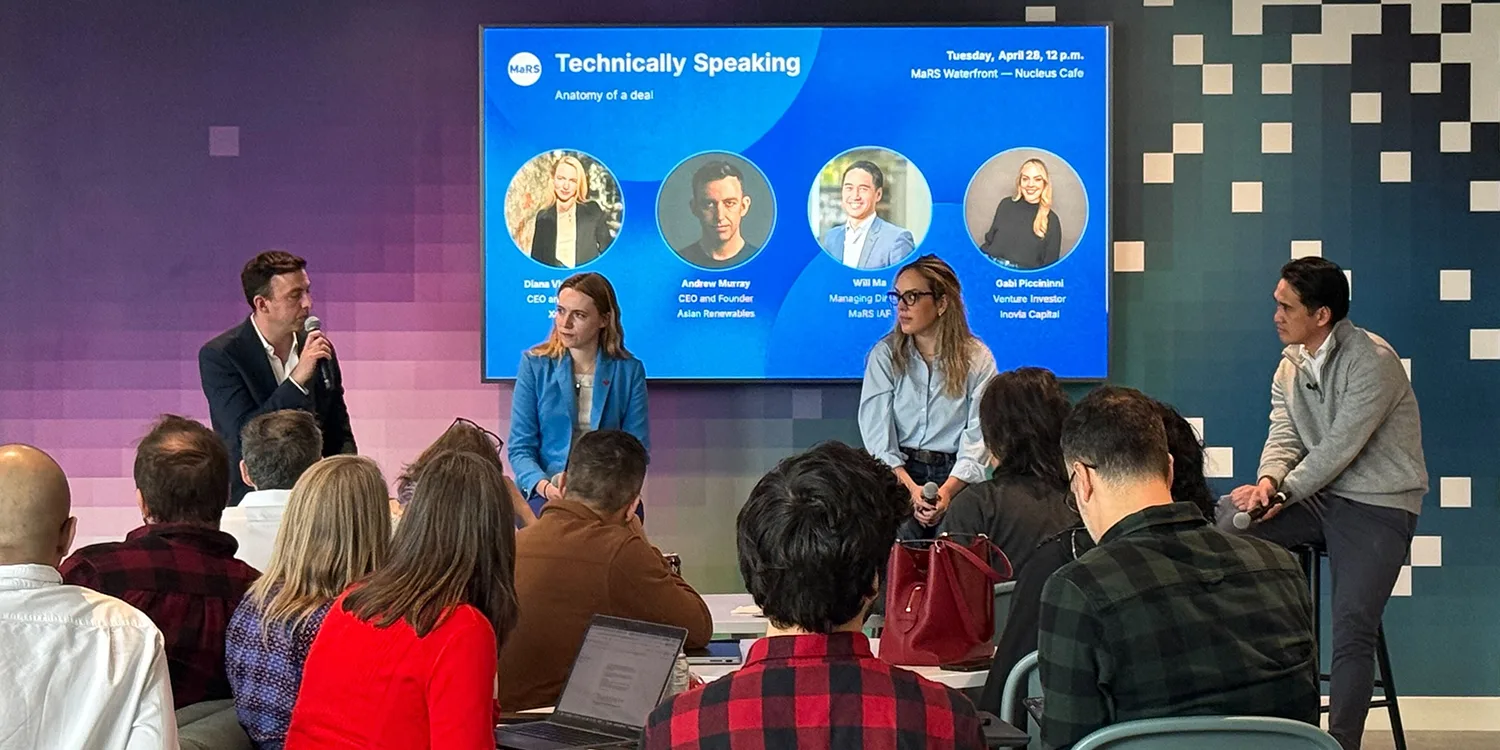
Main photo Aslan Renewables’ Andrew Murray at MaRS’s Technically Speaking series in April. (Photo credit: Kelvin Li)
Sign up for our newsletter
-
 MaRS Staff