There’s an answer to the housing crisis — build better buildings
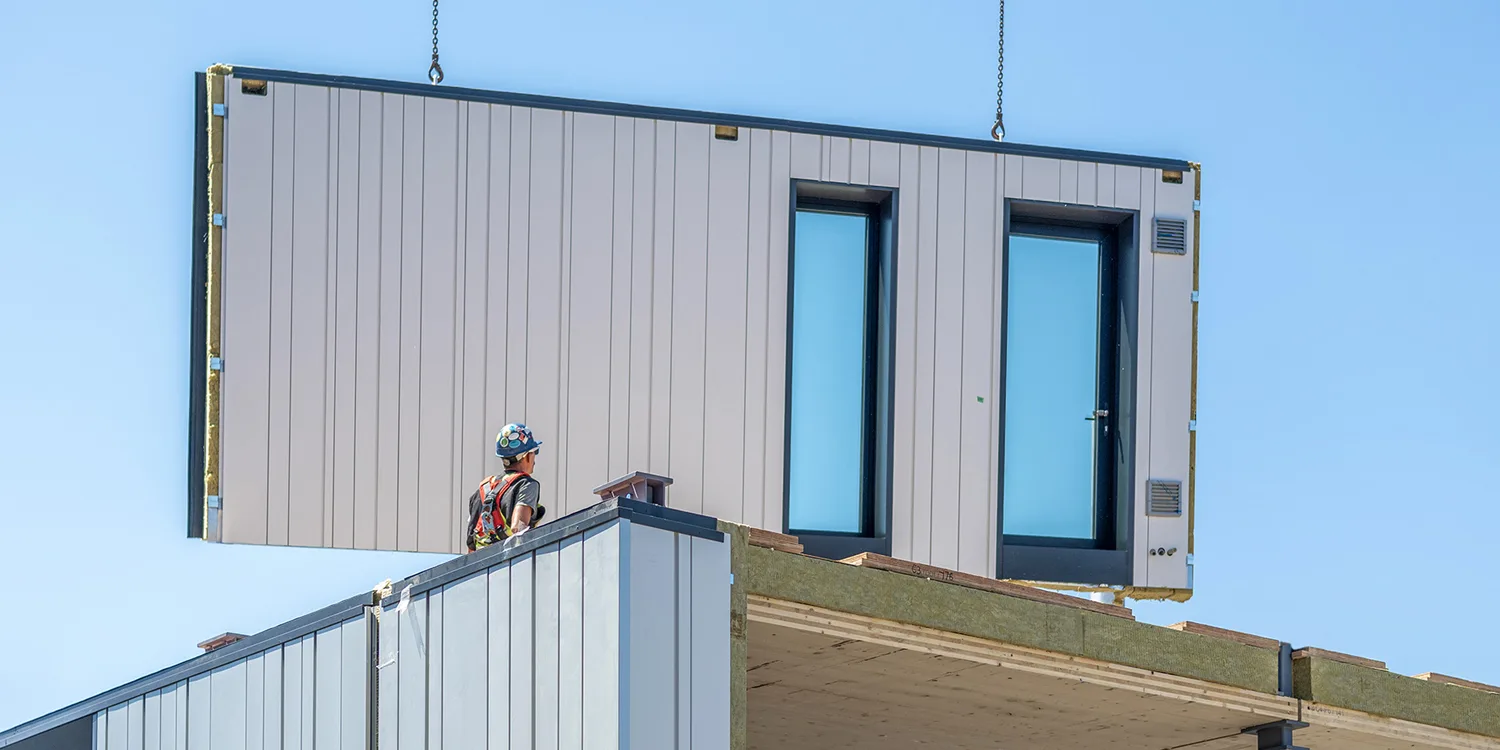
A blueprint for affordable, sustainable housing
Home prices may still be dropping, but the housing crisis hasn’t gone away. Far from it. One way to tackle it, however, is to radically overhaul the way we build housing. Innovative methods and materials — modular, mass timber, low-carbon concrete — could make our buildings both cheaper and more sustainable. Below, Ria Perrault, who heads up the Better Buildings mission at MaRS, explains how.
Also, in this week’s newsletter:
Stories from the ecosystem, upcoming events and the hottest jobs this week
House alarm
Call it a correction or a crisis, Ontario’s housing industry is definitely in distress. Inflated construction costs, high interest rates, U.S. tariffs and a glut of unsold, pre-construction condos have all but paralyzed the sector. In Toronto, according to the Canada Mortgage and Housing Corporation, housing starts are at their lowest level since 2009 — lower than Calgary, Montreal and Vancouver for the first time. Between 2022 and 2025, there was a fivefold increase in the number of condos cancelled in the city. In late June, internal documents revealed that the Ford government had given up on its promise to build 1.5-million new homes by 2031.
This situation is impacting developers of all kinds, but companies that are trying to deploy innovative, sustainable housing solutions are particularly vulnerable. In the last few years, a clutch of businesses in that space — Hamilton’s modular-housing startup, BECC Construction; Nexii, a B.C.-based green construction company; Calgary’s Nomodic Modular Structures — have gone bankrupt. More recently, Assembly Corp., the high-profile firm behind affordable, mass timber projects in Toronto and elsewhere, has restructured in the hopes of avoiding a similar fate.
But such modern techniques and materials — mass timber, modular construction, robotics, low-carbon concrete — are precisely the kinds of innovations that can help the industry navigate current headwinds. At scale, they would bring down costs, speed up construction and drive productivity. (The University of Toronto’s School of Cities estimates modular construction alone can reduce construction costs by 10 to 25 percent.) They’re also a key focus of the federal government’s Build Canada Homes agency. A year ago, Mark Carney visited the Delta, B.C. pilot facility of MaRS venture Intelligent City, also a prefab modular housing company, telling them that “you are the future of housing construction in this country.”
Without more precise, consistent investment and modernized policy, this future is at risk. In A New Blueprint, a report MaRS published in March, we argue that the industry can improve affordability, reduce carbon emissions and boost the economy all at once. But it can only do so by harmonizing building codes to allow these materials and methods everywhere, taking away some of the risk; simplify zoning and site plan regulations and incentivize developers and industry to use novel construction methods and work with companies like Assembly and Intelligent City.
“We need to make financing for these projects easier,” adds Ria Perrault, a manager on the climate team at MaRS. Businesses in this space, who manufacture very expensive components off-site and have minimal cash flow until late in the process, require more working capital at the start and a consistent pipeline of demand. Governments could help, Perrault says, by placing or enabling bulk orders that would help create stability for these businesses.
Intelligent City is currently gearing up to build a new, larger manufacturing facility in Ontario, where demand for their solutions is greater. But president OD Krieg acknowledges that because his company is so new it can be difficult for developers to commit to their methods. “In order to establish that predictable demand, developers need incentives,” he says, such as better financing deals or the ability to add greater density. “So they can balance the potential risk of using these new technologies.”
As Perrault says, we’re at a critical juncture: “When it comes to changing the status quo, everything is at stake. These are the Canadian companies working to deliver more housing, more sustainably and at lower cost.” Without adequate support, more of these companies will disappear and innovation in the sector will grind to a halt. “We’ll be tied to the methods we’ve always had for another 50 years,” Perrault says, “methods that clearly aren’t working for our housing market or sustainability targets.”
Solve for X: This uncanny moment
 AI has us lurching between hype and hysteria, but where do the real challenges and opportunities lie? On the latest episode of the pod, Pillar VC’s Leah Morris talks about how new technologies are exacerbating inequality, the enduring value of human judgment and how to reckon with this particularly effervescent investment market.
Stories from the ecosystem
AGTECH: Want a salad that won’t send you running to the washroom? Homegrown innovation can help.
CRITICAL MINERALS: Acid rock: A Quebec startup is on the verge of transforming the mining industry.
MOBILITY: Hamilton’s ImaginAble Solutions makes devices that help people create again.
CLEANTECH: What it takes to build a one-of-a-kind climate solution.
AI: Cory Doctorow on using AI without AI using you.
ENTREPRENEURSHIP: How bootstrapping can build a more resilient business.
Use case: BluWave-ai’s platform to regulate EV charging in Ontario

Who: Founded in 2017, Ottawa-based BluWave-ai builds AI-powered solutions to maximize the efficiency of renewable energy, energy storage and electric transportation.
What: On July 21, BluWave-ai announced it had signed a deal with four Ontario utilities to deploy its EV Everywhere platform to manage EV charging loads on the grid. The platform uses real-time data to predict consumer demand, providing optimal dispatch for intelligent charging scheduling. In effect, it mitigates peak loads, allowing municipalities to integrate EVs while reducing costly infrastructure upgrades.
How much: BluWave-ai expects there to be 500,000 EVs on Ontario roads by 2029, almost double current levels. Rather than building new power lines and transformers to accommodate increased demand, the Ontario Energy Board is encouraging electricity distributors to adopt demand management alternatives, and BluWave-ai anticipates being a big beneficiary of that policy — worth up to $100 million over the next three to five years.
Upcoming events
- Applications are now open for the WEtech ScaleUP accelerator program, which is seeking tech and innovation entrepreneurs looking to scale businesses in the Windsor-Essex and Chatham/Kent regions. Application deadline is August 9.
- Jenny Lemieux of MaRS venture Vivid Machines talks shop with leaders from 1Password and PartnerStack at TechTO’s Together Toronto. August 10.
- The OBIO Women in Health Initiative Seed Program, a six-month commercialization program, is now accepting applications from early-stage, women-led health science companies in Ontario. Application deadline: August 14.
- MaRS’s Mobility Unlimited Hub, a two-year accelerator designed to help founders bring inclusive innovation to market, is recruiting 10 ventures for its third cohort. This year, we are further broadening the definition of active mobility to encompass brain health, paving the way for holistic innovations that support both physical vitality and cognitive health. Learn more at this information webinar on August 19 or apply directly here. Application deadline: August 28.
- Mark your Calendly. Early bird tickets are now on sale for MaRS Climate Impact. November 17 and 18.
For more, visit our events page
In the queue: What we’re reading, watching and listening to at MaRS
The theme of Jake Hirsch-Allen’s recent reading has been, in his words, “pushing back on the AI hype cycle.” Here, the director of partnerships at The Dais shares his favourite expectations-managing thinking on the subject.
 A Substack from an AI OG: “Relentless, often cranky, and more often right than the industry would like to admit, Gary Marcus is the most consistent chronicler of the gap between what the labs promise and what the models actually deliver. And he lives in B.C.!”
- An already classic analysis of AI’s essential ordinariness: “‘AI as normal technology’ by Arvind Narayanan and Sayash Kapoor, has helped frame my take on how generative AI is impacting society, the labour market, our economy, etc: it’s transformative in the way electricity and the internet were, but also still normal — not a reason to hand Big Tech the keys to our economies.”
- A sober reminder of current limitations: “Daron Acemoglu’s ‘Don’t believe the AI hype’ shows that neither economic theory nor the data support the productivity forecasts coming from the tech giants and their bankers and consultants. We recently hosted the Nobel Prize–winning labour economist at DemocracyXChange and an epic dinner with Geoff Hinton and a slew of other Canadian luminaries, as well as a briefing with Minister Solomon.”
Careers: The hottest jobs in tech this week
- Friendlier, which makes trackable reusable takeout containers, is looking for campus leaders at three different college campuses. (Various cities)
- Promise Robotics, which combines robotics and intelligent automation in residential construction, is hiring a senior robotics software developer, a senior mechanical engineer, a site framer and many other positions. (Calgary)
- The Ontario Institute for Cancer Research is hiring a scientific associate. (Toronto)
- Aslan Renewables, which develops novel hydropower solutions, is looking for a civil engineer, a data and analytics product intern and a mechanical engineer. (Toronto)
For more, visit our jobs page
Thanks for reading! See you in two weeks.
Main photo courtesy of Intelligent City
Sign up for our newsletter
-
 MaRS Staff