Can Canada’s biotech sector reach its full potential?

A year ago, we set out to find out how exactly Canada could become a global leader in life sciences. We spoke with dozens of entrepreneurs, investors, policy-makers and other stakeholders, and arrived at one big conclusion: the status quo isn’t working. The result of those conversations, a series we call “Building Biotech,” launches today. Below, Sana Maqbool, manager of policy research at MaRS, provides an overview. Bonus: some provocative numbers from our new adaptech report.
Also, in this week’s newsletter:
Stories from the ecosystem, upcoming events and the hottest jobs this week
Business as usual is hurting our biotech industry
Biotech will be a defining industry of the next decade globally. Canada, however, remains stuck in a familiar pattern: world-class discovery, limited scale-up at home, value captured elsewhere.
If that wasn’t bad enough, the stakes have never been higher. Supply chains are less reliable, trade tensions are rising and demand for complex therapies is accelerating. If we can’t develop, manufacture and deploy critical health innovations here, we weaken both our health system and our competitiveness.
The domestic industry is grappling with a number of challenges. While our researchers and clinicians generate groundbreaking biomedical breakthroughs, most of the downstream gains — greater manufacturing capacity, export revenue and high-value jobs — lie outside of the country. Many Canadian biotech ventures also run into the same wall when they try to grow: They can’t find the appropriate capital, partners, talent or infrastructure at the right time. That pressure pushes companies to relocate, license early or sell before their full value is realized. Over time, this hollows out the talent pool and makes it harder to build a skilled workforce and domestic capacity across the sector.
But what created these conditions and how can we best improve them? To answer these questions, MaRS embarked on a venture-first study of the sector. We spoke with entrepreneurs and the organizations that support them, including investors, universities, policy-makers, commercialization organizations, wet lab providers and centres of excellence. We listened, mapped the pain points along the ventures’ growth trajectories, then explored potential solutions with ventures and ecosystem partners.
One message came through loud and clear: We can’t keep doing the same thing, waiting for multinationals to anchor the ecosystem and expecting a different result. We need to back domestic ventures, strengthen commercialization pathways and build lasting capacity. One useful model is the Mittelstand approach, supporting small and mid-sized firms that are considered the heart of the German economy, which scale with patient capital, deep specialization and strong regional networks.
This challenge is not only about economics. It’s about health outcomes, access and resilience. When Canadian biotech breakthroughs are commercialized elsewhere, we lose more than revenue. It weakens our ability to reliably develop, produce and deploy essential health technologies when, and where, it matters most.
Over the next few months, MaRS will be exploring these biotech challenges in a variety of ways. Stay tuned. And if you have any thoughts on the series, please drop us a line at media@marsdd.com. – Sana Maqbool
Adaptation and resilience in Canada: Three numbers you need to know
This month, MaRS and Tailwind Futures released the Canadian Adaptation and Resilience Innovation Playbook, a report on domestic climate resilience technologies and the innovation ecosystem that supports them. The upshot? While there are pockets of strong innovation in adaptech, we need to do much more to safeguard the country’s communities and economies. Here, a snapshot of the resilience landscape in three numbers.
$8.5 billion
In 2024, the amount of insured damage caused by severe weather events across the country, according to the Insurance Board of Canada. That was nearly triple the losses in 2023.
$1.2 billion
Amount spent by the federal government directly on adaptation- and resilience-qualifying projects and programs in 2024. Federal sources, such as the Disaster Mitigation and Adaptation Fund (DMAF) and Disaster Financial Assistance Arrangements (DFAA), distributed an additional $995 million to provincial and territorial governments to fund qualifying projects reported in their 2024 budgets.
$706 million
Total funding raised by adaptation ventures in 2024. The vast majority of this funding ($607 million) was directed toward companies in the food, agriculture and forestry sector. This outsized presence in the Canadian adaptation pipeline is being driven in large part by publicly-backed early-stage support rather than strong private-market pull.
Stories from the ecosystem
CLEANTECH: Canada excels at climate technology innovation, but struggles to adopt it.
GEOPOLITICS: What the “Carney Doctrine” means for Canadian trade.
HEALTH: Toronto pediatric health platform, KixCare, is always on call.
AGTECH: “We can no longer rely on the U.S. for food, we need to bring that into our urban centres.”
Solve for X: Is the hubris of tech billionaires endangering the planet?

On the latest episode of the pod, host Manjula Selvarajah sits down with astrophysicist and author Adam Becker to talk about Silicon Valley’s problematic influence, the unlikeliness of super-intelligent AGI and why Mars — the other one — isn’t where we need to go.
Upcoming events
- Join MaRS and CRIN for a free webinar on the Accelerating Cleantech Innovation Competition. February 3.
- MaRS and Tailwind host a free informational webinar on the future of Canadian adaptech. February 18.
- PaceZero Capital Partners host “Building Faster: Canadian Projects and Clean Technologies,” an in-depth discussion with leading public and private sector experts on innovation in the built environment, new financing models and emerging policy frameworks. February 18.
- Impact Health, MaRS’s annual health tech summit, is still months away (April 23, to be precise), but early-bird tickets are on sale until February 22.
- TechTO’s “Health Toronto” brings together industry leaders and founders for a discussion of how tech is reshaping healthcare. February 24.
- At the next BenchMark Hackathon, participants will compete to create an MVP AI co-scientist that helps preclinical scientists. February 26 and 27.
For more, visit our events page
Careers: The hottest jobs in tech this week
- Stack Adapt, a digital advertising platform, is hiring for multiple positions, including a software engineer, account executives and a BI engineer. (Multiple cities)
- Promise Robotics, an AI-powered offsite construction platform, is hiring a software development manager, senior robotics and control engineer, journeyman carpenter and other positions. (Calgary)
- Rippling, a workforce management system, is hiring a sales manager, an HR coordinator, a senior fraud strategy manager and many other positions. (Multiple cities)
- Blue J Legal, a generative AI solution for tax professionals, is looking for a customer enablement specialist. (Toronto)
- Smarter Alloys, an innovator in shape memory materials, is hiring a CNC EDM programmer/machinist. (Cambridge, Ont.)
For more, visit our jobs page.
In the queue: What we’re reading, watching and listening to at MaRS
This week, Ana Gonzalez Guerrero, MaRS’s senior manager of climate and cities (and author of the adaptech report mentioned above) shares her picks.
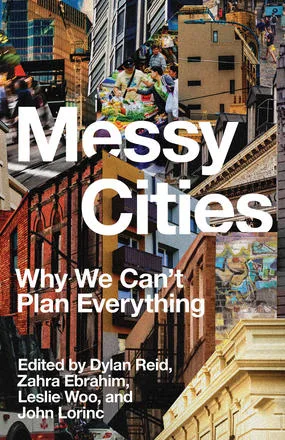 An urbanist argument for embracing disorder: “Messy Cities: Why We Can’t Plan Everything is a compilation of essays exploring how urban environments often thrive on spontaneity rather than rigid, top-down design. A good reminder that in both city-building and innovation, messy and unpredictable isn’t necessarily bad.”
- A moving memoir of politics and love: “Tareq Baconi’s Fire in Every Direction is a powerful exploration of his queer and Palestinian experiences and identities. A brilliant illustration of how selfhood and collective struggle (and liberation) are inextricably linked.”
- A podcast from the cutting-edge of climate adaptation: “Climate Proofers is probably the most relevant listen for my day-to-day right now. Louie Woodall, host and editor of the Climate Proof newsletter, dives deep into the ‘hows’ of adaptation, covering everything from financing to policy. A must-listen for anyone looking at how we think of and implement adaptation and resilience solutions.”
Thanks for reading! See you in two weeks.
Sign up for our newsletter
-
 MaRS Staff