How a school assignment grew into a viable business
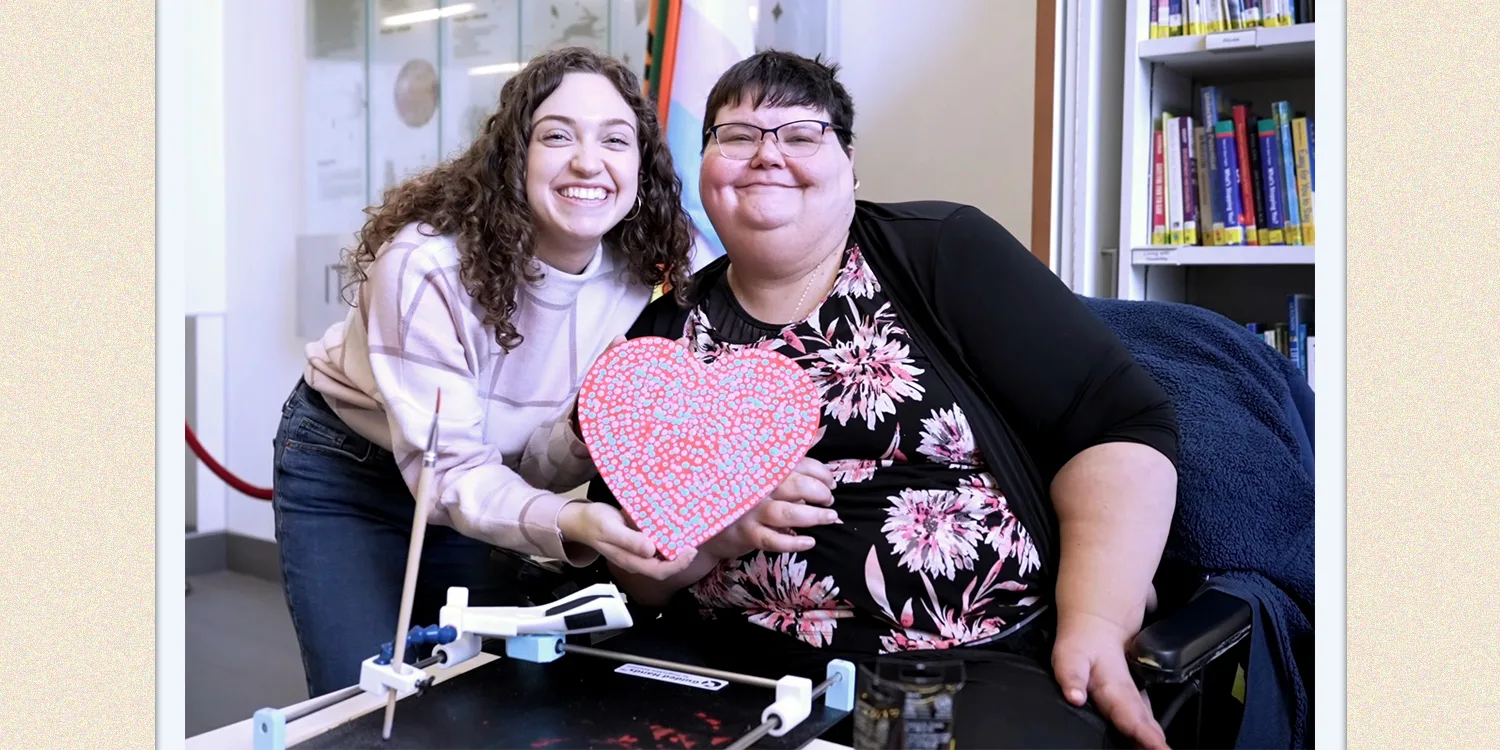
When Lianna Genovese saw the impact her mobility device could have on people, she “realized I had to continue.” Seven years later, ImaginAble Solutions is now available in 26 countries around the world.
“I’m an accidental entrepreneur,” says Lianna Genovese from a quiet corner of her company’s facility in Hamilton. It all started seven years ago when she was a first-year student at McMaster University. Students in her bioengineering class were introduced to Elissa James, a young woman with dystonia, a type of cerebral palsy. Their assignment was to design devices to help her function with the progressive neurological disease. Some students created feeding devices. Others developed aids for fastening buttons. When Genovese learned that James loved to paint but had lost the ability to hold and control a brush, due to weakness and spasticity in her hands, she knew what she wanted to do. She’d design a device to help James paint again.
Genovese came up with an innovative solution: a tool that could leverage the mobility of gross motor movement in the shoulder rather than the fine motor skills of the hand. Her support device straps a user’s forearm firmly into place. By moving their shoulders, they can then maneuver a handpiece over a board using a mechanical sliding system, which allows them to draw, write or operate an iPad. Genovese made her first prototypes with pipe cleaners, straws and a sponge. From there, it evolved into a roller-and-rail design using a ball of yarn as the hand piece and a paint roller as the wrist rest. The next version introduced linear bearings and rods.
James tested every prototype. But from the very first time she used the rudimentary device, the effect was clear. “Her face lit up with joy when she used it,” says Genovese. “I realized I had to continue.”
Over the next three years, she fine-tuned her project while continuing her education. As soon as she turned 19 and was legally eligible, she incorporated her company, ImaginAble Solutions, and filed a patent for her invention, which she calls Guided Hands. To pay for the patent, she used all of her savings from her years as a lifeguard. Her professor encouraged her to enter a design competition, which she did, coming first in Canada. She credits her strong work ethic to her Italian grandparents. “Hard work and being kind to others were the most important values that we had growing up,” she says. “It became second nature to take care of others.”
ImaginAble’s early days were a family affair. After upgrading to a 3D printer to create the device components, Genovese and her mother set up shop on a ping pong table in the basement, where they built the first 150 prototypes. “I ran up my dad’s electricity bill,” she says. She then cold-called hospitals, occupational therapists and nursing homes, carrying the device by bus around Hamilton in a garbage bag.
As soon as she graduated from McMaster in biomedical and mechanical engineering in 2022, she formally launched the product. When asked in finance pitches to describe in five words what her product does, her response came easily: “I make mothers cry.”
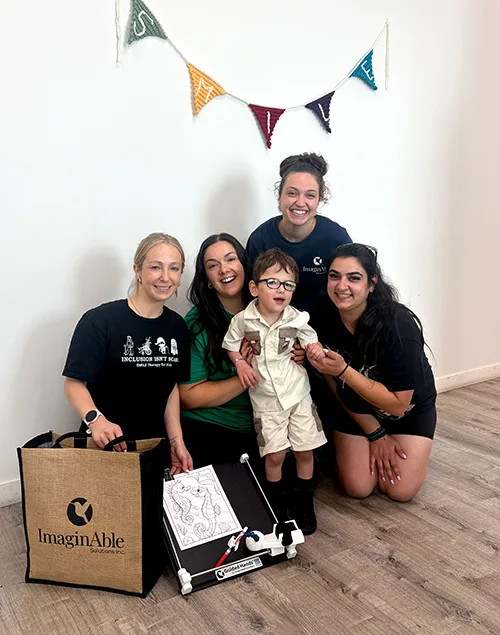
Maria Panayiotou’s son George started using ImaginAble Solutions’ device two years ago to help strengthen his muscles and improve his range of motion.
Helping a range of conditions
“As a parent, you just want to see your disabled child thrive,” says Maria Panayiotou, mother of George, who was born 18 weeks premature. After 10 months at the Hospital for Sick Kids, being treated for a series of medical problems, including a brain bleed, intestinal issues, cardiac arrest, meningitis and cerebral palsy, George came home. Now almost 4, he has weakness on his right side, is non-verbal and crawls rather than walks.
Two years ago, he started to use Guided Hands at SMILE Therapy for Kids in Vaughan. While other devices are available for people with poor hand mobility, users often need their parents or a therapist to hold a hand over theirs to stabilize the movement. Guided Hands provides independence. “At first, George was a little reluctant, but then, over time, you could see the gears of his brain turning, and he’s thinking ‘I can actually do it,’” says Panayiotou. “It makes him feel more included in the real world, doing stuff that his peers might be able to do.”
George, who attends pre-school at Holland Bloorview Nursery as well as weekly sessions at SMILE, has made great progress, says Panayiotou. As a rehabilitation device, Guided Hands has helped to strengthen his muscles and improve his range of motion while also allowing him to do fun things, such as colour and play games, which are helpful cognitively.
Genovese, who is involved with patients at SMILE, is continually adjusting her device to address different issues. “Getting an occupational therapist’s brain and an engineering brain together has been so helpful.” Now, patients from the age of 10 months to 97 years, with various conditions such as multiple sclerosis, ALS and spinal cord injuries, use Guided Hands.
“An assistive device doesn’t have to be the newest, next best thing with technology,” says Ana-Maria Christophilakis, lead occupational therapist at SMILE. “It can be simple. What matters is the functionality of it, and how many people use it.”
Scaling impact
Transitioning from a passion project to a business startup wasn’t easy, says Genovese. Despite her infectious enthusiasm and energy, she had to overcome a lot of rejection as she tried to get support for her project. “I looked like a kid. I had chubby cheeks,” she says. “People doubted me.” The first phase, while still a student, took place during the pandemic when she would send out the devices and teach people how to use it on Zoom calls. “I persevered because the disabled persevere.”
Now 26, Genovese has six large 3-D printers to make the Guided Hands devices in her facility at the McMaster Innovation Park, where she employs six people. Her mother works as lead assembly worker. To date, Genovese has won more than $1 million in pitch competitions. She plans to develop other assistive devices and scale-up production of Guided Hands, which has helped more than 6,500 people with hand mobility issues in 26 countries around the world. “Self-expression is a human right, one that should be accessible to everyone,” she says.
ImaginAble Solutions is one of 10 ventures in the second cohort of the Mobility Unlimited Hub. The two-year accelerator program is now recruiting ventures for its third cohort. Application deadline: August 28.
Photos courtesy ImaginAble Solutions
-
 Sarah Hampson