How MaRS can take your startup global (Part two)
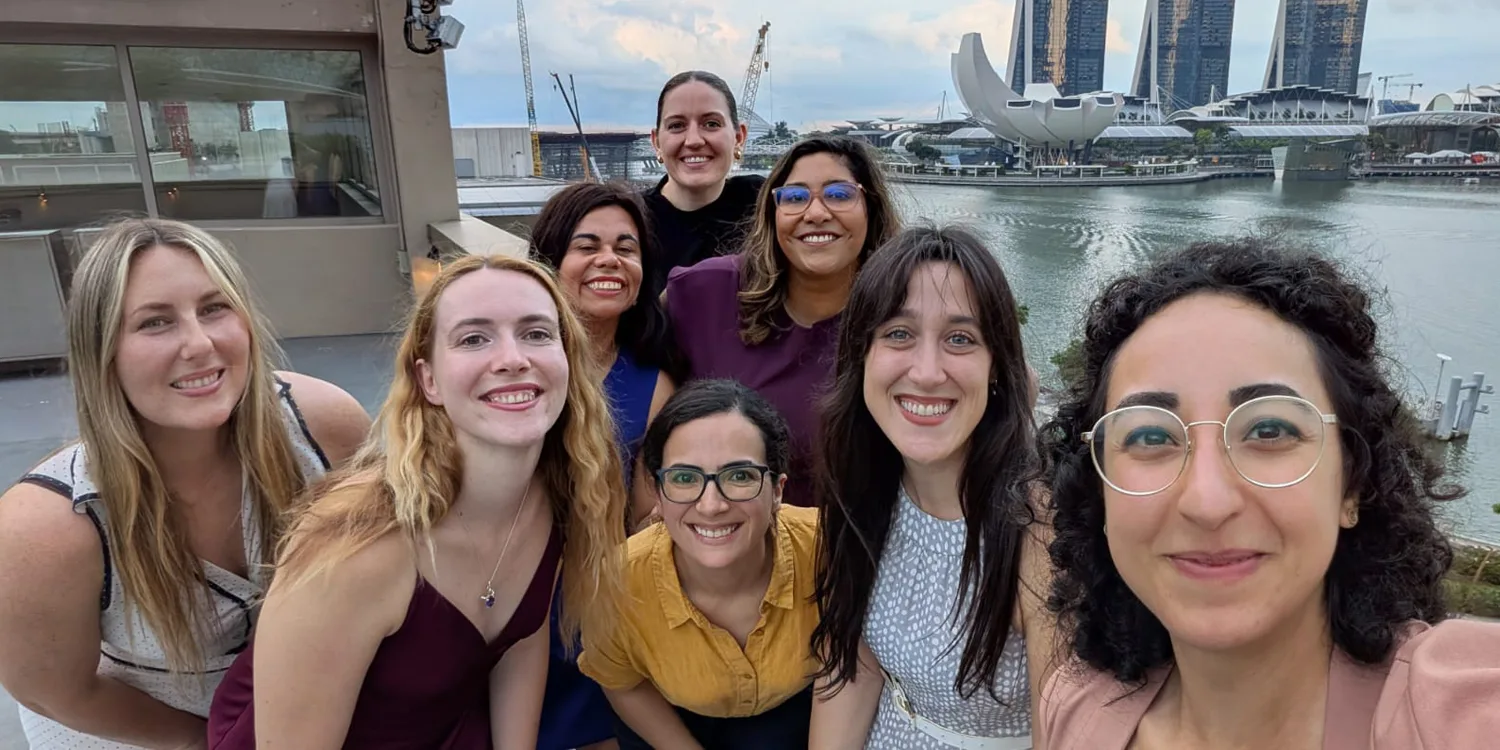
The RBC Women in Cleantech Accelerator heads to Singapore
Economically and geopolitically, Singapore has long punched above its weight. In recent years, the tiny city-state has emerged as a leader in climate and cleantech, often serving as a springboard for companies looking to enter the larger Asian market. Last month, MaRS took the entrepreneurs in the RBC Women in Cleantech Accelerator to Singapore to help them explore the market, pitch their tech and make new connections. Below, we share some insights into this vital and evolving region.
Also, in this week’s newsletter:
Stories from the ecosystem, upcoming events and the hottest jobs this week
Seeding cleantech opportunity in Singapore
MaRS is taking on the world. In early May, ventures in the MaRS Mobility Unlimited Hub travelled to Australia (you can read about that trip here). Immediately after, MaRS led a different delegation — this time, members of the RBC Women in Cleantech Accelerator — to Singapore, where founders met with government agencies and local investors, attended industry events and cemented relationships that will, with time, lead to new business opportunities. Here, MaRS’s Morgan Lorimer, who led the delegation, tells us why Singapore’s such a good market for Canadian cleantech, how MaRS can help startups with expansion and what’s happening next.
What makes Singapore an attractive market for Canadian climate startups?
It’s home to nearly half of Southeast Asia’s green economy startups and accounts for two-thirds of the region’s total venture capital funding. The country’s also very committed, we learned, to finding solutions to regionally specific problems, such as water security. Singapore can’t store enough rainfall to meet domestic demand, and relies on Malaysia for roughly half of its water supply. It also imports more than 90 percent of its food, so it’s investing heavily in food security. And because it has limited land for traditional renewables, people are eager for solutions that can help advance the energy transition and scale carbon capture. Ultimately, Singapore’s aggressive climate priorities have turned a vulnerable island nation into an indispensable engine driving the region’s green transition.
We’ve already seen MaRS startups paving the way with pilot projects, funding and partnerships in the Singaporean market, including Aslan Renewables, Ayrton Energy and Open Ocean Robotics, so we knew there would be an appetite for even more Canadian climate tech. In particular, several of the founders in WIC — Xatoms, CERT Systems and TerraFixing — are developing solutions that could directly support Singapore’s green transition. Getting support from the Singaporean Canadian Trade Commission and Enterprise Singapore helped make it happen.
How open is Singapore to adopting new climate solutions?
Singapore may be a young nation, but it has positioned itself as a living lab for climate tech. The proof is in its infrastructure: a multi-megawatt data centre testbed on Jurong Island, the cutting-edge research being done at the Agency for Science, Technology and Research (Singapore’s lead public sector R&D agency), one of the world’s largest floating solar farms and Tuas Nexus, the world’s first fully integrated waste and water treatment facility.
From their water to their skyscrapers, Singapore is incredibly open to testing new technologies and building relationships with innovators from around the world. They’re bullish about climate tech and that’s really refreshing to witness.
How does a MaRS-led delegation like this support startups’ global expansion?
Organizations like MaRS can play a key role in funding and coordinating delegations, including handling travel logistics and designing an intensive, well-structured visit for participating companies. This helps founders arrive ready to engage, with meetings and relevant connections already arranged, rather than spending months on research and outreach.
MaRS also has strong government-linked support. We arranged for our delegation to meet directly with Paul Thoppil, Canada’s High Commissioner to Singapore, and Suzanne Skinner, Assistant Deputy Minister for Trade and International Engagement with the Government of Ontario’s Ministry of Economic Development, Job Creation and Trade. The team also secured invitations to the Women Leading on Climate event hosted by Catherine McKenna, who said of the delegation, “I think it’s amazing to see all these young women with really awesome solutions.” And for me, it was amazing to see these entrepreneurs be able to showcase their technology to the right people.
What are the notable developments from this trip?
The response has been overwhelmingly positive, particularly around how seriously Singapore is looking at Canadian technology and its eagerness to implement it. The momentum hasn’t slowed down since we returned; cohort members are having follow-up conversations, with several exploring concrete pilot opportunities, engaging in ongoing investor discussions and applying to Singapore’s deep tech startup competition, SLINGSHOT 2026.
While the definitive commercial outcomes will shape up over the next few months, this trip has undeniably solidified these companies’ understanding of the region’s priorities. It’s given them the insights they need to shape their go-to-market plans, strengthening the long-term case for Singapore as a thriving expansion market for Canadian tech.
What stood out to you most?
We’ve spent the past two years with this group of founders and this was a fantastic way to showcase their growth and support for each other. There aren’t many cohorts like this in the world, where people are brought together across such different stages, both in terms of age range and the maturity of their companies. These women are leaders in their fields and the world should know about them.
Stories from the ecosystem
AI: Ottawa finally released its national AI strategy, but here’s what Canada really needs to become a global AI leader.
BIOTECH: What led Providence Therapeutics to launch its personalized cancer treatment trials in Australia.
QUANTUM: Xanadu’s Christian Weedbrook says Canada has to seize the quantum future — before the U.S. does.
AGTECH: Could Calgary-based Knead Technologies be the Uber of food recovery?
MOLECULAR BIOLOGY: How gene therapy is changing the way we treat disease.
HEALTH: GLP-1 drugs may have a beneficial effect across many types of cancer.
Overheard: At the Mission from MaRS Fifth Anniversary Celebration
 “Canada is a great place to start a company, but it’s one of the worst places to commercialize. I did not anticipate the amount of active involvement I was going to get from MaRS. You helped us secure a government contract north of $1 million, which at that time was the gap that we needed to go from pilot to commercialization.” — Cameron Jones, Co-founder and CTO, Flash Forest
Upcoming events
- At the Innovation Cluster session, “Unlocking innovation capital,” Pocketed CTO Aria Hahn discusses how funding decisions are made, where to find the right opportunities and practical strategies to successfully access capital. June 17.
- This month’s edition of Technically Speaking, “Bootstrapping your business,” brings together Trax’s Azam Khan and Spotwork’s Darren Perlman for a conversation about managing cash flow, winning customers and staying resilient when there’s no safety net. June 18.
- At the next MaRS Morning, “Produce results: from tech to table,” Haven Green’s Lindsay Bryson, Purchs’ Marcia Woods and Nadarra Ventures’ Mary Dimou discuss how innovation can create a more secure food supply for Canadians. June 25.
For more, visit our events page
In the queue: What we’re reading, watching and listening to at MaRS
Vida Gabriel, the co-founder and CEO/COO of TerraFixing (part of the Women in Cleantech cohort) shares what she’s been consuming lately.
 A counterintuitive bestselling business book: “No Rules Rules really inspired me and my co-founder Sean Wilson — it became the foundation for TerraFixing’s company culture. We’ve chosen to lead by context, not rules. The idea is to have the smallest amount of bureaucracy and hierarchy as possible, and instead empower the team to do what’s in the company’s best interest and support our mission to reverse global warming.”
- A Navy SEAL guide to leadership: “Jocko Willink and Leif Babin’s Extreme Ownership is also a big contributor to our company culture and management style. It highlights how having ownership over tasks and responsibilities is empowering rather than burdensome; we implement these core principles in our day-to-day operations.”
- A revolutionary productivity handbook: “I learned about the scrum method through Jeff Sutherland’s Scrum: The Art of Doing Twice the Work in Half the Time. In addition to working in three-week sprints, we’ve also implemented daily stand-up meetings, which last just 15 minutes. Each team member succinctly states what they’ve completed 100 percent in the last 24 hours and what they plan to deliver in the next 24. They also have a moment to communicate any obstacles and accelerators. I love these meetings; they’re so energizing and keep us all on track to deliver maximum value.”
Careers: The hottest jobs in tech this week
- The University of Toronto is recruiting a diagnostic neuroradiologist, a financial assistant and several sessional lecturers. (Toronto)
- Xanadu, the quantum computing company, is hiring a photonics engineer and a senior accountant. (Toronto)
- Maple, an on-demand healthcare platform, is hiring a process manager (operations), a lab and referral operations coordinator and a client success manager. (Toronto)
- Growcer, a manufacturer of modular hydroponic farms, is looking for a growth marketer. (Ottawa)
For more, visit our jobs page
Did you know that MaRS is a charity?
Your support helps us advance Canadian innovation and science, bring our community together and transform the world for the better. For instance, through our carbon removal donation program, you can help support Canada’s most promising CDR companies through tax-deductible donations. Learn more here.
Thanks for reading! See you in two weeks.
Featured photo: (Front, L to R) Morgan Lorimer, MaRS; Diana Virgovicova, Xatoms; Sofia Bonilla, ALT-PRO; Amanda Whalen, MaRS; Vida Gabriel, TerraFixing; (Rear, L to R) Macarena Cataldo, Viridis; Hailee Voegelin, MaRS; Aditi Sitolay, Synoro Med
Sign up for our newsletter
-
 MaRS Staff