How Seacork is transforming seaweed into sustainable construction materials
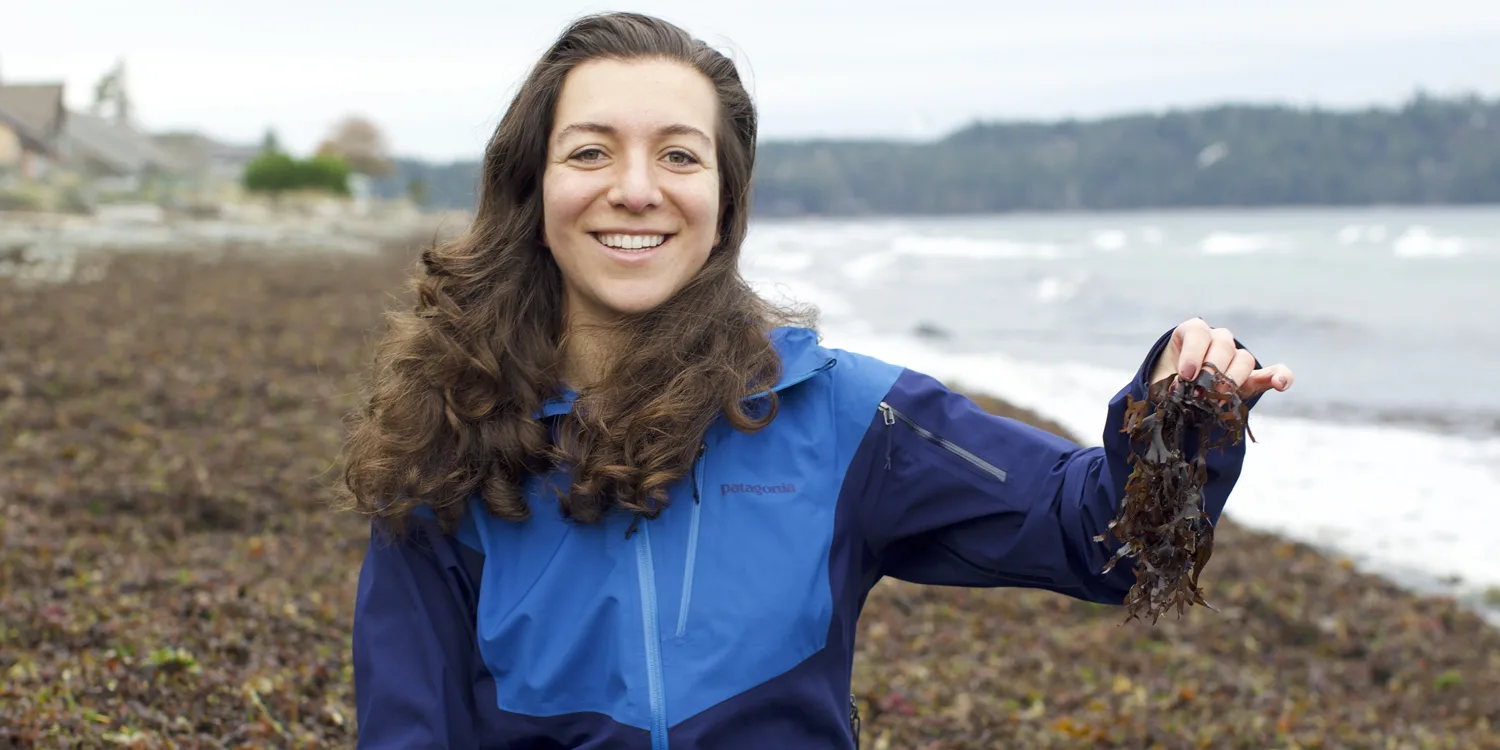
After moving to the west coast, Annie Dahan realized she could use invasive aquatic plants to make low-carbon acoustic panels.
When Annie Dahan first arrived in Vancouver, she’d wander down to the beach at low tide and pick seaweed. Dahan, who grew up in Montreal and studied environmental science at McGill before moving out west to pursue a master’s of architecture at UBC, developed a fascination with all the funky aquatic plants that washed up on the shore.
After completing her master’s, Dahan landed a job at an architecture firm, but she kept wondering if there was a way to combine her background in sustainability with her work in design. She started exploring alternative materials, curious about the possibility of building “in a way that’s more connected to local ecosystems,” she says. Surrounded by an abundance of seaweed, Dahan began experimenting with the stuff she’d harvested from the beach.
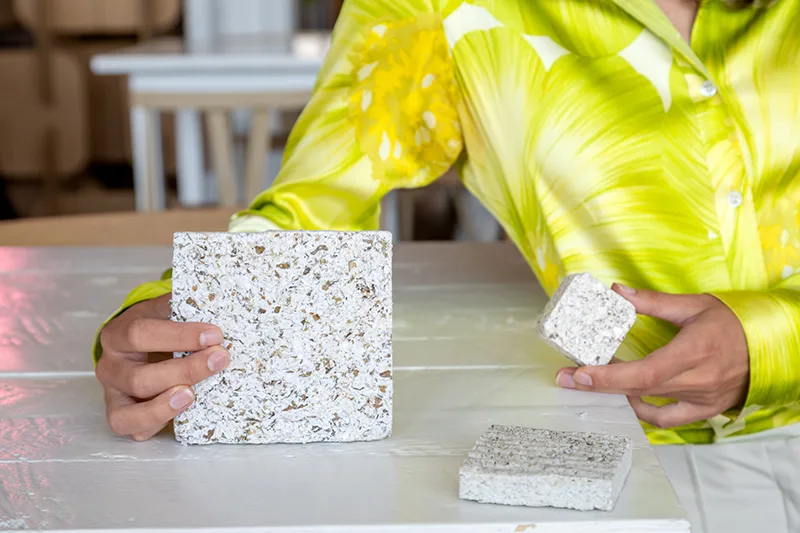
An idea started to form when she learned the world has a major seaweed problem: invasive species are taking over kelp forest beds, strangling native vegetation and forcing out critters. By removing these algal invaders, Dahan could help regenerate the environment. The key was figuring out how to turn it into something useful. Dahan did a bunch of visual and tactile tests with the lightweight, low-density and porous material. Eventually, while fashioning the seaweed into different shapes, she held a bowl she’d made up to her ear. Suddenly, she says, everything sounded muffled. “I was not looking to make acoustic panels in the beginning,” she says, “but that’s what the material wanted to be.”
Here, Dahan talks about kitchen-counter science, the seaweed supply chain and the challenges of scaling production.
In theory, you could turn seaweed into any number of products. Why acoustic panels?
On the science side of it, we really leaned into the material’s properties. From the business side, acoustic panels are super easy to install. It can be a renovation or a tenant improvement or just hung on walls or ceilings — you don’t need to do any construction. There are fewer certification requirements for interior finishes because they’re not structural, and there’s a lot less risk involved. So there was a low barrier to entry. And because it’s visible, there’s a design element as well and you can get pretty creative.
What’s the issue with conventional panels?
Basic drop-down acoustic ceiling tiles, the white or grey kind you see in classrooms and offices, are usually mineral fibre, which is really carbon intensive to make. You basically need to melt rock at 2,000 degrees Celsius, turn it into a fibre and add toxic chemicals and glues. Other acoustic panels might be made with plastic felt — some is recycled but you still need to melt the plastic at pretty high temperatures to turn it into felt. Some panels are made from cork, which is awesome, but there aren’t enough cork trees in the world. The carbon footprint of your average mineral fibre panel is like 1.46 kilograms of CO2 per square foot, while our seaweed panels have a footprint of negative 0.3 kilograms of CO2.
Is there something about the particular variety of seaweed you collected that lends itself to this application?
We played around with lots of different kinds. Initially it was just what I found on the beaches of Vancouver — lots of brown seaweeds, like rockweed, or kelps. All of those worked, but we moved toward a different kind that’s invasive. That’s what we’re working on right now. The way we want to go about bio-based material development is by understanding local ecosystems and what works for those areas. Seaweed is great because all of our coasts have it; we want to be using different types of seaweed depending on where we are. In Florida or in Mexico, for example, we want to be using a sargassum that is local to that area. Sargassum is basically a massive algal bloom. If you’ve been to Mexico or any Caribbean islands recently, the beaches are often covered in sargassum, which rots and smells and is bad for the ecosystem. Harvesting that and using it to create an upcycled product is another goal.
How did you go from figuring out that seaweed could block noise to developing the product?
My brother convinced me to apply for this circular incubator program with the Synergy Foundation. At the end of that program, I won the pitch contest and got $3,000 in funding. I decided to quit my job and work on the panels full time. For the first year, it was just me. Then, as of last November or December, I started getting funding, so I was able to bring on more team members, which was really exciting. Now that we’re a team of five (and a half, actually), things are moving so much faster. We’ve got a prototype, we’ve done a few small pilots and we’re setting up a pilot production facility in Vancouver so that next year we can produce and sell 10,000 square feet of panels.
What has been the biggest hurdle in building your business so far?
Funding was huge. And supply chain: figuring out where to get our seaweed. Right now, our biggest challenge is setting up our pilot production facility. So like, what equipment are we going to use? What does it look like when, instead of making 10 panels a day, we’re making 100?
Has it been difficult to shift from architecture to entrepreneurship?
I’m very happy to have made that decision but it was hard, for sure. School was so much fun and so creative — you get to push deeply into problems that interest you. Working at an actual architecture firm wasn’t the same. It got to the point where I was way more excited by the Seacork project than by my day-to-day work. Honestly, that’s a common experience for a lot of architecture students. I went to the Architecture Biennale in Venice a few weeks ago, and one of the pavilions was designed around how the architecture industry has completely changed and how there’s no creativity left. It resonated with me.
Compared to, say, fashion, it seems like the building and construction industry hasn’t fully embraced sustainability as a guiding — or even marketing — principle.
The construction material industry is known to be super slow in adopting anything. But we’ve found that there’s been a lot of interest in testing our products. I think it’s because it’s an interior finish, so there’s less risk. And we’re at a point where there is a lot of policy demand to reduce the embodied carbon in buildings, and there’s a lot of drive from architects, designers and clients. That’s who we’re targeting: people who deeply care about changing the industry.
What will it take to catalyze a larger shift within the sector?
There are a lot of great organizations leading the way. The International Living Future Institute is at the forefront; there’s LEED and other green certifications. There are also policies that can drive adoption. Vancouver recently passed a bylaw that any new buildings have to reduce their embodied carbon by 10 percent this year, and 40 percent by 2040. We have to start testing out these products, because how else are we going to reduce our embodied carbon of all new buildings by 40 percent?
Do you have plans for Seacork to expand into other aspects of sustainable construction?
It’s time consuming to develop one product well. We plan to explore thermal insulation, which has very similar material characteristics to acoustic panels. But right now, the focus is acoustic panels, which is itself a massive industry — it’s valued at $9 billion US per year globally, and it’s expected to go up to $14 billion.
What advice do you have for aspiring entrepreneurs?
You can’t be the only one who thinks your project is cool. Test it on your friends and family, as well as people who know the industry well, and see how they react. And get help whenever you can. There is so much support in the entrepreneurial ecosystem — take advantage of it as much as possible because no one can build something on their own.
This interview has been edited for length and clarity.
Learn more about how the RBC Women in Cleantech Accelerator is helping innovators build a sustainable future.
Photos courtesy of Seacork
-
 Rebecca Gao