How Toronto’s next mayor can shape the future
Fix housing, fix procurement, fix the vibes.
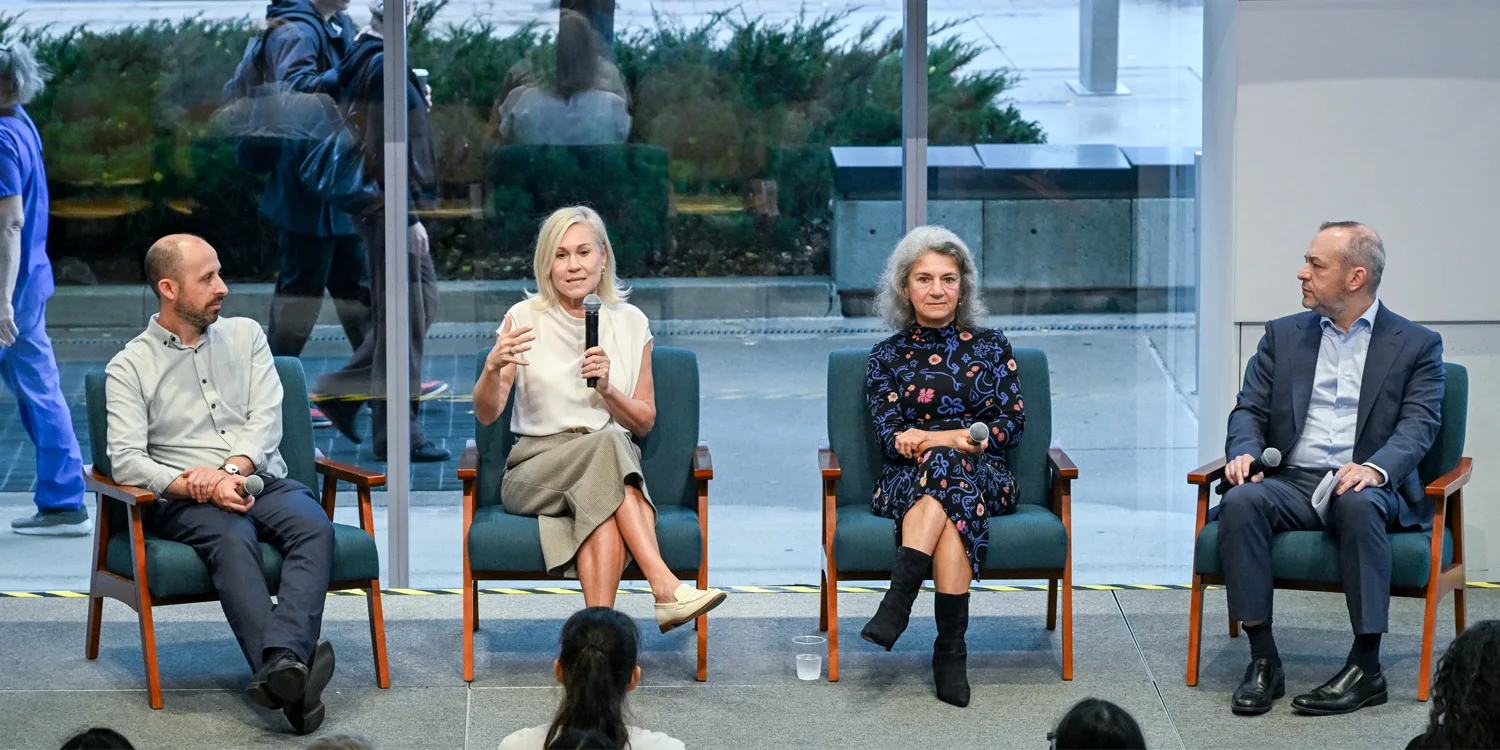
Toronto goes to the polls on October 26. MaRS and the Toronto Star recently gathered together a panel of experts to discuss how the city’s next mayor can best advance an innovation agenda. It was a wide-ranging and spirited discussion, tackling housing, immigration, procurement and that ever-elusive thing, good vibes. Below, we dig into some of the key takeaways.
Stories from the ecosystem
The hottest jobs this week
Innovation at the ballot box
Neither of the main mayoral contenders — incumbent Oliva Chow and challenger Brad Bradford — have spent much time during this election talking specifically about innovation. That’s not a big surprise — the issues top-of-mind for most voters are traffic, affordability, traffic, public safety, traffic, taxes and traffic.
But at the final event in the Toronto Star’s “If I were mayor” series, a panel at the MaRS Centre featuring planner and developer (and onetime mayoral candidate herself) Jennifer Keesmaat, economist Armine Yalnizyan and policy expert Noah Zon, argued that innovation and competitiveness touch on many of those issues. It’s difficult to become an entrepreneur, for example, if you spend all your money on rent. Attracting talent is tricky if your future employees will have to endure a two-hour commute.
To build a thriving city where people actually want to live and work requires an innovative approach. Here are some of the key components we need to get right. Candidates and voters alike, consider it required reading.
It starts with housing
“Housing is broken in this country and broken in this city,” Jennifer Keesmaat said bluntly at the panel’s outset. “It is a risk to the vitality of the city moving forward.” She sees stable housing as the bedrock upon which any innovation and competitiveness rests. To make Toronto more “sticky” for current residents, newcomers and investors, Keesmaat argues we need more affordable housing and better access to it. “When so much of your money goes into paying rent or a mortgage, it becomes very difficult to become an entrepreneur and start a new business,” she said. “A really critical part of transforming the economy in the city is freeing up more money so it can go to local businesses, main street retail, restaurants, the arts.”
Buy Torontonian
“What are the things that could be done better at the city level to support entrepreneurialism on the innovation side?” asked Adam Radwanski, a business columnist at the Star who moderated the event. For Zon, it was procurement. “Do you know how much work it is to deal with an RFP?,” he asked, before rhyming off the challenges: onerous paperwork and red tape, spec requirements that penalize unique and new products or processes that, by definition, don’t have track records. Streamlining that process— and increasing procurement budgets at all government levels — could give innovative businesses both a government endorsement that helps them sell abroad and provide them with important early customers.
All too often, procurement favours big companies: “You’ll notice most of the people who win the bids in Toronto are not small businesses, they’re multinational corporations,” said Keesmaat. “And whatever revenue they’re making, it’s ending up in Copenhagen or Belgium or some other place. It’s not staying in the city. And that’s a huge miss on the Buy Canadian that’s happening right now.”
Given the feds’ recent push for more international investment, we also have a huge opportunity to bake specific commitments into any future agreements — like foreign companies providing first jobs to Canadians. “This is what you do with public policy,” Keesmaat said. “You put criteria in place that are going to deliver bigger outcomes that we’re seeking to achieve.” Yalnizyan added that we already have a such a model — Community Benefits Agreements — which is used to comparable effect everywhere from the mining sector to transit.
Growth strategy
Between July 2024 and July 2025, Toronto’s population shrank by almost 1,000 people — the first such decline, outside of the pandemic, ever. A concerning trend, especially that, as Yalnizyan pointed out, newcomers make up 100 percent of labour growth in Canada. Given falling birth rates in the country, the only way to keep the economy growing is immigration.
So we need to provide better pathways, as we once did, for those newcomers to build permanent lives here: “If you’re good enough to work here, why aren’t you good enough to live here?” Yalnizyan said. “We are shooting ourselves in the foot with this, ‘I want to turn the tap on and off, whenever I feel it’s a good time or a bad time to invite people into my community.’ It’s not the way you build civilizations, and it’s certainly not the way you build an economy.”
Vibe check
Every municipal election is always also a referendum on how people feel about their city. While a significant number of Torontonians, particularly older ones, loudly grumble about the direction Toronto is going, Keesmaat suggested we look somewhere else for inspiration — New York City.
“A lot of Mamdani is real,” she said, “and a lot of Mamdani is vibes. A lot of what he’s doing is saying, ‘This is who we are as a city, this is the kind of people we are, we’re people who take care of one another and people who are optimistic about the future.’” Too many of Toronto’s leaders, she added, without naming names, are doing the opposite — relentlessly pointing out the city’s failings and shortcomings, hyperfocused on the things Toronto isn’t doing right. “We need a different feeling if people are going to invest their money in this city,” she said. “We need a different feeling for entrepreneurialism to thrive.”
Stories from the ecosystem
ENERGY: Why fusion proponents are betting on their big bang to blow up. (Toronto Star)
INVESTMENT: Business leaders ask Ottawa for tax incentives to boost startup investments. (Globe and Mail)
INNOVATION: EDC wants to help sell the full stack of Canadian technology abroad. (The Logic)
BIOTECH: When it comes to the biotech sector, Canada’s got talent. What’s missing is the infrastructure to build experience. (MaRS)
HOUSING: A new blueprint for more sustainable and affordable homes. (Toronto Star)
CLIMATE: Meet the nine women-led startups scaling Canada’s cleantech solutions. (MaRS)
MaRS Monthly
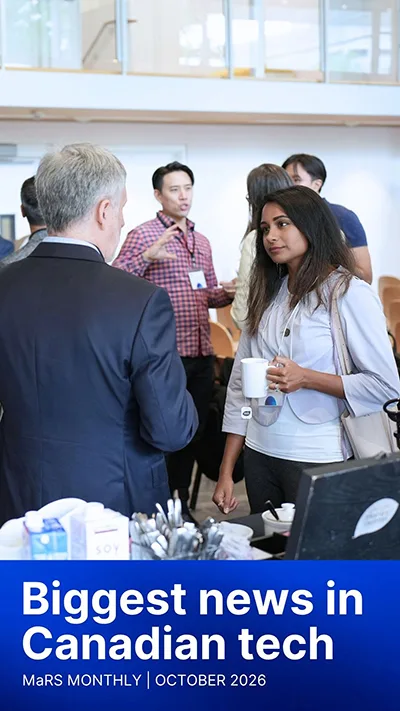
Get caught up on all the MaRS news of the past month in this 92-second video, including events that showcased Canada’s top tech ventures, some notable raises and the latest from Vivid Machines, Altis Labs and Orbits.
Upcoming events
- At “Pitch decks and playdates,” this month’s edition of Technically Speaking, MaRS startup advisor Katie Hayes hosts a panel discussion on how to juggle parenting demands while scaling a venture. October 13.
- This month’s MaRS Morning, “Growing up with the algorithm,” brings together Diana Fox Carney, Beeban Kidron and Ava Smithing to explore what a safer digital world for the next generation looks like — and how we get there. October 20.
- Four companies in the second cohort of MaRS’s Mobility Unlimited Hub demonstrate and discuss their rehabilitative, assitive and adaptive mobility technologies. October 20.
- At the 2026 Canada Gairdner Laureate Lectures, this year’s award recipients share the stores and science behind their discoveries. October 21.
- The Innovation Cluster hosts “How to build a more resilient business,” a workshop on growing and protecting your business in an AI era. October 21.
- Mark your Calendly: MaRS Climate Impact is November 17 and 18. (General admission tickets available until October 14.)
For more, visit our events page.
In the queue: What we’re reading, watching and listening to at MaRS
Oksana Nikitenko is a senior associate in MaRS’s venture cohort program, where she works on the Women in Cleantech program (see above for news on the latest cohort). This week, she shares her current obsessions.
 A Kiwi band that’ll have you on your feet: “Balu Brigada is an indie rock band from New Zealand. I found them randomly on Spotify and instantly liked their sound — it reminded me of my indie rock phase in high school. I’ve really enjoyed their 2025 album Portal and hope they come to Toronto soon.”
- A pair of relatable romantasy novels: “I discovered Rachelle Raeta’s Peaches & Honey duology (These Immortal Truths, These Godly Lies) on BookTok this summer. I often find myself feeling helpless to make a difference on a large scale — the future can sometimes seem hopeless. But this duology really gave me a new perspective and highlighted that, though time goes on, there are things that will always be true — like, humans need connection and we should never underestimate the impact of family and friends who show up for us, mentor us and guide us through life.”
- A deliciously fiendish reality show: “The Celebrity Traitors U.K.has quickly become a guilty pleasure. I’ve been bingeing it and enjoy discussing strategies with my friend while we watch. I still can’t decide if I’d want to be a Traitor or Faithful — both roles seem equally hard — but I do know I’d excel at the missions. I love a good challenge or puzzle.”
Careers: The hottest jobs in tech this week
- Growcer, a manufacturer of modular hydroponic farms, is hiring a senior account executive and a business development lead. (Multiple cities)
- Carbon Upcycling Technologies, which converts CO2 to low-carbon cement, is hiring a journeyperson millwright, a generator service technician and many other positions. (Multiple cities)
- Cinchy, an enterprise data collection platform, is looking for two senior account executives. (Toronto and New York)
- Haply, a robotics and haptic device company, is hiring an intermediate front-end developer, a hardware technician, a physical AI researcher and other positions.
For more, visit our jobs page
Did you know that MaRS is a charity?
Your support helps us advance Canadian innovation and science, bring our community together and transform the world for the better. For instance, through our carbon removal donation program, you can help support Canada’s most promising CDR companies through tax-deductible donations. Learn more here.
Thanks for reading! See you in two weeks.
Photo credit: Ernesto Di Stefano/George Pimentel
Sign up for our newsletter
-
 MaRS Staff