Unlocking early-stage funding: a $4.7-trillion opportunity
Some advice from the front lines.
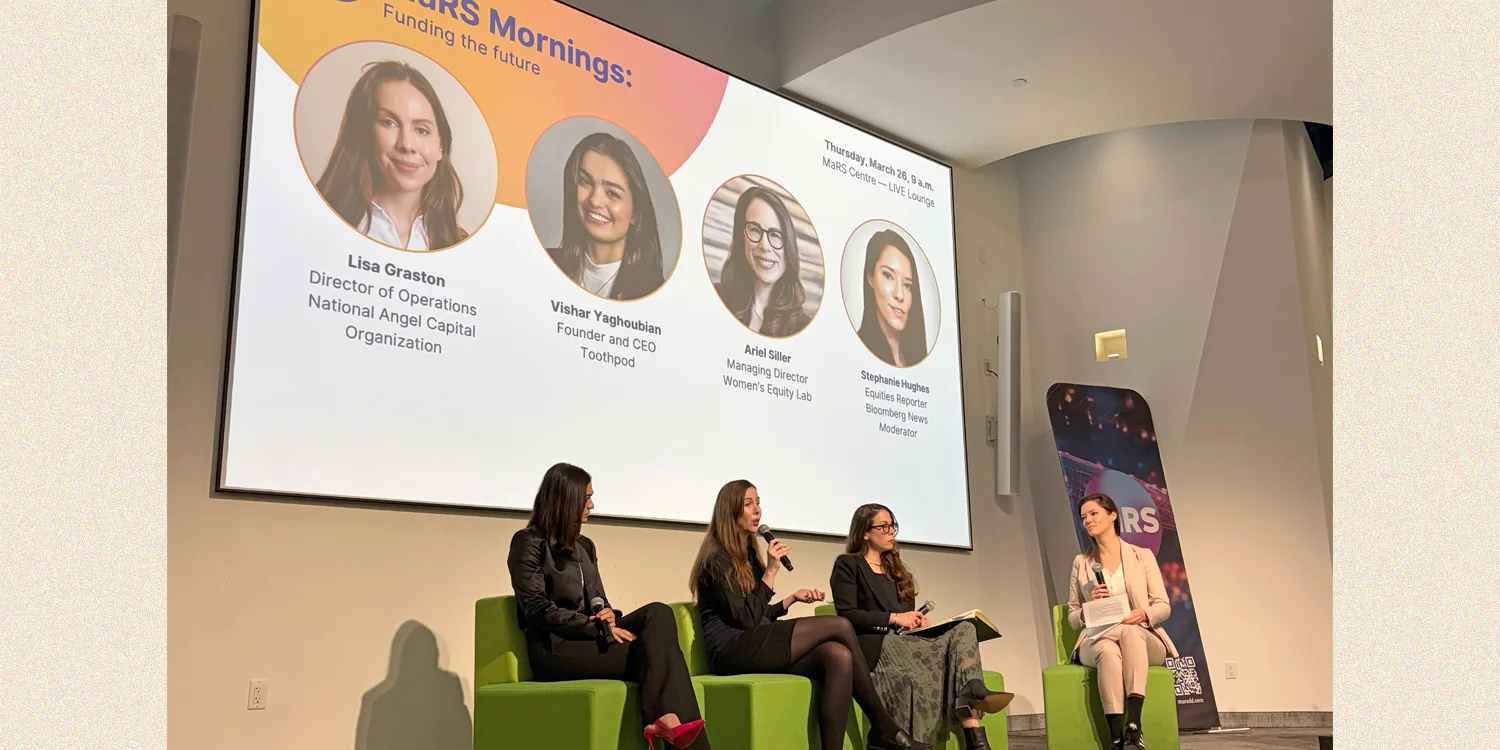
We often hear from founders that securing seed capital is tough. But what’s talked about less often is the enormous opportunity available for investors. At a recent MaRS Morning panel, two ecosystem builders and a successful entrepreneur shared what it takes to unlock early-stage funding, spark more investment and help more startups grow their bold ideas into real success stories. Below, some of the conversation’s key takeaways.
Also, in this week’s newsletter:
Stories from the ecosystem, upcoming events and the hottest jobs this week
Seeds of change
Last week’s MaRS Morning, “Funding the Future” came on the heels of a dire report released by the National Angel Capital Organization and the Startup Genome. It analyzed more than 65,000 funding rounds since 2006, revealing that Canada’s three largest ecosystems — Toronto-Waterloo, Vancouver and Montreal — have lost $66 billion in value and an estimated 133,000 startup jobs between 2019 and 2024. “Behind those rankings lies a funding architecture that is structurally broken at the seed stage: its foundation,” the report’s authors wrote. To translate that statement into cold, hard numbers: Canadian startups are missing U.S.$141 million annually at pre-seed/seed and U.S.$181 million at Series A, compared to similar startups in the United States.
And this gap isn’t being experienced equally. In Canada, women founders receive only a tiny fraction of venture capital — some estimates place it about 4 percent — despite growing entrepreneurship and strong performance.
At the same time, wealth ownership is shifting dramatically. By 2030, women are projected to control two-thirds of global private wealth. In Canada, this figure will surge to an estimated $4.7 trillion by 2028. Mobilizing this capital toward entrepreneurship has the power to fuel Canadian startup growth and bridge critical early-stage funding gaps.
But how do we get there? Our panel — Lisa Graston, director of operations at NACO; Ariel Siller, managing director of the Women’s Equity Lab and Vishar Yaghoubian, founder and CEO of Toothpod — have some ideas. Following is some of their advice for both entrepreneurs and investors.
Ignore women at your own peril
“There’s a huge amount of private wealth that’s transferring to women both because of their own earning, of course, but also because of the great wealth transfer that’s happening between generations. What that means is that there is actually capital sitting on the sidelines. As we think about what it takes to unlock Canadian capital for Canadian innovation, women are a hugely underutilized source of capital and expertise.” – Ariel Siller
Make decisions faster
“We raise in both Canada and the U.S., and the speed at which investors make decisions really makes a difference in how soon I can go back to building the company instead of fundraising. A lot of Canadian investors want to do due diligence for two or three months. Sometimes we’ll have a 15-minute call with the U.S. And the cheque sizes are the same. I would say that gap is costing money.” – Vishar Yaghoubian
But forget failing fast
“When we’re making an investment, we’re investing in a resilient, durable business that we think is going to have a strong exit in five to 10 years. And while current exit constraints are real, I think we have to recognize that early-stage investing is projecting onto a somewhat unknowable future. There’s going to be a lot of change. And when I think about durable, resilient businesses, one of the things we know is that typically women founders have less of an attitude about failing fast. They’re more about creating resilience and success over the short, medium and long-term. Women are not risk-averse, they are risk-aware.” – Ariel Siller
Ask a ton of questions
“There needs to be a level of trust for investors to want to deploy capital into an idea. Because pre-seed is an idea. To get to a level of trust, you have to build cycles of Q&As — a lot of cycles. Our investors will ask, ‘Have you thought about this channel, have you thought about this partnership, have you thought about this, this and this?’ And I have thought about all these, and it gives me an opportunity to show them. That really de-risks the investment because investors see how in-depth the plan is. So, put in the time to ask questions, make a decision quickly and don’t waste anyone’s time.” – Vishar Yaghoubian
Many hands make light work
“Angel networks and collectives do a lot for both entrepreneurs and investors. They provide an avenue for early-stage capital flow; rather than going angel by angel, multiple angels will come in at once, which prevents administrative burden on the cap table. They’re also able to do due diligence on deals, taking that burden off investors. These networks are hugely important in rural and other underserved areas in Canada, where capital flows sometimes exclusively through these networks in the early stages.” – Lisa Graston
Provide judicious assistance
“We often say that founders are over-mentored and underfunded. But they need different levels of support, and sometimes they just want a passive cheque. What I try to do, as both a parent and an investor, is say, ‘How can I help?’ I think that’s the most helpful thing you can do sometimes.” – Ariel Siller
What do you think would improve the early-stage funding process? Drop us a line at media@marsdd.com.
Stories from the ecosystem
CLEANTECH: The garment industry is an environmental nightmare, but B.C’s Viridis has developed a solution that could be a game-changer.
BIOTECH: From wet labs to sandboxing, how Canada can ensure early-stage innovators access the resources they need.
MOBILITY: This Canadian startup is bringing prosthetics to people in need.
HOUSING: A Toronto fintech mortgage platform is helping homebuyers who don’t fit the standard profile.
MEDTECH: Go inside Noa Therapeutics’ lab, where researchers are developing new treatments for chronic inflammatory disease.
Solve for X: Mind over matter

What if you could control a machine with your mind? This is the extraordinary promise of brain-computer interfaces. They allow people who can’t move their limbs to perform everyday tasks and even help communicate just by using their thoughts. On the latest episode of the pod, Manjula Selvarajah ponders a compelling and complicated question: Could BCI lead to a new era of innovation and healing?
Upcoming events
- At the MaRS and Innovate UK Manufacturing Showcase meet a powerhouse cohort of U.K. companies that are building a more resilient and productive manufacturing sector. April 1.
- Join those same cutting-edge companies at the Made Smarter Breakfast networking event, presented by MaRS and Innovate UK. April 2.
- The Mitochondrial Innovative Initiative hosts the MitoRevolution Research Symposium and Innovation Day. April 9.
- TechTO’s Best Of networking event features Chexy’s Liza Akhvledziani Carew, Biossil’s Anthony Mouchantaf and NationGraph’s Eden Ding, among other speakers. April 13.
- Impact Health, MaRS’s annual health tech summit, features dozens of speakers, including Handol Kim, Rachel Harding, Muhammad Mamdani and John Valliant. April 23.
- The NACO Summit in Ottawa brings together 500 founders, investors, senior industry leaders and policymakers for three days of keynotes, panels and pitches. May 5-7.
For more, visit our events page
Careers: The hottest jobs in tech this week
- Trulioo, which provides online identity verification services, is hiring a program director and head of marketing. (Vancouver)
- Ranovus, which makes semiconductor solutions for data centres and communications networks, is looking for a director of procurement. (Ottawa)
- Lumeto, which makes XR workforce training products, is hiring a marketing and communications intern, a backend/test automation developer intern and a quality assurance intern. (Toronto)
- Quantum computing company Xanadu is hiring a number of software developers, in hardware architecture tooling, R&D tooling and systems integration tooling. (Toronto)
For more, visit our jobs page
In the queue: What we’re reading, watching and listening to at MaRS
This week, OD Krieg, president of Intelligent City, shares his picks. Intelligent City, part of MaRS’s Better Buildings Adoption Accelerator, will be appearing at the NGen N3 Summit, and was recently profiled in the National Observer.
 A suspenseful space odyssey: “Andy Weir’s Project Hail Mary is one of my favourite sci-fi novels and I’m so excited it’s now a movie, too. It’s a fantastical mix of nerdy science and exciting discoveries, with an unusual hero journey.”
- A classic podcast about how design shapes our lives: “Every week on 99% Invisible, Roman Mars takes his listeners on a journey about everyday curiosities that we never notice but that have incredible backstories and meaning. It’s always eye-opening to realize how many decisions are behind the smallest things.”
- A guidebook for building better, happier teams: “There are many books on business and success, but Daniel Coyle’s The Culture Code stands out because it looks at the human side, and gives me inspiration for the kind of teams I want to be part of.”
Thanks for reading! See you in two weeks.
Featured photo by Steve McCann
Sign up for our newsletter
-
 MaRS Staff