What founders need to know to navigate a challenging year
Growth strategies for 2026
We’re not in the astrology business, but we’re still pretty good at reading the stars. The entrepreneurial stars, at least. There are several Canadian companies we’ve got our eye on in 2026 that are developing rock-solid solutions in cleantech, AI and life sciences. Below, regular contributor Dominique Ritter digs a bit deeper into the challenges these firms are facing this year, and the solutions they propose.
Also, in this week’s newsletter:
Stories from the ecosystem, upcoming events and the hottest jobs this week
2026 is for brass tacks
Not because we’re short on good news. But, like the startups we’ve included in our list of entrepreneurs to watch, we’re focusing on essentials — actionable ideas, practical solutions and cold, hard, demonstrable ROI. With ongoing trade upheaval, a trickling investment pipeline and geopolitical tremors, founders will require rigour to navigate the uncertain months ahead.
Action figures
Different challenges demand different approaches but this group of companies is notable for their proven, market-ready technologies that solve pressing real-world problems.
Like rare earth elements (REEs).
You’ve likely read countless takes on the frenetic effort to mine more of these minerals. But did you know they can be recycled? While only 1 percent of REEs currently come from post-consumer products, that’s about to change. Enter Cyclic Materials, which will start delivering localized, sustainable critical materials at facilities in Mesa, Arizona, and Kingston, Ont., later this year.

(Inside the Cyclic Materials warehouse)
Other ventures transitioning from proof-of-concept to market launch in 2026 include Aslan Renewables, which will be installing 100 small-scale hydroelectric dams in Canada as well as starting new projects in Indonesia and Japan, and Arca Climate Technologies, which has signed a 10-year deal with Microsoft for 300,000 tonnes of carbon removals using mine tailings.
One of the keys to commercialization has been building trust in a risk-averse investment environment.
“There are a lot of false claims and underperforming technologies which can divert attention and investment,” says Summit Nanotech CEO Amanda Hall, whose company has devised a sustainable method of lithium extraction. “We have focused on credibility, not hype, through independent validation and strong partnerships with key industry players.”
For the entrepreneurs in our list, those industry players include partners and clients in Europe, Egypt, Kenya, Southeast Asia, Australia, New Zealand and the U.S., where their startups are winning awards, attracting VCs and signing lucrative contracts. But if we follow that global trajectory full circle, we end up back in Canada, where the footing for our innovation economy is less firm.
Is Canada Strong… on tech?
“One of the hardest phases for any startup is scaling from early traction to broad adoption,” notes Jenny Lemieux, CEO of Vivid Machines, a startup harnessing AI to collect plant-level data at scale to support fruit farming.

(Vivid Machines at work)
Indeed, according to a report by the Canadian Venture Capital and Private Equity Association, 2025 was a particularly tough year for early-stage companies. The first six months saw a slump in pre-seed and seed investment dollars (-16 percent versus H1 2024) and deals (-28 percent versus H1 2024), with the stagnation expected to continue into 2026.
Some startups have been able to buck the downward trend but their awareness of current funding conditions remains top-of-mind.
“If Canada wants its innovation ecosystem to thrive, we need lending solutions that meet startups earlier in their growth curve,” Lemieux says. “Unlocking capital at this stage would have an outsized impact.”
The need for investor support and non-dilutive funding is more acute than ever, according to Summit Nanotech’s Hall. “Technologies like ours need bold backers,” she says. “This critical mineral boom is inevitable, what’s being defined right now is how big of a role Canada is going to play in it.”
Putting the prod in productivity
What role should the feds be playing to reverse the downtrend?
“Canada has the ingredients to be one of the world’s best places to build a technology company: talent, stability and quality of life,” says Darcy Tuer, CEO of ZayZoon, a flexible payroll app. “What we need are stronger upstream policies that support companies from seed to scale.”
Last fall’s budget included startup support in the form of R&D tax credits, immigration incentives and funding programs. But the details of those initiatives and the future of ElevateIP, a federal program that helps startups secure their intellectual property and retain innovations in Canada, remain in question.
For the tenacious ventures in our list, there’s a sense of urgency in securing their bright futures beyond the short term. In the words of Cyclic Materials’s Ahmad Ghahreman: “Policy support will be critical for us.”
Until that support comes to fruition, even the most promising entrepreneurs will be bracing for the 2026 headwinds. — Dominique Ritter
What challenges do you think are most pressing? Email us at media@marsdd.com.
Stories from the ecosystem
AGTECH: ALT-PRO Advantage has the recipe for healthier, more environmentally friendly dog food.
AI: An AI future demands liberal arts agility.
RETAIL: How Toronto-based GoBolt makes returning those unwanted holiday gifts simpler, cheaper and more sustainable.
ENERGY: The world’s oldest energy source is poised to power the future.
Solve for X replay: Is it time to rethink our power systems?

With energy demand top-of-mind these days, we’ve reposted a 2022 Solve For X episode that digs into how to make the grid more sustainable and dependable. It’s worth a re-listen.
Upcoming events
- Toronto Together gathers TechTO CEO Marie Chevrier Schwartz, N49P’s Alex Norman and Venue.ink’s Jason Goldlist for an evening of in-depth conversation and networking. January 12.
- Join MaRS and the Peter Gilgan Foundation for a free information webinar on the Better Buildings Adoption Accelerator program. The 2026 program cohort theme is housing. January 14.
- At the next MaRS Morning, “Healthy skepticism: Debunking miracle cures,” science communicator Krista Lamb discusses medical misinformation with TVO’s Molly Thomas. January 29.
- At this BenchSpark Hackathon, participants are challenged to create an MVP AI co-scientist. February 26 and 27.
For more, visit our events page.
Careers: The hottest jobs in tech this week
- Fintech company, VoPay, is hiring a director of technology, integrations specialist, senior backend developer and other positions. (Vancouver)
- Pulsenics, which develops more sustainable electrochemical solutions, is looking for an applications engineer, a field applications engineer and an electronics and systems technician. (Toronto)
- PolicyMe, a Canadian digital insurance platform, is hiring for several remote positions: senior software engineer; licensed life insurance advisor; junior software engineer. (Toronto)
For more, visit our jobs page.
In the queue: What we’re reading, watching and listening to at MaRS
This week, Andrew Murray of Aslan Renewables — one of our tech entrepreneurs to watch — shares some current faves.
 An inspiring nautical memoir: “Richard Henry Dana, Jr.’s Two Years Before the Mast was a gift from my mother, and one that’s become very personal. For the past nine years, we’ve sailed together through the Gulf of St Lawrence — from P.E.I. to Cape Breton, through the Bras Dor Lakes, and out to the Magdalen Islands. Reading Dana gave me a serious appreciation for the work ethic of Atlantic Canadians, and for water as a force that demands humility, discipline and respect.”
- An unusually honest podcast episode on DERs: “This conversation on Catalyst, about whether it’s the right time for Distributed Energy Resources to scale, stuck with me. It doesn’t rush toward optimism or tactics and it speaks candidly about hard work, meaning and the cost of responsibility.”
- An acclaimed departure from a cinematic master: “Martin Scorsese’s Silence is a really demanding but unforgettable film about conviction, doubt and moral cost. It’s stayed with me during moments where leadership means carrying ambiguity with few clear answers.”
Thanks for reading! See you in two weeks.
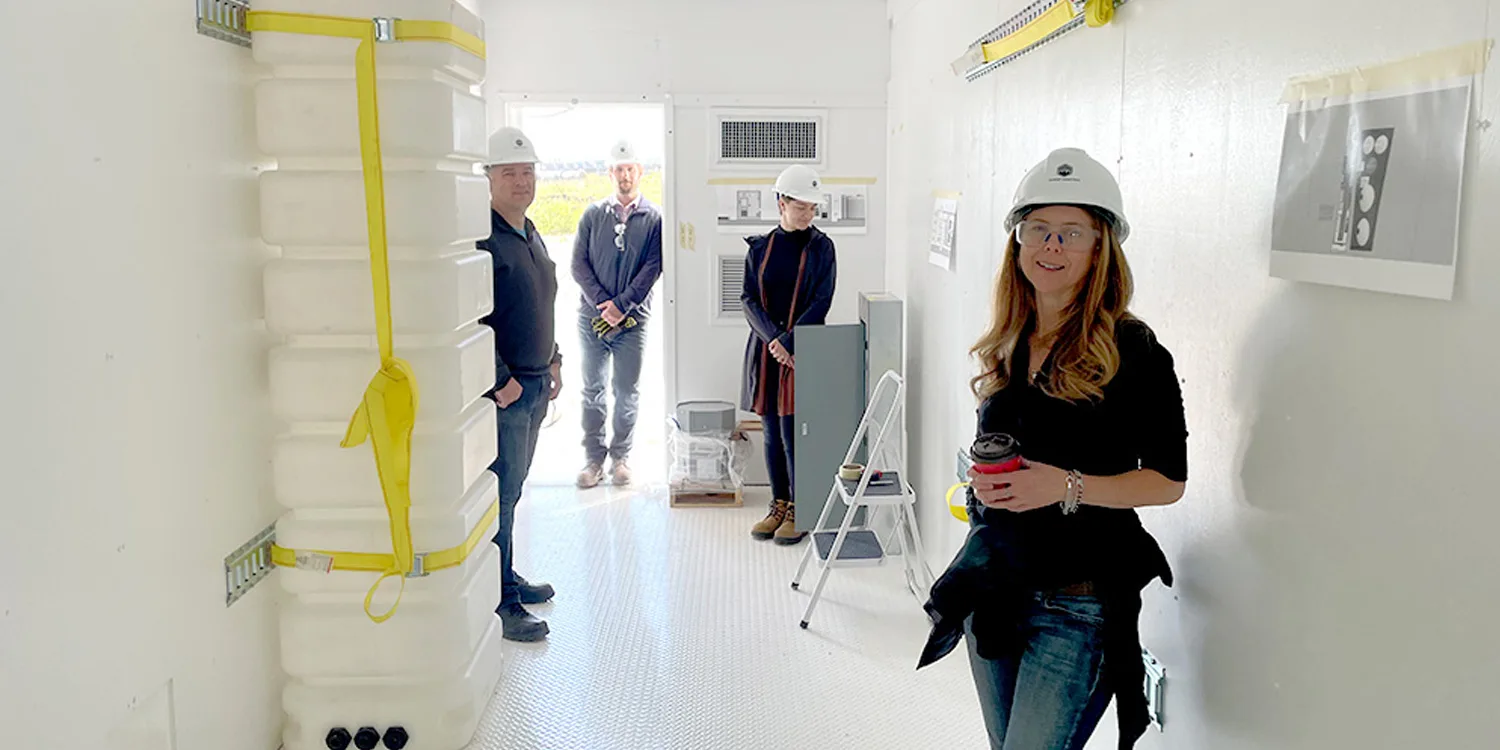
Featured image: Amanda Hall, CEO Summit Nanotech
Sign up for our newsletter
-
 MaRS Staff